





International Law in, and as, Crisis
Legal Breakdown and the Struggle for Transformation
International law has long been described as a “discipline of crisis”. Hilary Charlesworth’s formulation captured something essential: international law emerges most visibly in moments of catastrophe – war, mass violence, humanitarian breakdown – when it is called upon to restrain power, assign responsibility, and promise a horizon of order. Crisis has never been external to international law; it has been its condition of existence. Yet today, something more troubling is underway. International law is not only responding to crisis; it is itself in crisis. What we are witnessing is not merely the failure of rules in exceptional circumstances, but a profound breakdown of the discipline’s authority, legitimacy, and political imagination.
This crisis has become unmistakably visible over the past few years. The genocide in Gaza, conducted in plain sight and accompanied by the systematic destruction of civilian life, has exposed the hollowness of legal prohibitions that are invoked rhetorically while rendered inert in practice. In Ukraine, the illegality of aggression is affirmed almost unanimously, yet enforced selectively, reinforcing a hierarchy of victims and violators that mirrors geopolitical alignments rather than legal principle. Venezuela’s prolonged economic strangulation through sanctions, devastating in their social effects, has normalized collective punishment under the guise of legality even as the armed attack against it and the abduction of its President and First Lady by the Trump regime in Washington shreds any notion of sovereign equality even further. Greenland has reappeared in geopolitical discourse as an object of acquisition under threat of force, reminding us how easily colonial logics can be revived when power sheds its inhibitions.
The End of Liberal Pretense
What marks this moment as distinct is not simply lawlessness, but the abandonment of even the pretense that law and “civilization” constrain imperial ambition as was the case during the colonial era. The revival of overt colonial and imperial designs under the Trump regime in Washington is notable not because it has invented new forms of domination, but because it has dispensed with the traditional liberal rhetoric that once accompanied them. Where earlier empires cloaked themselves in development, humanitarianism, or the rule of law, this iteration speaks openly of seizure, exclusion, and coercion. The mask has slipped – and international law is now revealed as either incapable or unwilling to respond.
++++++++++Advertisement++++++++++++
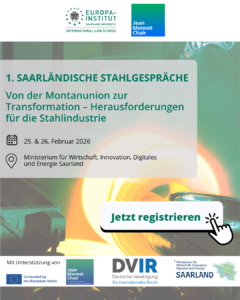
Einladung zur zweitägigen Fachkonferenz „Von der Montanunion zur Transformation – Herausforderungen für die Stahlindustrie“ am 25. und 26. Februar 2026 im Ministerium für Wirtschaft, Innovation, Digitales und Energie des Saarlandes in Saarbrücken. Die Konferenz bringt Expertinnen und Experten aus Wissenschaft, Politik und Industrie zusammen, um zentrale Zukunftsfragen der europäischen Stahlindustrie zu diskutieren, unter anderem zu geopolitischen Rohstoff- und Energiemärkten, Energiepreisen und Wettbewerbsfähigkeit, Wasserstoff und grüne Transformation, Handels- und Industriepolitik einschließlich CBAM sowie regulatorische Entwicklungen auf europäischer Ebene.
Weitere Informationen finden Sie hier.
++++++++++++++++++++++++++++++++
This unraveling is mirrored in the institutional architecture of global governance. The United Nations Security Council has become a theatre of paralysis, its veto power functioning less as a mechanism of collective security than as a shield for impunity. The General Assembly issues resolutions whose moral force grows as their practical effect diminishes. The World Trade Organization, once the crown jewel of legal globalization, stands hollowed out, its dispute settlement system deliberately sabotaged. Across the UN system, agencies face funding crises, political blackmail, and open attack. UNRWA has been physically targeted and politically delegitimized for fulfilling its mandate. Judges of the International Criminal Court have been sanctioned for daring to apply the law to the powerful. A UN Special Rapporteur, Francesca Albanese, has been subjected to unprecedented pressure including sanctions for naming what international law prohibits.
Yet to understand this moment solely as a departure from an otherwise functional legal order would be a mistake. The crisis of international law did not begin in Gaza, Ukraine, or Washington. These events have made the crisis more visible and acute, but its roots run far deeper. The problem is not that international law has recently failed to live up to its ideals; it is that its structure and logic have always been aligned with hegemonic power. From its colonial origins to its modern doctrines of sovereignty, intervention, and trade, international law has consistently operated in the interests of dominant states and classes, while insulating them from the equal application of its norms.
This is not an incidental flaw; it is constitutive. International law proclaims universality while institutionalizing exception. It promises equality while organizing hierarchy. It promises to curb anarchy but sanctions it under the color of law. It criminalizes aggression and atrocity, yet renders enforcement contingent on political convenience. The powerful are not merely more likely to violate the law; they are more likely to define what counts as law in the first place. The result is a system in which legality functions less as a constraint on power than as one of its techniques.
False Choices for a Failing Legal Order
Faced with this reality, the discipline stands at a crossroads. One path leads toward what Gerry Simpson has described as an “international law of sentimentality” – a law of moral outrage, expressive resolutions, and symbolic condemnation. This is the law that speaks eloquently of values while accepting its own irrelevance to material outcomes. It is the law of hashtags, emergency statements at Davos, and solemn anniversaries, offering affect in place of transformation. Sentimentality may soothe consciences, but it leaves structures intact.
++++++++++Advertisment++++++++++++
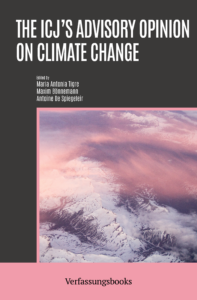
The ICJ’s Advisory Opinion on Climate Change
Edited by Maria Antonia Tigre, Maxim Bönnemann & Antoine De Spiegeleir
The ICJ’s Climate Advisory Opinion is one of the most significant developments in international climate law. This new volume shows why – and explores its implications for global climate governance.
Get your copy here – as always, Open Access!
+++++++++++++++++++++++++++
Yet another path leads alternatively to what might be called an international law of atrophy. This is a law that clings to inherited institutions and norms even as they decay, mistaking endurance for vitality. It invests hope in procedural fixes, institutional reform – such as that of the Security Council – or a rebalanced geopolitics, often under the banner of multipolarity. But multipolarity, absent a transformation of underlying power relations, risks becoming merely a new configuration of empire. Replacing a world dominated by one or two superpowers with a condominium of hegemonic states and classes does not democratize international law; it multiplies the sites of domination.
The danger of the atrophy model is that it treats international law as a patient to be stabilized rather than a structure to be reimagined. It asks how to preserve authority without confronting whose authority has mattered, and at whose expense. In doing so, it risks reproducing the very exclusions that have brought the discipline to its current impasse.
International Law from Below
The alternative to sentimentality is not cynicism, but a radical reorientation of where and how we locate international law. Critical work in international law has urged us to see international law not as a closed system of rules emanating from Geneva or New York, but as something embedded in everyday life, contested, as a site of struggle, and one that amplifies counter-hegemonic power (see, e.g., here, here, and here). On this view, international law is a language of other worlds – a Weltanschauung that operates across the registers of the planet, human and non-human, living and non-living. It is present in struggles over land, water, labor, migration, and survival, long before it is codified in treaties or adjudicated in courts. It recognizes that the struggle for international law is about more than rules, as Judge Rosalyn Higgins noted long ago, which opens the door for what else besides rules must international law be about.
Indeed, what is needed is an international law from below. As I have argued for many years, such a law cannot be bestowed by elites or engineered solely through institutional reform. It can only emerge from counter-hegemonic practices – through social movements, indigenous resistance, labor struggles, environmental defense, and everyday transformations of power and rights within and across States, including at urban and local levels. This is not a romanticization of informality, but a recognition that law’s legitimacy flows from lived experience, not abstract universality.
An international law from below would not abandon norms against genocide, occupation, or exploitation. It would insist that these norms be grounded in the realities of those who bear their consequences. It would treat Gaza not as a test case for doctrinal debate, but as a demand for structural accountability. It would see Ukraine not only through the lens of sovereignty, but through the global political economy of war and development. It would confront sanctions regimes as forms of violence, and colonial revivals as the logical outcome of a system that never truly decolonized.
The crisis of international law is therefore not simply a moment of breakdown; it is a moment of choice. We can cling to the ruins of a legal order that has always privileged the powerful, or we can participate in the slow, contested work of building something else. Crisis has always defined international law. The question now is whether the discipline can survive its own contradictions – or whether it will be transformed by those who refuse to accept that legality must always serve empire.
*
Editor’s Pick
by MAXIM BÖNNEMANN
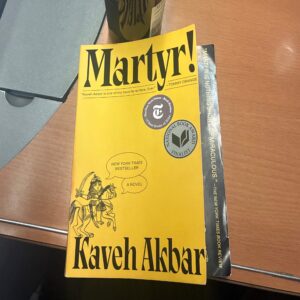 Cyrus is fascinated by martyrs. Life, he believes, should not be the only thing that carries meaning; death should as well. This has much to do with the family history of the depressed poet. His mother was killed when the U.S. military accidentally shot down an Iranian passenger plane; his father died after many bleak years working in a chicken factory in Indiana. Cyrus wants to die differently. Until then, he wants to write a book about martyrs such as Joan of Arc or Bobby Sands. In the course of his research, he meets Orkideh, a woman who lives – and dies – for art. Like Cyrus, she is from Iran, but the two are connected by more than that. Martyr! may sound like heavy fare, but it is the opposite. The novel is less concerned with death than with life: with loss, friendship, love, and the search for meaning. Art plays a central role throughout. And anyone who experiences the beauty and lightness with which Kaveh Akbar tells this story will quickly understand why.
*
The Week on Verfassungsblog
summarised by EVA MARIA BREDLER
After the first weeks of January felt more like international law from a low, BALAKRISHNAN RAJAGOPAL’s insistence on what he calls “international law from below” was much needed.
It is precisely from such a perspective that we’ve explored the Greenland crisis this week. STEWART MOTHA (ENG) revisits the UK’s dispossession of the Chagossians as a cautionary tale for Greenland: “Morning-tea at Downing Street could accomplish what a U.S President’s incontinent media posts have been threatening to do with much froth and fury since 2019.” Security narratives may enable a fragmented absorption of Greenlandic territory and distract from interconnected vulnerabilities: those of Indigenous Peoples and of the climate. This is all the more relevant given that Greenland’s predominantly Inuit population is recognised as an Indigenous People with a corresponding right to self-determination under international law. JØRGEN NYBERGET (ENG) analyses what this means for a possible annexation.
It is also worth looking at Denmark’s regulation of its own territory from below. With its infamous “ghetto law”, Denmark wanted to gentrify neighbourhoods – including forced relocation – designated as socioeconomically disadvantaged, where at least 50 % of residents are classified as “immigrants and their descendants from non-Western countries”. SARAH GANTY (ENG) shows how the judgment grapples with racialised categories, but ultimately entrenches a two-tier system of protection and obscures the racialisation of poverty.
SUSANNE BECK (GER) takes a critical perspective on the German debate on “Neutralität”. Neutrality is increasingly used to draw lines: to brand some kinds of criticism as “political” and therefore out of bounds, while others – usually those that defend the status quo – pass as neutral. For her, the answer lies in reflexive objectivity: making assumptions transparent, exposing power relations, and actively assuming responsibility when the constitution comes under attack. ERIC HILGENDORF (GER) replies: Neutrality is not a tool of power, but a professional stance. The accusation that objectivity today primarily serves to discipline critical voices falls short. In his view, separating rigorous analysis from political commentary protects the authority of science in turbulent times, and true responsibility lies in disciplined method and knowing the limits of your role.
Meanwhile, Italy is on its way to redrawing the limits of prosecutors’ and judges’ roles, as it heads toward a March 2026 referendum on a constitutional reform. Framed as modernisation, the Meloni government’s proposal raises serious rule-of-law concerns, as CHIARA GENTILE and PAOLO MAZZOTTI (ENG) contend.
More rule-of-law concerns are haunting Italy. The Italian Data Protection Authority, a cornerstone in the enforcement of the General Data Protection Regulation, is under criminal investigation for embezzlement and corruption. For PIETRO PAOLO GILARDINO (ENG), this raises a deeper EU-wide problem in EU data protection governance: when data protection authorities lack accountability, independence risks turning into immunity.
What if authorities are governed by data itself? Albania is betting on AI to speed up its EU accession – it even appointed an AI system as a minister. While these initiatives promise efficiency, transparency, and participation, they risk treating symptoms rather than the deeper ethical and institutional reforms required for EU acquis alignment, as WALKER WINSLOW-STEPHENSON (ENG) argues.
Grok revealed a deeply troubling use of AI. Since Elon Musk’s AI tool began generating images in seconds, X has been flooded with sexualised deepfakes – briefly turning the platform into the largest AI porn site on the internet. Speaking from her own experiences, THERESIA CRONE (GER) shows how German law is still struggling to recognise this form of digital sexualised violence, let alone stop it, and advocates for tailored regulation.
++++++++++Advertisement++++++++++++
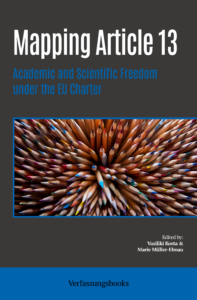
Mapping Article 13: Academic and Scientific Freedom under the EU Charter (forthcoming)
Vasiliki Kosta & Marie Müller-Elmau (eds.)
Academic freedom is under pressure. Though protected by Article 13 of the EU Charter, academic freedom in the context of EU law received very little attention in both scholarship jurisprudence. This edited volume puts Article 13 of the EU Charter in the spotlight and reflects its potential in light of past and present threats to academic freedom.
++++++++++++++++++++++++++++++++
Meanwhile, the Greek Council of State greenlighted private university branches – although the Constitution guarantees public higher education. With its decision, the Council bent the Constitution with EU law, even without referring the case to the CJEU. For KONSTANTINOS LAMPRINOUDIS (ENG), this is a prime example of EU “multilevel constitutionalism”.
Multilevel constitutionalism was also at the heart of the Egenberger case. While the CJEU again effectuated a directive’s content via the horizontal direct effect of EU law, the FCC applied its own doctrine of indirect horizontal effect. LEANDER HASUBEK (ENG) explains how the CJEU and the FCC give effect to a directive in a horizontal context through two layers of fundamental rights.
Hungary offered a new horizontal effect: it has granted political asylum to Poland’s former justice minister Zbigniew Ziobro. PETRA BÁRD (ENG) shows why granting of political asylum by one EU Member State to a citizen of another Member State is not merely unusual, but a challenge to EU asylum law and judicial cooperation — and an example of autocratic legalism in the Union.
A fatal example of autocratic legalism is “capital punishment revivalism”: populist Heads of State want to reintroduce the death penalty. Most recently, Israel’s Knesset advanced a bill to impose the death penalty for terrorism – breaking with decades of abolitionist practice. NOAM KOZLOV (ENG) explores the strategy behind this and warns that Israel risks setting a dangerous precedent far beyond its own borders.
Autocratic legalism is en vogue, and public funding of institutions is a main target. At the heart of German science funding lies the Gemeinsame Wissenschaftskonferenz (Joint Science Conference). NIKKO KULKE and MATHES TRAUER (GER) describe how an AfD-led state government could block the Joint Science Conference and, with it, science funding.
Another funding question kept the EU busy for months: how to fund Ukraine’s reconstruction? On 14 January 2026, the European Commission published a series of legislative proposals to enable the EU to grant a €90 billion loan to Ukraine. It is now clear that this loan is to be financed by the Union borrowing on the capital market, not by using Russian frozen assets. From a European constitutional law perspective, HANNO KUBE (GER) sees good reasons for anchoring the loan in the EU’s Own Resources Decision.
A not-so-own resources decision could have serious consequences for the EU. A new OECD agreement grants the US an exemption from the global minimum tax. SAM VAN DER VLUGT (ENG) shows that it effectively empowers an international forum to determine which companies fall under EU tax law, amounting to a delegation of core taxing authority.
And finally, an example of international law quite literally from below: Germany published its first “Space Safety and Security Strategy”. Notably, it acknowledges that outer space is no longer just a potential battlefield – but “the centre of conflict itself”. According to Germany’s first “Space Safety and Security Strategy”, outer space is no longer just a potential battlefield – but “the centre of conflict itself”. FLORIAN KRIENER (ENG) analyses what this means for international law, self-defence, and military uses of space.
If your hope wanes even with a legal approach from below, simply gazing at the stars might help restore it (well, at least as long as they are still not a battlefield).
*
That’s it for this week. Take care and all the best!
Yours,
the Verfassungsblog Team
If you would like to receive the weekly editorial as an e-mail, you can subscribe here.
“Replacing a world dominated by one or two superpowers with a condominium of hegemonic states and classes does not democratize international law; it multiplies the sites of domination.” I cannot follow. I compare it to the fall of the British empire. The British Empire, a superpower, was replaced by hegemonic states, leading to a multiplication of sites of domination. Still, I would argue that this order of a multiple sites of domination is more democratic, in terms of International Law and other terms. So opposing transitions toward a goal democracy looks to me like preferring utopian conversions instead of stepwise transformation