






Abigail Smith Adams
Remembering the Lady
Born into the last decades of British colonial rule in North America, Abigail Adams (née Smith) lived to see the thirteen colonies rebel, revolt, declare independence and develop into a republic. Her legacy is the wealth of more than 1,000 letters that detail not just an intimate account of one woman’s life, but the story of a momentous change in world history, told from its innermost circle.
Even though history remembers Adams prominently, it is rarely for the woman that she had been. Instead, the facts of her life have been picked apart to fashion her into a semi-fictional character that fits whatever narrative was suited to the narrator’s objective at the time. The ensuing retellings accordingly portray her not as a complex human being but rather as an amalgamation of separate traits to be sorted into neat categories. In classical fashion, those categories have long been marked along gendered stereotypes, both in historical and modern accounts.
The wife and mother
In the latter half of the 18th century, a well-bred young woman married an aspiring statesman nine years her senior, after which the newly-made Mrs. John Adams remained his dutiful and faithful companion throughout the great moments that defined his life. Mrs. Adams wrote tirelessly to her husband – imploring him in 1776 while he was at the second Continental Congress, supplying him with news from hearth and home during his time as a diplomat in Europe in the 1780s, and keeping him informed about his various political rivals throughout his presidential term at the turn of the century. At the end of President Adams’ office in 1801, his wife accompanied him home to the family farm in Massachusetts, having kept his affairs in order all the while raising their children in his image. John Quincy Adams, his eldest son, went on to become the 6th President of the United States in 1825, which his mother did not live to see after succumbing to an illness in 1818.
No other narrative is more prominent, more persistent, and more celebrated than that tale of Abigail Smith Adams, Wife to One President and Mother to Another. Such “biographical” accounts turn her into a footnote to her own life, referencing her only in relation to the men around her. If her character finds mention, it is only to express bewilderment at the fact that despite being A Woman, Adams was passionately interested in politics, witty and outspoken. Countering this as well as the considerable influence she had on her husband’s opinions, a narrative quickly formed to ridicule her as a domineering, interfering matriarch.
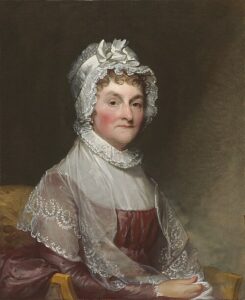
© Gilbert Stuart, Public Domain <https://commons.wikimedia.org/wiki/File:Abigail_Adams_by_Gilbert_Stuart.jpg> via Wikimedia Commons).
The virtuous and ideal
Alongside the works that record the cornerstones of her husband’s life, a tradition has sprung up that paints Adams as an ideal of womanhood, the very image of what a wife and mother should be. Depending on the narrative’s intention, aspects of her life are selected to show her story either as an aspiration for the cult of womanhood or as a tragic figure, forced to sacrifice herself to society’s demands. As the very image of domestic obedience, Adams did as her husband said. At times she stayed at home with her young children while the British frontier was only half an hour away, at other times she left some of the children behind when he requested her to join him at the insidious European Courts. As a paragon of Christian virtue, Adams’ charitable work never ceased, particularly amongst the widows of her husband’s tenants. She detested frivolity and lavish spending and even as First Lady, managed the different households frugally, which enabled her husband to enter and leave the White House debt-free. No other act speaks of Adams’ personal sacrifice as exemplary as when she missed her husband’s inauguration to care for his sick mother.
Regarding Adams in this context, she certainly seems to fit into the storied mould of yet another remarkable woman who was robbed of her potential to enable a man’s accomplishments. While it may seem like a life lived with little autonomy under patriarchal rule, Adams’ letters do not convey that she experienced her circumstances as oppressive. When receiving directives from her husband, she interacts with them emphatically, embracing, expounding, and even criticising them and vice versa, giving the impression of a collaborative decision-making process rather than a strictly hierarchical partnership between them. Adams took great pride in the sacrifices she made as a service to her country, but she would never have thought of obeying her husband and facilitating his success as a sacrifice, but rather as her life’s achievement.
The witty wife and her feminist life
Another kind of narrative has evolved that sees in her an early feminist icon campaigning for women’s rights. In these biographical descriptions, Adams’ story is filled with her challenging the gendered restrictions of her period: While taking up the management of an absent male’s property was common practice in 18th-century New England, Adams went beyond acting on her husband’s behalf and quickly progressed to telling rather than asking him about new changes and acquisitions she had made. Against his opposition, she was speculating with government bonds, at times in her own name. Even though under the law of coverture, married women’s assets belonged to their husbands, Adams’ letters make it clear that she is disposing over their joint, and later her own property and sums of money in knowing defiance of the law. Aside from her economically independent behaviour, Adams also ventured into the typically male sphere of public opinion. Contrary to her predecessor Martha Washington and other socially comparable ladies, Adams did not remain quiet when her husband’s administration was criticised in the newspapers. She was soon known for the using her position to distribute news by forwarding letters and reports to be published or republished in different newspapers, underlining sections or excerpting paragraphs, even writing editorial letters herself. Her sharp tongue and quick wit were well-known, just as her astute understanding of politics was – if not always respected, then at least acknowledged. The very fact that Adams was so involved in daily politics is taken as a sign of her uncaring attitude towards gender norms, just as the infamous admonition to her husband to “Remember the Ladies […]” is read as cementing her commitment to equal rights.
In between the stories
It is tempting to take Adams’ refusal to abide by the social and legal standards of her times as a premature feminist stance, as some kind of proof that she sought to change the circumstances of womankind towards equality. However, every foray outside of the societally acceptable womanly behaviour was experienced by Adams with great discomfort. She was deeply ashamed and insecure about her “unwomanly” conduct, particularly using her public influence, and could display severely righteous disdain when observing social transgressions in other women.
The fact that Adams has been cast in such contrary narratives highlights that her character is made up entirely of what modern viewers can only perceive as direct contradictions. She was decidedly not a feminist but steadfastly believed women to be the inferior sex with their place in the domestic sphere, to be submissive to and protected by men. While she frequently and fervently criticised societal and governmental institutions for their disregard for women’s plights, her criticism was directed at corrupt institutions that failed to protect women properly, not for the social or political principle of equality behind it. Her passion for equal education was pioneering but stemmed from her belief that mothers should be better equipped to teach their sons. Adams was not ignorant of the extent of women’s legal disenfranchisement. Urging her husband to “Remember the Ladies” during the lawmaking of the new Republic, she continued to caution:
“If particular care and attention is not paid to the La[i]dies we are determined to foment a Rebe[l]lion, and will not hold ourselves bound by any Laws in which we have no voice, or Representation.”
While this raises several fundamental questions about the so-called rule of the people or universal truths and rights, Adams pursues none of them.
Beyond another narrative
Comparing Adams to other women who appear in the series on outstanding women, she seems like the odd one out when it comes to noteworthy accomplishments, especially with concern to women’s equality. In contrast to the vast majority of her peers, Adams was in a nearly unique position politically, socially and economically to advance the cause of gender equality, even possessing the personal capacity to have at least partially recognised the inherent atrocity of women’s subjugation. The fact that she seemingly chose not to do so might disqualify her from any recounting of noteworthy women.
However, sifting through numerous different accounts of one life’s story has shown the futility of trying to fit a cohesive narrative on top of all the contradictions that make up an individual. Asking whether or not Adams’ legacy measures up to modern standards of accomplishment or the accomplishment of completely different women is no different from the previous narratives. In the end, it does not matter if only some parts of Abigail Adams’ life furthered the progression of women’s rights or other major changes. The worth of her contribution to history lies not in isolated outstanding moments, but in all the aspects and contradictions of her life’s story combined.
In this light, it seems only fitting to remember the remaining part of her notorious quote:
“Do not put such unlimited power into the hands of the husbands. Remember all men would be tyrants if they could.”
Further Readings
- Andrew Daily, Wife or Revolutionary: Historiography of Abigail Adams, Paper at Eastern Illinois University (available here).
- Edith Belle Gelles, Abigail Adams: Domesticity And The American Revolution, Dissertation to University of California 1978 (available here).
- Woody Holton, Abigail Adams, Bond Speculator, in: The William and Mary Quarterly, Third Series, Vol. 64, No. 4 (October 2007), 821 (available here).
- Marie Basile McDaniel, Review of Zagarri, Rosemarie. Revolutionary Backlash: Women and Politics in the Early American Republic, H-Women, H-Net Reviews, November 2009 (available here).
- National First Ladies Library, First Lady Biography: Abigail Adams (available here).
- Dorothy Schneider; Carl J. Schneider, First Ladies: A Biographical Dictionary, 3rd Ed., New York 2010.
- David S. Shields; Frederika J. Teute, The Court of Abigail Adams, in: Journal of the Early Republic, Vol. 35 No. 2 (2015), 227 (available here).
- Rosemarie Zagarri, Revolutionary Backlash: Women and Politics in the Early American Republic, Philadelphia 2007.