






Amal Clooney (née Alamuddin)
“Justice doesn’t just happen”
Amal Clooney is an international human rights lawyer known for representing victims of mass atrocities, journalists prosecuted for their reporting, survivors of genocide and sexual violence, political prisoners, and marginalised communities. Through strategic litigation before international, national, and regional courts, as well as through the Clooney Foundation for Justice and the Oxford Institute of Technology and Justice, her work is dedicated to expanding access to justice.
Background and Education
Amal Alamuddin was born in Beirut, Lebanon, on 3 February 1978. At the age of two, she and her family moved to the United Kingdom to escape the Lebanese Civil War. She studied at St. Hugh’s College at the University of Oxford, where she received an exhibition scholarship and the Shrigley Award for excellence in legal studies. After graduating with a Bachelor of Arts in Jurisprudence in 2000, Clooney was later named an Honorary Fellow of St. Hugh’s College, about which she says:
”I have always been so grateful to St. Hughs’s for giving me my shot and my legal compass […].”
Clooney completed her master’s degree in 2001 at the New York University School of Law (NYU), where she was selected for an externship in the chambers of Sonia Sotomayor1) – a position typically reserved for JD students. Reflecting on the difference between her two academic experiences, she noted,
In 2002, she was admitted to the New York Bar and started practicing as a litigation attorney at Sullivan & Cromwell LLP. Samuel Seymours, then partner at Sullivan & Cromwell LLP, recalls that Clooney could pair sharp legal analysis with genuine care for the people behind the cases, so that clients felt both expertly advised and personally looked after.
Early work and experience in international (criminal) law in The Hague
During this early stage of her career, Amal Clooney realised “how all my interests – in courtroom advocacy, in representing victims, in using the law to address conflict – could come together” in the field of international law. She thus applied for a one-year clerkship at the International Court of Justice (ICJ) in The Hague and was selected.
Afterwards, she worked for the International Criminal Tribunal for the Former Yugoslavia (ICTY), where she was involved in the Slobodan Milošević Trial.2) Clooney went on to work as a prosecutor at the Special Tribunal for Lebanon, created to try those responsible for the 14 February 2005 attack which killed former Lebanese Prime Minister Rafiq Hariri and 22 others. Her position required her to live part-time in a secure compound on a mountaintop in Lebanon, protected by four security checkpoints.
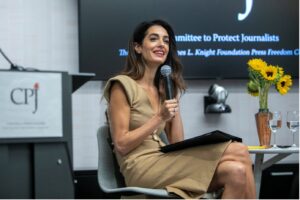
Copyright: Committee to Protect Journalists – 2022, CC BY 2.0 via Flickr
Work as a barrister in international (criminal) law and human rights
In 2010, Amal Clooney left The Hague for London, where she was called to the Bar of England and Wales (Inner Temple) and joined Doughty Street Chambers as a barrister. Her practice as a barrister placed her at the centre of some of the most significant cases concerning genocide, sexual violence, torture, other mass atrocities, gender-based violence, freedom of expression and journalists, the right to a fair trial and political prisoners.
Among other cases, she represented WikiLeaks founder Julian Assange against Sweden in extradition proceedings, and defended two Reuters journalists imprisoned in Myanmar following their reporting on alleged war crimes committed by Myanmar forces. They were ultimately released in 2019. She acted as counsel for over 100 victims of genocide in Darfur, Sudan, at the International Criminal Court (ICC) in a case in which – for the first time – a senior commander ( “Ali Kushayb”) of the Janjaweed militia was charged with war crimes and crimes against civilians in 2003 and 2004. On 6 October 2025, the ICC convicted “Ali Kushayb” on 31 counts of war crimes and crimes against humanity (see also Oidtmann).
Clooney also represented several Yazidi women in criminal cases against members of ISIS. One such case, Prosecutor v. Taha A-J, resulted in the first conviction of an ISIS member for genocide, crimes against humanity, and war crimes under universal jurisdiction laws.3)
She also represents Nobel Peace Prize-winning journalist Maria Ressa of the Philippines, who has filed an appeal with the Supreme Court of the Philippines over her cyber libel conviction, which carries a potential prison sentence; the case is still pending.
In December 2023, Clooney and others filed a civil lawsuit, representing the lead plaintiff, Nobel Peace Prize-winner Nadia Murad and more than 400 other Yazidis, against French building materials conglomerate Lafarge S.A. and its former Syrian subsidiary for allegedly paying ISIS and an associated group nearly six million dollars.
When asked by Maria Ressa in TIME’s 2022 Women of the Year issue what made her choose human rights law and defend journalists and women, Clooney replied,
“I’m responding to what I see happening in the world. A world where the guilty are free, and the innocent are imprisoned – where the human-rights abusers are free, and those who report on the abuses are locked up. As a lawyer, I can do something about that. Or I can at least try. So my work is focused on trying to help liberate victims and prosecute perpetrators – and by extension, our foundation’s work is trying to really do that at scale and globally. When I choose a case, I think carefully about the ripple effect. I’ve said it about your case: there’s one journalist in the dock, but it’s democracy in your country that’s on trial. What’s driving you to continue to fight your battle is, as you put it, you’re holding the line for others. So I do think about which cases are going to have the greatest impact – not only for that individual but for others who are vulnerable as well.”
In the same article, Maria Ressa said that Clooney’s “empathy is as strong as her knowledge of the law and her courage”; that she is “a hard worker, poring over thousands of pages of documents, highlighting, and taking meticulous notes”; and that she “makes sure that women who are victims of mass atrocities, including genocide and sexual violence, are not forgotten, that they get justice, that their lives and communities are better as a result”.
Amal Clooney’s endeavours beyond barristership
Since 2010, Amal Clooney has held numerous positions in addition to her barrister practice. She has served as a rapporteur for the International Bar Association’s Human Rights Institute, as a senior advisor to Special Envoy Kofi Annan on Syria and as Counsel to the UN Inquiry on the use of armed drones. From April 2019 to September 2020, she was the UK’s Special Envoy for Media Freedom and was also appointed to the UK government expert panel for the Prevention of Sexual Violence in Conflict Initiative. Clooney has also been appointed to the UK Attorney General’s Public International Law Panel of Counsel.
More recently, she led the Legal Task Force on Accountability for Crimes Committed in Ukraine. In September 2021, Amal Clooney was appointed as a Special Adviser to ICC Prosecutor Karim Ahmad Khan KC. In 2024, she served on the advisory panel that assisted the ICC Prosecutor in evaluating evidence of suspected war crimes and crimes against humanity in Israel and Gaza. The report by the advisory panel supported the ICC arrest warrant applications for crimes in Israel and Palestine. Explaining her decision to serve on the panel, she wrote:
“I served on this Panel because I believe in the rule of law and the need to protect civilian lives. The law that protects civilians in war was developed more than 100 years ago and it applies in every country in the world regardless of the reasons for a conflict. As a human rights lawyer, I will never accept that one child’s life has less value than another’s. I do not accept that any conflict should be beyond the reach of the law, nor that any perpetrator should be above the law. So I support this historic step that the Prosecutor of the International Criminal Court has taken to bring justice to victims of atrocities in Israel and Palestine.”
Clooney has also served in academia. She was formerly a Visiting Professor at Columbia Law School and, since February 2025, has been a Visiting Professor of Practice in International Law at Oxford University’s Blavatnik School of Government.
In 2021, together with Philippa Webb, she co-authored The Right to a Fair Trial in International Law, which was awarded the American Society of International Law (ASIL) 2022 Certificate of Merit for high technical craftsmanship and utility to lawyers and scholars. The book has become the leading work in its field for lawyers and judges.
Over the years, Clooney has received numerous awards, including the World Economic Forum Young Global Leader Award, the ASIL Champion of International Rule of Law Award, and the Simon Wiesenthal Center Humanitarian Award together with her husband George Clooney. She was also recognised with the Committee to Protect Journalists Gwen Ilfill Award for extraordinary and sustained achievement in the cause of press freedom and the Legal 500 International Law Junior of the Year Award.
The Clooney Foundation for Justice
In 2016, Amal Clooney and her husband – who together have twins – founded the Clooney Foundation for Justice (CFJ), where she serves as Co-Chair of the Board. She summarises the foundation’s mission as follows:
“We call what we do waging justice for victims of human-rights abuses. Because justice doesn’t just happen – you have to wage it; you have to bend the arc toward it. We try to do that by holding those who are responsible to account. So the methodology is to expose, but also to punish and remedy. And it is a result of both my experience and the many years George has also spent working on these issues.”
They aim to wage justice by providing free legal aid services in defence of free speech and women’s rights through two programmes. First, the Waging Justice for Women Program aims to challenge unjust laws by enforcing international law and representing the women such laws impact, to establish mobile legal aid clinics to empower women to advance their rights, and to fund and mentor the next generation of African gender justice and women human rights lawyers. Second, TrialWatch is a global initiative – the first of its kind – that monitors and evaluates criminal trials globally, exposes unfair trials, and helps the people affected by those trials challenge their sentences and challenge the laws to uphold freedom of speech. With an app co-developed with Microsoft, the CFJ has achieved a one-of-a-kind overview of compliance with fair-trial guarantees in criminal trials.
The Oxford Institute of Technology and Justice
In October 2025, Clooney and Philippa Webb co-founded the Oxford Institute of Technology and Justice, where she is a Senior Fellow. The Institute is a partnership between the University of Oxford’s Blavatnik School of Government and the Clooney Foundation for Justice. The Institute’s focus is on harnessing AI to expand access to justice, promote accountability for unlawful cyber operations, and advance justice through and in AI-assisted proceedings. The first and third focus points in particular tie in with Clooney’s other work. The access to justice focus point currently consists of three pilot projects, a Journalists’ Legal Chatbot4), the Malawi Lawyer Assistant5) and the Malawi Legal WhatsApp chatbot6), implemented through the CFJ with technical assistance from Microsoft’s AI for Good Lab. Within the third focus point, advancing justice through and in AI-assisted proceedings, the Institute created the AI Justice Atlas, a map that shows the use of AI in criminal proceedings around the world.
Conclusion
Amal Clooney’s career shows what a determined, groundbreaking, “smart as hell” lawyer she is. She tirelessly represents victims of severe human rights abuses in landmark proceedings, helped defining standards on the right to a fair trial in international law, and played a central role in establishing institutions that go from exposing international law violations in criminal courts all over the world all the way to harnessing AI to broaden access to justice. In doing so, she has opened opportunities on a global scale for those often sidelined by the justice system. She strategically employs the tools and fora of international law to enable greater access to justice and ensure accountability for those who are rarely held accountable for their actions, “because justice doesn’t just happen – you have to wage it.”
Further Readings
- Amal Clooney, David Neuberger, Freedom of Speech in International Law, Oxford University Press, 9 January 2024.
- Amal Clooney, Human Rights and Diplomacy (Chapter 18) in Satow’s Diplomatic Practice (8th Edition, edited by Ivor Roberts), Oxford University Press, 29 August 2023.
- Amal Alamuddin, Nidal Nabil Jurdi, David Tolbert, The Special Tribunal for Lebanon, Oxford University Press, 27 May 2014.
- Amal Clooney, Philippa Webb, The Right to a Fair Trial in International Law, Oxford University Press, 11 February 2021.
- Amal Clooney, Philippa Web, The Right to a Fair Trial under Article 14 of the ICCPR, Oxford University Press, 14 October 2021.
- Atticus Gannaway, Barrister Without Borders – Amal Clooney LLM ’01 has built an unparalleled human rights law practice that reaches around the globe. NYU Law is where she found her passion for international law (last accessed 22 November 2025).
- Lord Justice Fulford, Judge Theodor Meron CMG, Amal Clooney, Danny Friedman KC, Baroness Helena Kennedy LT KC, Elizabeth Wilmshurst CMG KC, Why we support ICC prosecutions for crimes in Israel and Gaza, oped in Financial Times, 20 May 2024 (last accessed 21 November 2025).
- Maria Ressa, Amal Clooney Won’t Back Down, in Time Magazine, 2 March 2022.
Further Sources
- Lafarge Lawsuit: Nadia Murad and Amal Clooney speak to CNN (YouTube), https://www.youtube.com/watch?v=N3nXDTcz8AM (last accessed 21 November 2025).
- Professors Philippa Webb and Amal Clooney launch the Oxford Institute of Technology and Justice (YouTube), https://www.youtube.com/watch?v=1K1Euv9jgrY (last accessed 22 November 2025).
- Waging Justice in an Age of Authoritarianism by Amal Clooney and Philippa Webb (YouTube), https://www.youtube.com/watch?v=qscAf0kqozo (last accessed 20 November 2025).
References
| ↑1 | Sonia Sotomayor was at the time a judge on the US Court of Appeals for the Second Circuit. Today, she serves as an associate justice of the Supreme Court of the United States. |
|---|---|
| ↑2 | Slobodan Milošević was the President of the Republic of Yugoslavia from 15 July 1997 until 6 October 2000 and the President of Serbia from 26 December 1990. He was on trial for genocide, crimes against humanity, and war crimes. The trial ended without a verdict after Milošević died in the United Nations Detention Unit in The Hague on 11 March 2006. |
| ↑3 | For a more detailed list of Amal Clooney’s Cases see: https://www.doughtystreet.co.uk/barristers/amal-clooney. |
| ↑4 | Operated in cooperation with the Committee to Protect Journalists. |
| ↑5 | Operated in partnership with the Women Lawyers Association of Malawi. |
| ↑6 | Operated in partnership with the Women Lawyers Association of Malawi. |