






Zheng Yuxiu
Born a Rebel
As the first female lawyer in China, Zheng Yuxiu made her mark on legal history. Her achievement was no accident. It rested on a lifelong willingness to question traditions and go her own way – a way that led her through revolution, state-building and women’s emancipation in early twentieth-century China.
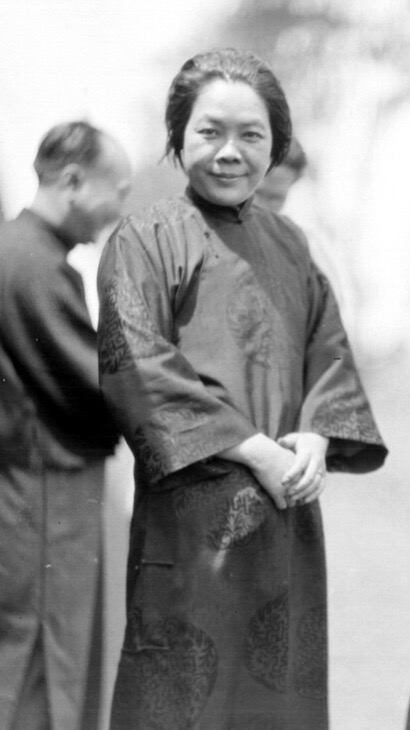
Photograph by Fu Bingchang. Image courtesy of C.H. Foo, Y.W. Foo and Special Collections, University of Bristol Library
Childhood
In 1896, Zheng Yuxiu was born into a society bound by rigid conventions. Inspired by her idol, Mulan, she rebelled against the foot-binding tradition in childhood and successfully resisted an arranged marriage in her youth. At just 12 years old, Yuxiu left her family and went to an American missionary school, where she learned English.
Subsequent stays abroad in Japan and France allowed her to further expand her freedom and become independent. During these years, she encountered revolutionaries who were fighting against imperialism and for an independent Chinese republic. Yuxiu joined this revolutionary movement and became politically active. She was driven by the idea that international law was the key to China’s recognition as a sovereign nation – a conviction that drew her toward diplomacy and legal studies.
The fall of the Qing Dynasty in 1911 and the political upheavals that followed forced Yuxiu to leave China for Europe, where she continued her political activism and began studying international law.
The Paris Peace Conference and doctoral studies
One of the first successes in her legal career was her participation in the Peace Conference in Paris in 1919 as a member of the Chinese delegation. The delegation represented the young Republic of China, which had only been founded in 1912. A key objective of the delegation’s participation was to secure sovereignty over Shandong Province, where Germany had retained special rights. Despite China’s participation in the First World War on the side of the Allies, the Republic’s desire to regain control over the occupied territory was ignored, and the special rights to Shandong Province were transferred to Japan. This sparked major protests among the Chinese population and led to China’s refusal to sign the Treaty of Versailles. It also shaped Yuxiu’s own view of international relations. Despite this massive disappointment, the experience strengthened her conviction that international law was a key factor in the struggle for China’s sovereignty. For this reason, she decided to write her doctoral thesis on the new constitution of the young Chinese Republic. Within the intellectual circles Yuxiu moved in, adopting a Western-style constitution was seen as a possible way to ensure China’s equal participation in international relations. This was intended to improve the Republic’s standing and signal to Western countries that the young republic was an equal partner. In her work, Yuxiu examined various constitutional models and the history of constitutionalism in China. Her doctoral thesis was subsequently published not only in China but also in France, earning her recognition as an expert in this field.
Legal and political career in China
When Yuxiu returned to China in 1926, the social image of women had shifted. Women were now more visibly present in social and political life. This transformation was rooted in the recognition of women as equal participants in Chinese society, a shift brought about by both the women’s and the New Culture Movement of 1915 to approximately 1920. Together with her fellow student and later husband, Wei Daoming, Yuxiu founded a law firm in Shanghai. At the same time, they continued to secretly support the Nationalist Party (KMT), which sought to unify a divided China and was waging a campaign against warlords who claimed various regional domains for themselves. In 1928, Yuxiu and her husband gave up their law firm to devote themselves more fully to supporting the party. As a long-time supporter of the now ruling party, Yuxiu was offered new opportunities. She became not only the first female judge in Chinese history, but also a member of the Jiangsu Provincial Council and ultimately a special envoy to France, where she worked to build European support for the newly founded government.
One of Yuxiu’s greatest achievements was her participation in the Civil Codification Commission. There, she fought for gender equality – a cause central to her life’s work. The draft prepared by the Commission provided for gender equality in almost all relevant areas of civil law, such as property, family, and inheritance law. The draft was adopted and came into effect between 1930 and 1931. The principles developed by Yuxiu continue to influence legal frameworks to this day and remain embedded in some areas of law.
Later years and exile
In the years that followed, Yuxiu withdrew from the government and returned to her work as a lawyer. As president of the University of Shanghai’s School of Law and Politics, she influenced the next generation of Chinese lawyers.
With the Japanese invasion of Chinese territory and the subsequent outbreak of the Asia-Pacific War in 1937, the balance of power in China changed significantly. The KMT, to which Yuxiu belonged, and the Communist Party, the CCP, entered into open conflict. The civil war ended with the proclamation of the People’s Republic of China and the CCP’s rule. As a supporter of the opposing side, Yuxiu was forced to leave China for the second time in her life. Together with her husband, she lived in exile in the United States, where she remained until her death in 1949.
Through her work, Yuxiu paved the way for many women to pursue careers in law. Her lifelong commitment to equality, which she ultimately secured as an established principle in civil law, helped anchor gender equality as a legal principle and ensured its protection for future generations.
Sources
- Bundeszentrale für politische Bildung (bpb), Politische Geschichte Chinas 1900–1949, available at: https://www.bpb.de/themen/asien/china/44251/politische-geschichte-chinas-1900-1949/.
- The Fate of Judicial Independence in Republican China (1912–1937), New University in Exile Consortium, available at: https://newuniversityinexileconsortium.org/wp-content/uploads/2020/09/The-Fate-of-Judicial-Independence-in-Republican-China-1912-37-1.pdf.
- Kuo, Margaret, ‘Zheng Yuxiu and the Diplomacy of Nationalism and Feminism’, in Immi Tallgren (ed.), Portraits of Women in International Law: New Names and Forgotten Faces? (Oxford, 2023; online edn, Oxford Academic, 18 May 2023), https://doi.org/10.1093/oso/9780198868453.003.0035
Further Sources
- Wei, Tao-Ming: My Revolutionary Years: The Autobiography of Madame Wei Tao-Ming, New York 1943.
- Gao, James Z.: Historical Dictionary of Modern China (1800-1949), Plymouth 2009.
- Liu, Xiaonan: “Gender, Law and Legal Professions in China”, in: Miyazawa, Setsuo et al. (Hrsg.): East Asia’s Renewed Respect for the Rule of Law in the 21st Century: The Future of Legal and Judicial Landscapes in East Asia, Leiden/Boston 2015, S. 193-212.
- Liu, Xiaonan: “Women Legal Academics in China”, in: Ulrike Schultz et al. (Hrsg.): Gender and Careers in the Legal Academy, Onati 2021, S. 233-248.
- https://www.instagram.com/reel/DVyu9WXjhB9/
Thank you for the very good biography. I would simply correct the date of her birth and death. The Wikipedia entry is reliable.