






Three Lessons from the UN Declaration on Enslavement
On Time, Responsibility, and International Law
On 25 March 2026, the United Nations General Assembly adopted, led by African and Caribbean states, the Declaration on the Trafficking of Enslaved Africans and Racialised Chattel Enslavement of Africans as the Gravest Crime Against Humanity. As Ghana’s President John Mahama put it, “Today, we come together in solemn solidarity to affirm truth and pursue a route to healing and reparative justice.”
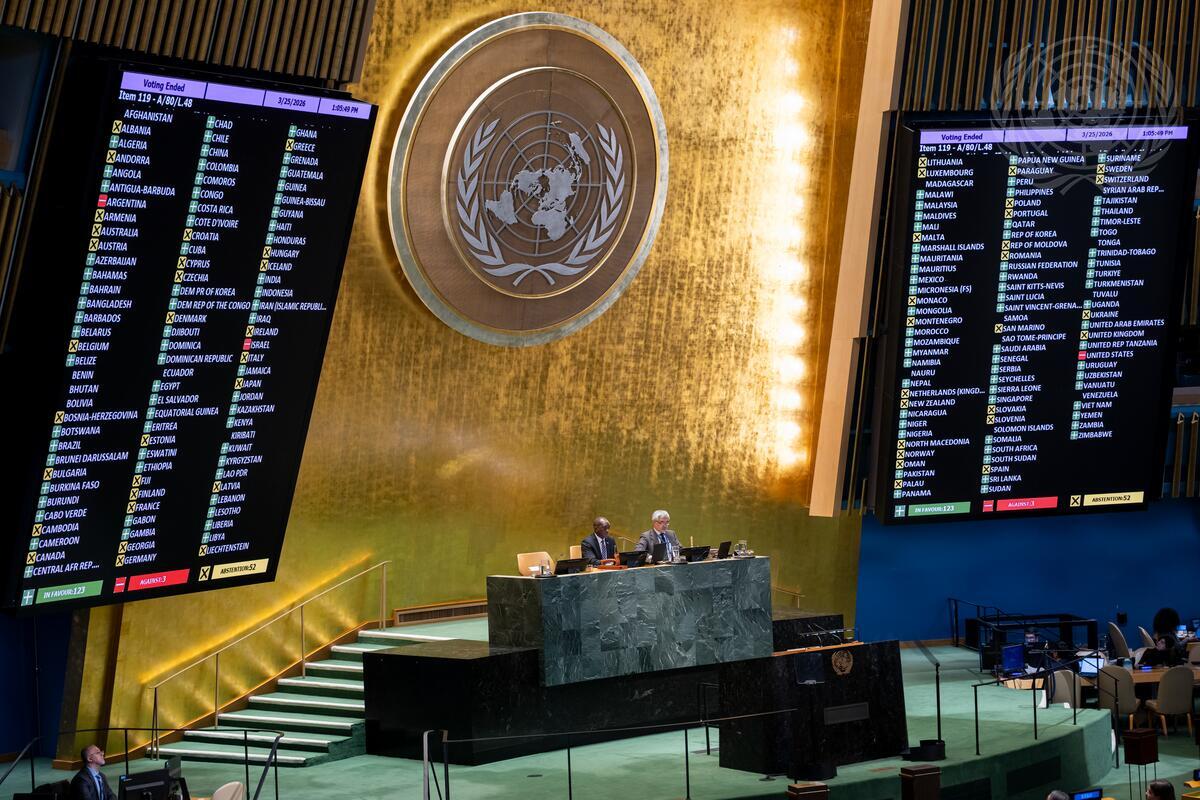
UN General Assembly Hall following the vote on Resolution A/80/L. 25, March 2026 (New York, US). Unique Identifier. UN71134166. UN Photo/Manuel Elías. Courtesy UN Photo Library.
The final vote on the Declaration was striking: 123 in favour, 3 against (Argentina, Israel and the United States), and 52 abstentions, including Australia, the United Kingdom, and most European Union member states. This distribution revealed some of the deep fault lines running through the international legal order – a split between competing understandings of what international law is and what it can and should do. Against this background, the Declaration can be read as operating within the language of foundational instruments of international law while simultaneously pushing their limits through a set of decisive doctrinal moves. Seen in this light, the Declaration offers at least three lessons for international law today.
Rethinking time
The first and perhaps most immediate intervention lies in how the Declaration reconfigures time in international law.
The Declaration frames slavery not simply as a historical wrong, but as a crime whose consequences endure. It describes racialised chattel enslavement as the gravest crime against humanity by reason of its “enduring global consequences”. In doing so, it unsettles a central assumption that continues to structure legal reasoning, namely that the past can be neatly separated from the present.
Slavery, in this framing, is not over. It is constitutive of the present. This is a juridical claim. The Declaration reminds us that slavery was not simply an economic or political system, but a legal project. The Declaration refers to the “progressive codification of the racialized chattel enslavement of Africans across the world”. This language is important. It foregrounds the role of law as one of enslavement’s primary conditions of possibility.
Through legal instruments, doctrines, and administrative practices, human beings were rendered inheritable, alienable, and perpetual property. Reproduction itself was juridically reorganised as a mechanism of accumulation. Race was codified as a principle of differentiation structuring labour, mobility, and entitlement. In this sense, slavery operated through a global legal infrastructure.
The Declaration makes this point with clarity. It describes enslavement as historically unprecedented in its legal and structural design, a “world-breaking and world-redefining” formation that transformed the fates of all peoples through new racialised regimes of labour and property, the effects of which continue to be widely experienced by Afrodescendant populations across the globe. From this perspective, the claim that slavery belongs to the past becomes increasingly difficult to sustain. Not only because its material consequences persist, but because the legal scaffolding of slavery continues to organise the present.
Crucially, the Declaration also affirms – and reminds audiences still oblivious to the battles by grassroots organisations against the ongoing effects of slavery, from Black Lives Matter to the work of the Caribbean Community (CARICOM), which supported the Declaration – that Africans and people of African descent have “continuously resisted, contested and litigated” the crimes of slavery and the slave trade from their inception. This matters because it further destabilises the narrative of closure. If both domination and resistance persist, then the legal and political questions raised by slavery remain open.
The Declaration reinforces this temporal reconfiguration through a principle drawn from African moral and legal traditions, that “a crime does not rot”, which is explicitly cited in the Declaration’s preamble. This formulation carries significant doctrinal implications. It affirms that grave crimes are not subject to statutory limitations and that they generate continuing obligations until addressed through truth, justice, and reparation.
What emerges here is a jurisprudence of the present structured by enduring past wrongdoing. Paraphrasing Pierre Bourdieu, “the present is [then] not the temporal present, it is what is still sufficiently alive to be the object of struggles.”1) African, Caribbean, and other supporting states endorsing the Declaration thus outline a new jurisprudence of enduring past structural wrongdoing as “present”.
From acknowledgment to obligation
The second lesson concerns the long-standing tension between acknowledgment and obligation in international law.
The Declaration situates itself within a longer lineage of anticolonial legal interventions, including the Decolonisation Declaration of 1960 and the New International Economic Order of 1974. Across these moments, a recurring demand has been articulated that historical injustice be translated into present-day legal and institutional responsibility.
This translation has always been contested. The reactions to the present Declaration make this clear.
The United States rejected the Declaration’s legal implications, insisting that it does not recognise a legal right to reparations and cautioning against the imposition of obligations for acts that were not unlawful under international law at the time they occurred. The European Union, while abstaining rather than opposing, raised concerns about legal and factual issues and warned against approaches that could imply retroactive responsibility or unsettle established legal categories.
These positions differ in tone, but they converge in structure. Both rely, in different ways, on a doctrine of non-retroactivity. Both seek to stabilise the temporal boundaries of international law by locating legality firmly within the normative frameworks of the past. And both work to prevent the translation of historical injustice into binding obligations in the present.
What both the US and Europe defend is not simply a technical rule about temporal jurisdiction but a broader architecture of the international legal order – one that insulates past distributions of wealth, power, and responsibility from contemporary claims.
This pattern is familiar. International law has long been willing to acknowledge injustice, even to condemn it in strong moral terms. But it has been far more hesitant when that acknowledgment threatens to generate enforceable consequences. The Declaration disrupts this settlement. It insists that acknowledgment without obligation is insufficient. By explicitly linking enslavement to jus cogens norms and to the law of state responsibility, it places pressure on the idea that the past can be legally closed. In the language of the Declaration: “grave crimes generate continuing obligations”.
A politics of refusal
The third lesson concerns the nature of international law itself. The Declaration’s voting pattern revealed the coexistence of distinct international legal projects.
On one side, there is an international law that stabilises the existing order. It manages the past, regulates its visibility, and limits the extent to which it can generate present-day obligations. It is a law oriented toward closure, one that absorbs critique while preserving underlying structures.
On the other side, there is an international law that is confirmed through this Declaration, one that does not seek closure, but interruption.
It is here that Vasuki Nesiah’s notion of a politics of refusal becomes particularly illuminating. For Nesiah, reparations claims are interventions into the very way the global order is perceived and organised. They function as counter-regimes of visibility, drawing attention to the structural relations that link historical dispossession to contemporary inequality. More importantly, reparations are also performative. They interrupt.
A politics of refusal thus challenges the terms on which inclusion is offered. It refuses the conversion of structural injustice into manageable claims. It resists the closure that often accompanies reparations when framed as technical or humanitarian remedies.
In this sense, reparations as refusal operates at multiple levels. It refuses the idea that injustice can be confined to the past. It refuses the idea that recognition without obligation and material redistribution is sufficient. And it refuses the adequacy of one reading of international law, as one already existing that limits the scale and persistence of structural inequality.
Keeping this in mind, this is precisely what the Declaration does. It forces a confrontation with a history that has long been here, but normalised and contained. It disrupts the background conditions that have allowed that history to persist without transformation. It is a reminder of slavery and its aftermath as what Kathryn Yussof identifies as the grammar of our present racialised planetary order.
In doing so, the Declaration repositions international law itself – not as a neutral framework, but as a terrain of contestation in which different normative projects continue to struggle over the meaning of justice, responsibility, and repair.
On the wreckage upon which we stand
Taken together, these three lessons demonstrate that the Declaration is a juridical intervention that reconfigures how international law understands time, responsibility, and itself.
It reminds us that slavery was not only an event, but a structure. That acknowledgment without obligation is a form of containment. And that international law is not a single, unified system, but a field of contestation in which competing projects – of course, with asymmetrical capital, military and cultural capital behind them – continue to unfold.
These lessons are only the beginning of the journey of a Declaration that arrives as a reminder of the wreckage upon which we stand. And as we stand here, the Declaration invites a broader question: not only about what international law has been, but also what it might still become.
References
| ↑1 | Pierre Bourdieu/ Roger Chartier, The Sociologist and the Historian, Polity Press 2015, p. 16. |
|---|