






Security Sells
El Salvador’s Mega Prison as an Export Model
There is one place that Latin America’s right-wing politicians are now particularly keen to visit: the 23-hectare maximum-security Centro de Confinamiento del Terrorismo (CECOT; Terrorism Confinement Center) prison. Inaugurated in 2023 in central El Salvador, the prison houses thousands of inmates, many of whom have not received any due process. CECOT is the brainchild of El Salvador’s authoritarian president Nayib Bukele, who came to power in 2019, governed under strict emergency laws, incarcerating a majority of El Salvador’s gang members, leaving behind the country’s escalating problems with gang violence – and the rule of law with it.
From Puerto Rico to Argentina, growing numbers of politicians and delegations make the pilgrimage to El Salvador to see for themselves the “model of success” and apparent silver bullet against gang violence. What they miss is that the model cannot be separated from its authoritarian foundations. The Salvadoran “success” rests on emergency rule, suspended fundamental rights, and a Constitutional Court pushed aside. Politicians who want the prison cannot have only the building.
The CECOT
The CECOT drew international attention in March 2025 when 288 Venezuelan and Salvadoran nationals were deported (in some cases unlawfully) from the U.S. to El Salvador. Bukele plans to double the capacity from 40,000 to 80,000 inmates. The country’s incarceration rate is now with 1.7 % of the total population the highest in the world.
Recent accounts of Venezuelans who returned from CECOT are harrowing and offer only a glimpse of what else goes on within those walls. In an interview with the New York Times, former inmates reported severe mistreatment, sexual abuse, suicide of other inmates, and torture.
When referring to a CECOT-style prison here, the term does not merely denote a new high-capacity, maximum-security prison, but rather a prison explicitly inspired by CECOT, with officials or politicians expressly citing CECOT in El Salvador.
A regional trend
Ecuador’s increasingly authoritarian president, Daniel Noboa, for example, is already building a replica of the CECOT prison. Newly elected Chilean right-wing president José Antonio Kast toured the Salvadorian prison in January 2026 and asked Salvadorian president Bukele for “collaboration”, although stating that he would not have to implement the same approach as El Salvador. But not only does Bukele receive official delegations in El Salvador. The commitment goes both ways: Bukele even visited Costa Rica to personally lay the foundation stone of the planned CECOT-style prison there, just weeks before the country’s elections.
Similar demands are also mounting in the run-up to the 2026 Colombian presidential election. Right-wing conservative presidential candidate Abelardo de la Espriella (from the newly founded party “Defenders of the Homeland”) calls for abolishing the National Penitentiary and Prison Institute (INPEC) and integrating a public-private CECOT-style prison system housing inmates “10 stories underground”. De la Espriella’s ally in the presidential election, Medellín’s mayor Federico Gutiérrez, already began construction of a CECOT-style prison at the beginning of this year.
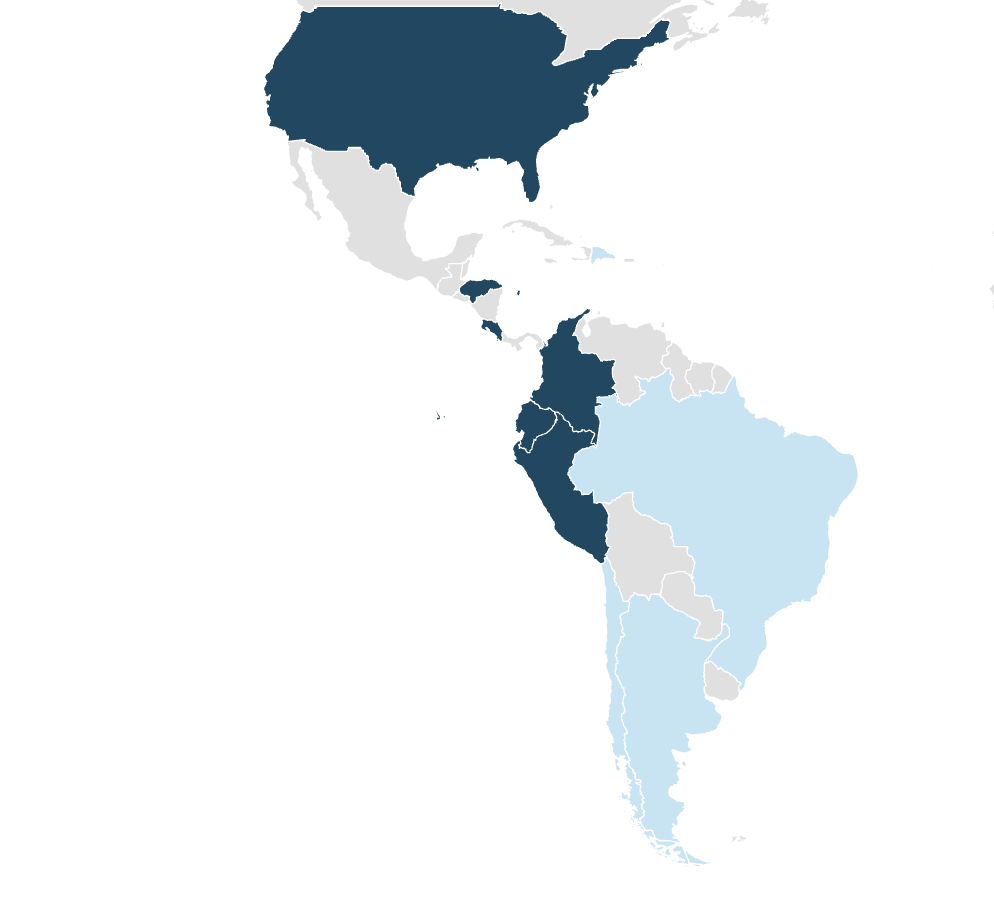

Illustration created by the author
Rise in violence in the region
The demand for security in the region has a real basis. Violence has risen sharply in countries once considered relatively safe, such as Ecuador, Chile, and Costa Rica. Prisons are overcrowded, and some argue that they often serve as “universities” for criminals, where inmates emerge more dangerous than they entered.
However, the CECOT model does not answer that problem. It offers little to no rehabilitation, which leaves an open question: what happens to the inmates once they are released? Permanently locking away 1.7% of the population also does not seem like a viable solution.
It is understandable – and, in principle, reasonable – that politicians are placing greater emphasis on crime. Nevertheless, the solution to the problem is not to be found in El Salvador. A place like CECOT should not and cannot serve as a role model; neither for the (partly) unconstitutional process by which the inmates ended up there, nor for the conditions they are experiencing inside.
According to reports by Human Rights Watch, prison conditions amount to human rights violations on a massive scale. By March 10, 2026, more than 500 people had died in custody since the beginning of the state of emergency. The IACHR had already reported “widespread and systematic illegal and arbitrary detentions” in its report in 2024 (p. 126) and during its 195th Period of Sessions in March 2026, it stated that El Salvador’s security policy “might amount to crimes against humanity”.
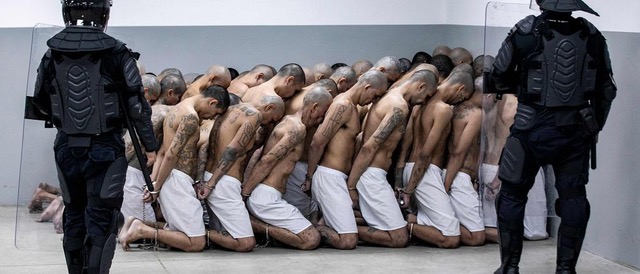
Source: AFP
Embracing authoritarianism
The visits to CECOT did not take place behind closed doors. On the contrary: the visits were staged for public attention and went viral on social media in Latin America. The videos of the visit by Chilean president José Antonio Kast received millions of views. Comments under these videos largely praise the “quick success” in fighting crime and express the hope that Chile will follow suit. The far-right Kast won precisely on the strength of security policy promises and a campaign that prioritized security.
Unsurprisingly, the narrative of the Salvadoran “miracle”, the transformation from one of the most dangerous countries to one of the safest in Latin America, resonates with voters. The idea of building state-of-the-art prisons to solve the (undeniably) significant problem of crime is simply too tempting. However, if these “mega-prisons” were implemented, the follow-up question would be: how would they be filled? Crucially, the success in reducing crime in El Salvador does not lie in the existence of the “mega-prison” itself. Rather, it lies in Bukele’s broader authoritarian approach. One pillar is the repressive practice of the police, enabled by a continuous state of emergency. The other is the systematic weakening of institutions. In May 2021, for example, the National Assembly, dominated by Bukele’s party Nuevas Ideas, removed five judges and four alternate judges from the Constitutional Chamber of the Supreme Court of Justice, along with the Attorney General. They were replaced by figures loyal to the government, effectively capturing the Constitutional Chamber of the Supreme Court of Justice. The newly composed Court later approved the arguably unconstitutional consecutive reelection of the autocrat.
A look at Ecuador
Given a regional trend toward authoritarian rule, how are the courts responding? In Ecuador, there is strong resistance from the Constitutional Court against what some call retaliatory measures. It has already declared several decrees by President Daniel Noboa unconstitutional. The court also declared the emergency law decree 493 of 2 February 2025 and, in part, the emergency law decree 599 of 12 April 2025 unconstitutional, further limiting the broader security-related powers Noboa intended to use to tackle the rising violence in some Ecuadorian provinces. On the other hand, it approved the use of emergency law in other provinces. A far different outcome from the 49th prolongation of Bukele’s state of emergency, declared on 27 March 2022 without any intervention by El Salvador’s Constitutional Court.
Since taking office in late 2023, authoritarian President Daniel Noboa has repeatedly and openly attacked the Ecuadorian Constitutional Court as an institution, as well as the judges personally. Following a protest march to the Constitutional Court, the court’s financial affairs and potential criminal proceedings against two constitutional judges are now under scrutiny (see Gutmann/Núñez Santamaría/Valle Franco). Critics suspect that this is a pretext to influence two ongoing proceedings before the Constitutional Court: the review of early elections and the appointment of the acting Attorney General. José Suing Nagua, then President of Ecuador’s National Court of Justice, expressed “deep concern” and voiced his solidarity with the Constitutional Court after the March 2025 march. Checks and balances exist for a reason, he reminded the public.
Intimidation attempts and pressure will likely continue.
The price of import
El Salvador’s transformation – from one of the most violent to one of the safest countries in the region, through authoritarian rule – creates a powerful image that many voters find difficult to put in perspective.
But powerful are also the images from inside CECOT – shaved heads, naked men in crouched positions, crammed together in the tightest of spaces. They say a lot about the societal need for security. And demagogues know how to exploit this for their own ends.
Democratic politicians in the region must now offer voters convincing alternative security policies without falling into the CECOT symbolism, and they have to expose the dehumanizing logic of a CECOT-style prison import. Courts have to hold the line – as Ecuador’s Constitutional Court still does, and as El Salvador’s no longer can. And finally, it is up to voters themselves not to buy into the harsh rhetoric and mounting calls for a Salvadorian-style security policy.
Meanwhile in El Salvador, the parliament passed – without prior review or plenary debate – a law that imposes life imprisonment for “murderers, rapists, and terrorists”. The fact that CECOT stands for “Terrorism Confinement Center” hardly reassures. The prison already holds thousands accused of gang membership under Bukele’s emergency regime, many without charge or trial. If anything, it raises the question of how many criminals could fall under the Salvadorian scope of “terrorist” – a contested legal category that keeps widening.
| Country | Activity | Date |
|---|---|---|
| Argentina | Visit of CECOT by Security Minister Patricia Bullrich | June 2024 |
| Brazil | Visit of CECOT by delegation of federal lawmakers | November 2025 |
| Chile | Visit of CECOT by president-elect | January 2026 |
| Colombia | Call by right-wing conservative presidential candidate Abelardo de la Espriella to implement a CECOT model in Colombia alongside partially privatizing prison system and abolish INPEC;
Announced construction of CECOT-style prison in Medellin |
November 2025
February 2026 |
| Costa Rica | Visit of CECOT by President Rodrigo Chaves;
Construction of CECOT-style prison, inaugurated by Salvadoran president Nayib Bukele |
December 2025
June 20025 |
| Dominican Republic | Visit of CECOT by Interior Minister Faride Raful | May 2025 |
| Ecuador | Visit of CECOT by Minister of Interior and Minister of Defense;
Beginnig of construction of CECOT-style prison |
May 2025
June 2024 |
| Honduras | Announced construction of CECOT-style prison | June 2024 |
| Peru | Announced construction of CECOT-style prison | September 2025 |
| USA | Visit of CECOT by several officials, notably former secretary of Homeland Security Kristi Noem;
Construction of a deportation detention center in Florida (“Alligator Alcatraz”) |
March 2025
June 2025 |

This article is part of VB Security and Crime: A Cooperation Project of Verfassungsblog and MPI-CSL. Subscribe to the newsletter to stay informed.
I really enjoyed this post—it’s a sharp and thought-provoking analysis of CECOT and what it represents in terms of modern punitive politics and the wider “security model” being exported beyond El Salvador. I like how it doesn’t just describe the prison itself, but also connects it to bigger questions about rule of law, due process, and the political appeal of harsh incarceration policies, which makes the discussion feel much more relevant than just one country’s policy experiment.