






Amalia González Caballero de Castillo Ledón
From Mexican Suffrage to the Universal Declaration of Human Rights
“Will we women have the strength necessary to do away with the traditional Mexican concept of a democracy without women?”1)
What sounds like an oxymoron today was the very real question women all around the world had to face in the 20th century. Fortunately, the answer to this question posed by Amalia González Caballero de Castillo Ledón would eventually be affirmative – after 24 years of struggle to obtain women’s suffrage. However, the mark she left extends far beyond Mexican or even Latin American history and reaches into the very foundation of our legal understanding today, the Universal Declaration of Human Rights.
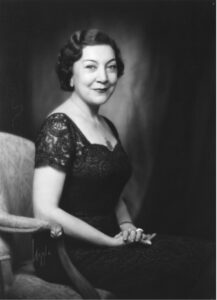
Fototeca Amalia González Caballero. Acervo Histórico Diplomático. Secretaría de Relaciones Exteriores. México. A 3/1 S.84 Ej. 5.
The early years
Amalia was born in Santander de Jiménez, Tamaulipas, Mexico, on 18 August 1898.2) Her widowed mother moved the family of two to Ciudad Victoria, where she formed a close friendship with Adela Gil, the mother of Emilio Portes Gil – a tie that would later accelerate Amalia’s political career when he became president of Mexico in 1928.3)
From a young age, she was passionate about music, theatre and poetry and earned a Bachelor of Arts degree from the National University of Mexico.4) In 1920, Amalia married the historian Luis Castillo Ledón, with whom she had three children.5)
Laying the foundations
Amalia started her career as a secretary to President Portes Gil’s wife and was soon offered a position in cultural promotion where she founded the Teatro de Masas. It was unusual for young wives to work in a position that required them to spend so much time outside the home, and she was only able to pursue her profession because other women in her family helped with the housework that was expected of her.6)
The groundwork for her diplomatic career was laid in 1935, when Amalia carried out a delicate mission as a representative of the Mexican government in Texas in which she succeeded to resolve a long-standing conflict between the state of Texas and the Mexican consul.7) Having proven her diplomatic talent, she was appointed Mexico’s representative to the Inter-American Commission of Women (CIM) four years later.8) It was in this environment that Amalia first met and formed friendships with other prominent Latin American feminists, such as Minerva Bernadino, whose allyship helped her push for change through their combined forces.
In the 1930s, Amalia founded the Ateneo Mexicano de Mujeres as well as the Club Internacional de Mujeres to strengthen mutual support among women from different fields and generations in Mexico.9)
The Declaration of Human Rights and the Commission on the Status of Women
Amalia was sent as a delegate to the Chapultepec and San Francisco Conferences, which led to the creation of the United Nations and enabled her to play an active role in the drafting of the Universal Declaration of Human Rights.10) Unlike other female delegates, she felt that she represented the women of the world and fought for the explicit recognition of women as subjects of human rights, whereas others showed up as “delegates” first and “women” second and saw no reason to differentiate between men and women.11)
Eleanor Roosevelt, for example, opposed the explicit inclusion of women’s rights, asserting that women were already included in the terms “human rights” and “rights of men”. Amalia, on the other hand, sought to ensure that the word “women” was included as often as possible.12)
During the drafting of the Declaration, Amalia was a member of the UN Commission on the Status of Women and was elected vice president of the Commission in 1948.13) Alongside women such as Bertha Lutz, Minerva Bernardino, Isabel Pinto Vidal, Jessie Street, and Hansa Mehta, she succeeded in changing the wording of Article 1 of the Declaration from “all men are born free and equal in dignity and rights” to “all human beings are born free and equal in dignity and rights”. The expansion of the wording in Article 16 was particularly close to Amalia’s heart, given the difficulties faced by illegitimate children and women seeking maternity support. By renouncing “marriage” in the definition of family, the wider definition included otherwise marginalized communities.14)
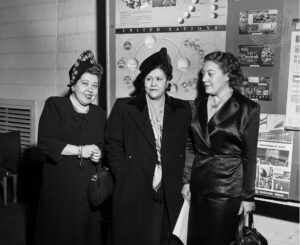
UN Photo by Kari Berggrav
Minerva Bernardino, Dr. Ophelia Mendoza and Amalia González de Castillo Ledón at the Opening of the Second Session on the Status of Women
The concept of state feminism and women’s suffrage
Amalia saw a need for formal rights as a prerequisite for achieving political equality. She envisioned the presence of women in all government offices and planned to achieve this through systematic action. Her so-called state feminism included calls for the creation of a Department of Women (a cross-cutting federal government agency) or for a minimum quota ensuring women’s inclusion during the renewal of city councils.15)
The very basis for true political equality lay in securing women’s suffrage, which Amalia aimed to establish at all three levels of the Mexican government: federal, state and municipal. It took her and the other Mexican suffragettes 24 years and an extensive signature drive to finally achieve the constitutional reform that established universal suffrage in Mexico in 1953.16) Ironically, the reasoning for the denial of this full citizenship was the fear of post-revolutionary Mexican elites that women would take a stance that was too conservative for their liking, while from today’s perspective, being one of the last countries in Latin America to establish women’s suffrage would be deemed even more conversative.17)
Shaping policy and representation
The same year that women’s suffrage was achieved, Amalia’s public work also proved fruitful on a personal level when she was appointed extraordinary envoy to Sweden and Finland simultaneously. Only three years later, in 1956, Amalia was promoted to the rank of ambassador – becoming the first woman in Mexico to hold that title as well as the fourth female ambassador worldwide. In 1957, she was appointed ambassador to Switzerland. She excelled in the then male-dominated sphere and retired from her final posting as ambassador to Austria in 1970, aged 72.18)
Following her successful endeavors on the international stage, Amalia became the first woman in Mexico to hold a position in a presidential cabinet when President Adolfo López Mateos appointed her as the Undersecretary of Cultural Affairs at the Ministry of Public Education in 1958.19)
Amalia’s legacy
Throughout her life, Amalia remained true to her roots and expressed herself creatively by writing plays and publishing poetry alongside her political work and activism. She died in Mexico City on 3 June 1986 aged 87. Throughout her life, she was a trailblazer for women in Mexico and beyond – serving as a role model for women by entering fields long dominated by men. She also left a lasting legacy through her leadership in the establishment of women’s suffrage in Mexico, and through her contributions to making the Universal Declaration of Human Rights more inclusive for women and children.20)
Further readings:
- “Amalia González Caballero de Castillo Ledón: entre las letras, el poder y la diplomacia” by Gabriela Cano and Patricia Vega, Gobierno del Estado de Tamaulipas, Secretaría de Cultura, Instituto Tamaulipeco para la Cultura y las Artes, Mexico 2016.
- “Feminism for the Americas: The Making of an International Human Rights Movement” by Katherine M. Marino, University of North Carolina Press, 2019.
- “El disciplinamiento de los cuerpos en Cubos de noria, de Amalia de Castillo Ledón: la estrategia política de la Revolución mexicana” by Edith María Alberta Ibarra Araujo, pp. 65 ff. in “La política en el Teatro y el Teatro en la polítcia”, Universidad Iberoamericana, Mexico City 2023.
References
| ↑1 | “El feminism de estado” de Amalia de Castillo Ledón durante los gobiernos de Emilio Portes Gil y Lázaro Cárdenas” by Gabriela Cano, “Relaciones Estudios de Historia y Sociedad“ 149, 2017, p. 43. |
|---|---|
| ↑2 | “La estela literaria, política y social de Amalia de Castillo Ledón“ by Olga Martha Peña Doria p. 138 in “Mujeres y Constitución”, INEHRM / Instituto Nacional de Estudios Históricos de la Revolución Mexicana 2019. |
| ↑3 | “El ‘feminism de estado’ de Amalia de Castillo Ledón durante los gobiernos de Emilio Portes Gil y Lázaro Cárdenas” by Gabriela Cano, “Relaciones Estudios de Historia y Sociedad” 149, 2017, p. 46. |
| ↑4 | “Diario de una Sufragista, Lideresa Feminista y Diplomática: Amalia González Caballero de Castillo Ledón” by Ana Gabriel Carillo Montijo, p. 10, INEHRM / Instituto Nacional de Estudios Históricos de la Revolución Mexicana 2021. |
| ↑5 | “El ‘feminism de estado’ de Amalia de Castillo Ledón durante los gobiernos de Emilio Portes Gil y Lázaro Cárdenas” by Gabriela Cano, “Relaciones Estudios de Historia y Sociedad“ 149, 2017, p. 47. |
| ↑6 | Ibid, p. 48 ff. |
| ↑7 | Ibid, p. 62 ff. |
| ↑8 | “Diario de una Sufragista, Lideresa Feminista y Diplomática: Amalia González Caballero de Castillo Ledón” by Ana Gabriel Carillo Montijo, p. 11, INEHRM / Instituto Nacional de Estudios Históricos de la Revolución Mexicana 2021. |
| ↑9 | “El ‘feminism de estado’ de Amalia de Castillo Ledón durante los gobiernos de Emilio Portes Gil y Lázaro Cárdenas” by Gabriela Cano, “Relaciones Estudios de Historia y Sociedad“ 149, 2017, p. 59; “La estela literaria, política y social de Amalia de Castillo Ledón” by Olga Martha Peña Doria p. 138 in “Mujeres y Constitución”, INEHRM / Instituto Nacional de Estudios Históricos de la Revolución Mexicana 2019. |
| ↑10 | “El ‘feminism de estado’ de Amalia de Castillo Ledón durante los gobiernos de Emilio Portes Gil y Lázaro Cárdenas” by Gabriela Cano, “Relaciones Estudios de Historia y Sociedad“ 149, 2017, p. 40. |
| ↑11 | “Learning journey for a feminist: Making women visible, recognizing women’s achievements, and demanding power to women” by Torild Skard, introductory note p. xv in „Women and the UN – A New History of Women’s International Human Rights“, Routledge 2022. |
| ↑12 | “From women’s rights to human rights“ by Katherine M. Marino, p. 11 in „Women and the UN – A New History of Women’s International Human Rights”, Routledge 2022. |
| ↑13 | “La estela literaria, política y social de Amalia de Castillo Ledón” by Olga Martha Peña Doria p. 139 in “Mujeres y Constitución”, INEHRM / Instituto Nacional de Estudios Históricos de la Revolución Mexicana 2019; “Women and the Universal Declaration of Human Rights” by Rebecca Adami, p. 56, Routlegde 2019. |
| ↑14 | “From women’s rights to human rights” by Katherine M. Marino, p. 11 in “Women and the UN – A New History of Womens’s International Human Rights”, Routledge 2022. |
| ↑15 | “El ‘feminism de estado’ de Amalia de Castillo Ledón durante los gobiernos de Emilio Portes Gil y Lázaro Cárdenas” by Gabriela Cano, “Relaciones Estudios de Historia y Sociedad“ 149, 2017, p. 41. |
| ↑16 | “Diario de una Sufragista, Lideresa Feminista y Diplomática: Amalia González Caballero de Castillo Ledón” by Ana Gabriel Carillo Montijo, p. 13, INEHRM / Instituto Nacional de Estudios Históricos de la Revolución Mexicana 2021. |
| ↑17 | “El ‘feminism de estado’ de Amalia de Castillo Ledón durante los gobiernos de Emilio Portes Gil y Lázaro Cárdenas” by Gabriela Cano, “Relaciones Estudios de Historia y Sociedad“ 149, 2017, p. 61. |
| ↑18 | “La estela literaria, política y social de Amalia de Castillo Ledón“ by Olga Martha Peña Doria p. 145 in „Mujeres y Constitución”, INEHRM / Instituto Nacional de Estudios Históricos de la Revolución Mexicana 2019. |
| ↑19 | “Cinco cartas inéditas de Griselda Álvarez a Guadalupe Zuno: Apostillas” by Silvia Quezada Camberos in “Memorias del Coloquio Internacional de Literatura Mexicana e Hispanoamericana”, p. 119, Universidad de Sonora 2017; “La estela literaria, política y social de Amalia de Castillo Ledón” by Olga Martha Peña Doria p. 145 in “Mujeres y Constitución”, INEHRM / Instituto Nacional de Estudios Históricos de la Revolución Mexicana 2019. |
| ↑20 | “La estela literaria, política y social de Amalia de Castillo Ledón” by Olga Martha Peña Doria p. 138 in “Mujeres y Constitución”, INEHRM / Instituto Nacional de Estudios Históricos de la Revolución Mexicana 2019; “Diario de una Sufragista, Lideresa Feminista y Diplomática: Amalia González Caballero de Castillo Ledón” by Ana Gabriel Carillo Montijo, p. 14, INEHRM / Instituto Nacional de Estudios Históricos de la Revolución Mexicana 2021. |