







“Muskism Proposes Something More Like Social War”
Five Questions to Quinn Slobodian and Ben Tarnoff
Elon Musk’s influence extends far beyond business. From his attempts to intervene in national elections to the deep reliance of governments on his companies, his power is felt across a wide range of public life – and it continues to grow. But to understand how powerful and how potentially dangerous for democracy Musk’s empire truly is, one has to examine the worldview that made his rise possible. In their new book, the historian Quinn Slobodian and the writer Ben Tarnoff trace the ascent of the self-styled “Technoking” and the idea of fusing human beings with machines. We spoke with them about Musk’s relationship with the state, “cyborg conservatism,” and whether anything can still counter the fusion of political and digital power.
1. Elon Musk is not only the richest person in the world; he has also become a major political force worldwide, with influence that extends even into the dynamics of war. In your book, you suggest that instead of asking who Musk is, the more interesting question is what he is a symptom of. So let’s start there: what kind of worldview lies behind his rise?
We treat Muskism the same way previous thinkers have treated Fordism: not as a worldview articulated in advance by a singular innovator-genius, but as a way of organizing production processes and social relations that offered both a novel model of accumulation and a novel form of social stabilization. Musk’s wealth has always hinged on his capacity to surf the vanguard of new means of enrichment – whether by tapping capital markets, finding commercial uses for the state-funded research network of the Internet, sniffing out new consumer niches as tastes change, or, time and again, aligning his own enterprises with government priorities.
The challenge, as we see it, is that his system has an adaptive economic logic but it often has difficulty finding its social complement. Whereas Fordism, at least ideally, was a system of social peace – reconciling workers to wage labor through rising incomes and intragenerational chances for mobility – Muskism proposes something more like social war, compensating for inequality through a language of violent exclusion and the vilification of outsiders.
Musk makes machines – and, famously, the machines that make the machines – but he also needs to make meaning-making machines. Hence, his interest in social media and, more recently, generative AI. Part of what drives Muskism is the quest for the equivalent of what Louis Althusser called “ideological state apparatuses”: institutions that can inculcate a particular set of values and beliefs in the broader population.
2. Many people associate Musk with an especially hardline version of libertarianism. You argue that this label misses the mark. Why?
Like all capitalists, Musk seeks to evade, dilute, and dismantle laws or regulations that threaten to constrain his freedom to accumulate. But it would be a mistake to suggest that he wants to shrink the state. On the contrary, Musk has always been keenly attuned to the advantages to be gained by partnering with the state and using its resources to his advantage.
We call this dynamic “state symbiosis,” and we trace its development from Musk’s early days as a dot-com entrepreneur in Silicon Valley in the 1990s. Perhaps its clearest expression is to be found in SpaceX, whose control of the orbital launch market – in 2025, the company was responsible for 95 percent of all U.S. orbital launches and more than half of all launches globally – has made many governments around the world, including and especially the US government, deeply reliant on Musk. The satellite service of the company, Starlink, owns over 70 percent of the satellites currently circling the earth.
SpaceX doesn’t want its client-governments to be weak. It wants them to be strong enough to assert their sovereignty – so long as the assertion of their sovereignty requires deepening their dependence on private providers like SpaceX. In this sense, Muskism is about increasing state capacity through private means. We call this “sovereignty as a service.”
++++++++++Advertisement++++++++++++

The ICJ’s Advisory Opinion on Climate Change
Edited by Maria Antonia Tigre, Maxim Bönnemann & Antoine De Spiegeleir
“The ICJ opinion is the most definitive statement ever made about international law and climate change. However, it is lengthy and complex. In this volume, the editors have assembled some of the world‘s leading scholars in the field to unravel the opinion and probe the subtleties of what it did and didn‘t say.”
– Michael Gerrard, Columbia Law School
Get your copy here – as always, Open Access!
+++++++++++++++++++++++++++
3. You place considerable weight on the influence of apartheid-era South Africa on Muskism, particularly on what you call “fortress futurism.” What do you mean by that?
Fortress futurism is the belief that technology can strengthen self-reliance and sovereignty in a hostile or unstable world. It presents itself as a successor ideology to the system of multilateralism that dominated the decades after the fall of the Berlin Wall. It is also a predecessor ideology, in the sense that we trace its origins to apartheid South Africa, where Musk grew up. The leaders of the apartheid regime saw themselves as an embattled garrison state surrounded by enemies, and to ensure the survival of their state, they had to embrace high technology and economic self-sufficiency. They pursued a model of militarized, modernizing isolation.
We can see fortress futurism as a theme surfacing throughout Musk’s career. One of its clearest expressions was in his early – and, at the time, deeply unfashionable – emphasis on vertical integration. Musk started SpaceX in 2002 and became CEO of Tesla in 2008. At both companies, he pushed to reduce his reliance on external suppliers and to concentrate production as much as possible within the walls of the firm. These decisions cut deeply against the globalizing currents of the 2000s, which positioned the factory as a node within an international production network woven together through global supply chains. Think of how Apple assembles its iPhones, for instance: “designed in California, assembled in China.” By contrast, Musk envisioned the factory as an enclave.
His industrial philosophy may have been out of step with the 2000s, but it would come in handy in the 2010s and 2020s, as SpaceX and Tesla navigated the tariffs, geopolitical tensions, and supply chain shocks of a deglobalizing world, not to mention the dislocations of the Covid-19 pandemic. As policy uncertainty multiplies, and export controls and license bans become part of the workaday repertoire of advanced industrial states rather than exceptions, fortress futurism has increasingly become mainstream.
4. Let me come back to Musk’s relationship with the state. You argue that Muskism no longer sees sovereignty mainly as a matter of territory, but of infrastructure. Why is that shift so significant?
Scholars like Frank Pasquale have argued that our increased reliance on digital platforms and technologies has produced a gap between what he calls “territorial sovereignty” and “functional sovereignty.” Although states may still retain the final say over traditional matters of defense in legal terms, they are nevertheless functionally reliant on private companies to realize their own ambitions, often even at the most basic level.
Our argument is that one critical component of Muskism is the acceleration of the state’s dependency on private service providers. This is why, for example, in the book’s final chapter, we do not frame the DOGE initiative as primarily an austerity or cost-cutting effort, but rather as a means of opening up and integrating sections of government that were previously siloed from one another, making them interoperable and accessible to data and systems integrators like Palantir. In many cases, states have willingly gone along with this rise of functional sovereignty; for example, by using websites like X as official portals for information. Musk’s decision to turn off internet connectivity to Ukrainian forces in the early months of the Russian conflict shows how high the stakes can be for this loss of functional sovereignty.
The twist we identify in Muskism, however, is that it promotes sovereignty not just at the national level, but at the household and individual level. Tesla offers an entire ecosystem of products around a vision of energy autonomy: not just cars, but battery storage and solar panels for your home. Lately, the still-rising valuation of Tesla is premised on the displacement of the automobile as its primary product by the humanoid robot Optimus, which Musk promises will become the best-selling product of all time. Here, individual sovereignty is augmented in a long-standing, even premodern way: through a servant, a laborer, a soldier and, as he has repeatedly promised, an on-demand sexual companion. Yet, as we make clear through many examples, what is sold as autonomy is in fact a deepened dependency on the systems Musk provides – systems that can be turned off at the press of a button, or subjected to new and higher subscription rates.
Scholars have long understood sovereignty to be not just a formal and legal category but a question of a state’s capacity to fulfill its aims. Muskism presents itself as an enabler of both individual and state sovereignty while in practice producing asymmetric dependency on himself and his products.
5, As you describe it, Muskism is also about machine power gradually displacing democratically legitimized forms of rule. Is there any realistic way to push back against the growing fusion of political authority and digital power?
Traditionally, scholars and activists have critiqued algorithmic systems for being depoliticizing. By giving the appearance of neutrality and impartiality, such systems conceal their fundamentally political character – that is, the fact that they both reflect and reinforce a particular distribution of social power. So, for example, when a government agency begins using software to help make certain choices – to evaluate people’s eligibility for social services, say, or to determine the length of a prison sentence – it looks “less political” even if politics is still at work.
What’s distinctive about Muskism is that, while it is eager to substitute machines for humans, it embraces technology as a political force. Musk’s DOGE initiative made reference to increasing the efficiency of government and reducing the federal deficit, but its main agenda was to purge Washington of “wokeness,” and, toward that end, replaced human workers with software wherever possible. Similarly, Grok represents Musk’s attempts to develop an “anti-woke” AI, in order to counter what he sees as the liberal bias of the tech industry. AI’s automation of human labor, in this view, goes hand in hand with the automated dissemination of “anti-woke” politics.
Understanding this aspect of Muskism helps us understand how its fusion of political authority and digital power might be resisted. It’s not that we need to insist on the fact that Musk’s technological ventures are political – he already insists that they are. It’s that they have the wrong kind of politics: they are explicitly designed to intensify social inequality and strengthen social hierarchies. He propagates what we call cyborg conservatism. Contra Donna Haraway and many others, under Muskism fusion with the machine should not scramble and rewrite traditional categories of gender, race, and national identity but buttress and harden them.
One response would be to say that the use of AI should be restricted. Certain spheres of human activity should be reserved for human deliberation and decision-making, especially when it comes to choices that are likely to affect the lives of millions. Equally important, however, is that we see politics not as a kind of “programming” coordinated from above – which is how Musk sees it – but rather as a process of collective intelligence and creativity that arises from below. Such politics can make use of digital technologies, of course, but for very different ends than those sought by Musk and Muskism.
*
Editor’s Pick
by MARGARITA IOV

Man Soo, the protagonist of “No Other Choice” by Park Chan-wook, appears to have it all: a wife, two children, a beautiful house. But when he suddenly loses his job at the paper factory after 25 years, his status, security, and sense of self are at stake. If he does not find work soon, the house will have to be sold. In a desperate attempt to reclaim his place in the world, he begins to eliminate his competitors for a promising position at another paper factory, one by one. In each of them, he recognizes his own reflection. With dark humor and deep compassion, the film explores the meaning of work in late-stage capitalism and the fragility of social security. In the end, who will succeed in securing the very last spot in this new, depopulated world of work — and at what cost?
The Week on Verfassungsblog
summarised by EVA MARIA BREDLER
Not just states, but all of us have become deeply dependent on private Big Tech companies: ChatGPT’s search function now reaches an average of 120.4 million users per month in the EU (and many of them likely trust the search results more than their own judgement – or even fall in love with them, but that’s another story). The European Commission is currently assessing whether ChatGPT can be classified as a “Very Large Online Search Engine” under the Digital Services Act. This is primarily a politically and economically sensitive question. JACOB SCHAAL, MAXIMILIAN LENNER, and TUNMISE AKINYEMI (ENG) make a case for a functional interpretation of the DSA, which would bring ChatGPT under EU regulatory oversight.
Big Tech regulation was also in the spotlight last week amid a proposed social media ban for minors. While Germany is still debating the issue, France has already put forward a draft law. LUC VON DANWITZ (GER) examines the French Council of State’s opinion on the law and draws lessons for constitutional and EU law that could inform similar regulation in Germany.
Aside from social media, young people spend most of their time in school (often mixing the two). Almost a decade ago, research at the Berlin Social Science Center sparked a debate over the increasing social selectivity of private schools in Germany. Yesterday, the Berlin House of Representatives passed a reform to make private school funding fairer, including tuition tables and social supplements. MICHAEL WRASE and FELIX WIRTH HANSCHMANN (GER) defend the reform as constitutional.
Money also governs the funding of democracy projects. Increasingly, the German government seeks to steer this funding directly towards specific policy aims. JANNIK JASCHINSKI and KLAAS MÜLLER (GER) warn that this threatens the sustainable work of civil society in support of the liberal democratic basic order.
A subtler threat comes from the return of the extremism clause, which obliges democracy project sponsors to affirm their commitment to the liberal-democratic order. MAXIMILIAN PICHL (GER) explains how democracy projects operate and why the AfD’s new extremism clauses could play into their hands.
Parity debates have returned as well: following a push from SPD and CDU politicians, gender-balanced electoral lists are once again on the political agenda. DANA-SOPHIA VALENTINER (GER) notes that the discussion is dominated by extreme positions and instead emphasises the room for manoeuvre available to policymakers.
At the EU level, the room for manoeuvre may be a little too wide: EU heads of state and government met on 12 February at Alden Biesen Castle. Under the banner of “simplification”, they approved reforms that could fundamentally reshape EU law-making. ALBERTO ALEMANNO (ENG) criticises what he calls the “castle method”: treaty-level change via informal summitry, bypassing Article 48 TEU and undermining institutional balance.
The EU has also engaged in global informal diplomacy: Commissioner Dubravka Šuica’s participation in the inaugural meeting of Trump’s “Board of Peace” in Washington has drawn significant criticism. While several Member States questioned whether she even had any mandate to participate in such a politically contested initiative, the Commission defended her presence on the grounds of the EU’s direct interest in Gaza’s reconstruction. PETER VAN ELSUWEGE (ENG) highlights the serious EU law concerns this raises.
The institutional design of the African Union also raises concerns. Burundi has now assumed the AU’s rotating presidency, even as violence escalates in eastern Democratic Republic of Congo and thousands of Burundian troops are deployed there. The AU does not regulate how participation in an armed conflict affects the chairmanship. For HAKIM NKENGURUTSE (ENG), this exposes a structural tension at the heart of the Union’s peace mandate.
++++++++++Advertisement++++++++++++
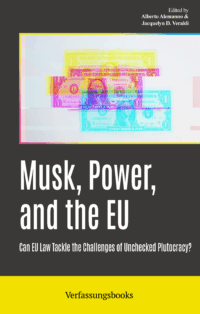
Musk, Power, and the EU: Can EU Law Tackle the Challenges of Unchecked Plutocracy?
Alberto Alemanno & Jacquelyn D. Veraldi (eds.)
At a time when calls for the EU to respond to Musk’s actions are multiplying, the question of whether, why, and how the EU may react remains largely unanswered. What makes Musk’s conduct problematic under EU law? Is it a matter of disinformation, electoral integrity, foreign influence, unprecedented market concentration, or possible abuse of power? This edited volume unpacks whether and how (EU) law may tackle the existence and exercise of unprecedented plutocratic power.
Explore the Verfassungsbook here – as always, Open Access!
+++++++++++++++++++++++++++
In July last year, we made numerous, until-then largely unpublished memoranda and letters from Israeli international law scholars on the Gaza war publicly available, introduced and analysed by KAI AMBOS. We now present an updated version, including a further letter on the ground offensive in Gaza City and the “widespread bombing of residential buildings,” as well as a document on the duty to investigate war crimes.
The US intervention in Venezuela violated the UN Charter’s prohibitions on the use of force and non-intervention. At the same time, it created political space: Venezuela has recently adopted an amnesty law. KAI AMBOS and GUSTAVO URQUIZO (ENG) explain why the sweeping amnesty may entrench executive control over justice rather than promote reconciliation.
No amnesty was granted in South Korea: on 19 February, the Seoul Central District Court sentenced former President Yoon Suk Yeol to life imprisonment for leading an insurrection. His supporters refuse to recognise the verdict. JOSEPHINA LEE (ENG) argues that this delegitimisation of judicial decisions only deepens polarisation.
Italy, too, remains polarised. The latest symptom is the two “Security Decrees” issued by the Meloni government, restructuring the criminal justice system. FILIPPO VENTURI (ENG) traces how Italian populism has evolved into a punitive governance style that curtails protest and expands state coercion.
Space for dissent was also on the agenda at the Bavarian Administrative Court, which confirmed that far-right activist Björn Höcke may speak in municipal halls. RALF MICHAELS (ENG) describes Bavaria’s attempt to exclude certain political events from public venues – and why it conflicts with the Basic Law.
In a few decades, we may look back almost fondly on the headaches once caused by analogue public spaces. Or we may have closed digital spaces and fought for a fairer use of public space, where Optimus offers us clusters of grapes. Anything is possible if, as QUINN SLOBODIAN and BEN TARNOFF suggest above, politics is understood not as programming but “as a process of collective intelligence and creativity that arises from below”. Creativity is not a gift bestowed on a few geniuses by divine providence, but our everyday, instinctive way of living in this world: the bread we are baking at the weekend, the way we spread butter on it – even if the recipe is courtesy of ChatGPT.
*
That’s it for this week. Take care and all the best!
Yours,
the Verfassungsblog Team
If you would like to receive the weekly editorial as an e-mail, you can subscribe here.