






Anatomy of an Escalation
Deepfakes and the Persistence of Power
Deepfakes, manipulated videos, synthetic voices – public discourse currently casts them as a startling new threat. They dominate headlines, raise difficult legal questions, and fuel technocratic debates on regulation. One prominent example is the legislative initiative put forward by Stefanie Hubig, German Federal Minister of Justice, aimed at specifically tackling digital violence and the abuse of deepfake technologies. However, we must not overlook the true scale of the problem: deepfakes are not the cause, but the latest symptom. They represent a technological upgrade for a form of violence deeply embedded in analogue power structures: one that is systematically discriminatory and closely aligned with existing social inequalities.
Digital violence cannot be understood in isolation. Those who harass or publicly demean women, queer individuals, and other marginalised groups online rarely do so out of a purely technological impulse. Instead, their conduct draws on well-established forms of violence – forms we need to call out for what they are: stalking, intimidation, and the abuse of power. This continuity is evident in practice. Even before the advent of AI, clients reported being threatened with the publication of intimate images when attempting to leave a partner. The force of such threats lay in the ever-present possibility of digital dissemination and the accompanying loss of control – effectively trapping these women in abusive relationships. In other cases, male control did not end with separation. It simply evolved: starting with physical stalking in daily life and moving toward hacked accounts and the doxing of private information. Over time, violence has increasingly migrated into the digital sphere without ever changing its fundamental character.
++++++++++Advertisement++++++++++++
 – Humboldt Speech on Europe –
We are pleased to announce that Jakov Milatović, President of Montenegro, will deliver the next Humboldt Speech on Europe on the topic of “The European Union – Towards a New Era of Completion, Enlargement and Deepening”. This lecture will address the EU’s evolving agenda at a defining moment for European integration.
April 15, 2026, 5pm | Humboldt University Berlin
Registration via Eventbrite
++++++++++++++++++++++++++++
The same dynamic persists in professional settings. One young woman described how a colleague initially harassed and belittled her in the workplace. When she pushed back, manipulated images of her suddenly appeared on social media. The message was unmistakable: a woman who asserts boundaries risks retaliation in the form of (digital) violence.
A similar pattern emerged in a neighbourhood dispute that escalated over several months, culminating in the circulation of fabricated audio recordings intended to socially isolate the victim. What began as a personal conflict was digitally weaponised for public defamation. Analogue and digital violence are deeply intertwined – a point also highlighted by Collien Fernandes. They overlap in their triggers, their methods, and ultimately in their impact. In our current social fabric, deepfakes do not mark a break with the logic of sexualised violence – they represent a new stage of escalation. They amplify the scale, speed, and persistence of trauma. What might once have been confined to a limited social circle can now reach millions – and remain accessible indefinitely.
If digital violence is to be addressed effectively, the broader picture must come into view. It is not enough to simply regulate platforms or define new criminal offences. While the current debate is vital for closing legal gaps and signalling political resolve, the decisive questions are structural: How do we change the social frameworks that enable, normalise, and obscure violence? How do we foster a culture where abuse and harassment find no quarter – neither offline nor online?
++++++++++Advertisement++++++++++++

Die Universität Kassel, Fachgebiet Öffentliches Recht, IT-Recht und Umweltrecht (Prof. Dr. Gerrit Hornung), sucht zum nächstmöglichen Zeitpunkt:
Wissenschaftliche:r Mitarbeiter:in (m/w/d), EG 13 TV-H, befristet (für 3 Jahre mit der Möglichkeit zur Verlängerung), Vollzeit (teilzeitfähig)
zur Mitwirkung in Lehre und Forschung, insbesondere zu Rechtsfragen von KI, Datenschutz- und IT-Sicherheitsrecht
Bewerbungsfrist: 16.4.2026; weitere Informationen im Ausschreibungstext.
++++++++++++++++++++++++++++
This, in turn, points to systemic challenges: economic dependencies that make it difficult to escape abusive relationships. Social inequalities that increase vulnerability. A culture that downplays boundary-crossing while turning a blind eye to abuses of power, often out of shame and fear of social stigma. Prevention, institutional awareness, and education remain chronically underfunded. Safe spaces are scarce, and low-threshold support systems are lacking. Without intervention at this level, legal responses risk addressing symptoms rather than causes.
A meaningful response must go further. It requires sustained efforts to combat poverty and inequality, alongside the expansion of protection and counselling services. It calls for an education system that critically reflects on power dynamics and addresses both digital and analogue violence. Above all, it demands that societal responsibility be taken seriously in practice, not merely invoked in the abstract. And to the legal professionals reading this: identifying doctrinal gaps is not enough. We need concrete proposals, sustained dialogue, and tangible steps forward – especially from those who currently retreat into legal formalism.
Finally, we must challenge traditional gender roles. This includes men who are willing to look closely and take responsibility. Men who speak out against sexualized violence, reflect on their own roles in relationships, and embrace non-violent forms of masculinity and care. We need men to confront perpetrators and hold them accountable. At the same time, we need women who stand together, share their experiences, and act in solidarity through collective care.
Ultimately, digital violence lays bare how tightly power, control, and gender remain interwoven in our society. Deepfakes disproportionately target women, girls, and marginalised people. They reproduce sexism, racism, and patriarchal narratives, encoding longstanding hierarchies into new technological form: the persistent idea that bodies, voices, and identities can be reduced to mere objects. Anyone seeking to address digital abuse must be willing to confront this discomforting reality: the fight against deepfakes is inseparable from the broader struggle against violence and inequality.
*
Editor’s Pick
by MAXIM BÖNNEMANN
 “I carved out a space for the crow. Inside. Up under my ribs. I wrapped it in a sleeve of the red shirt and put it up in there. Little red mummy. I have a crow inside me and no one can know.” A lone undead narrator walks across the United States. She is heading west. Fragments of a former life flicker along the way. Where her heart once beat, there now lies a crow that sometimes utters words. An apocalypse has overtaken the country. Zombies linger in hotels, tell stories, and feed on humans. The prose of this fascinating debut is dense and fragmented, haunted by a single, overarching theme: a profound grief for something once present that can never be reclaimed.
*
The Week on Verfassungsblog
summarised by EVA MARIA BREDLER
The dynamics are always the same: violence surfaces, it looks rather ugly – so people hastily slap a criminal-law plaster over it and breathe a sigh of relief. This time, it is deepfakes. As Asha Hedayati does in our editorial, AZIZ EPIK (GER) also exposes this dynamic: everyone looks hopefully to criminal law, yet the real and more lasting solutions lie elsewhere. Digital violence, he argues, is patriarchal violence – and anyone who wants to combat it must pull off the plaster and examine the structural causes, however painful that may be.
Denmark is also trying to tackle the symptoms. As the first country in the EU, it will now specifically protect a person’s physical appearance and voice. ALMA EGGERS (ENG) traces how the new law transforms classic personality rights into intellectual property rights, making them transferable and commercially exploitable.
In the United States, two courts ruled this week that Meta and YouTube have failed to protect young users adequately and ordered the companies to pay millions in penalties. In a similar vein, EU Member States are discussing and enacting social-media bans. Last month, the Commission provisionally found that TikTok’s addictive design violates the Digital Services Act. Yet in order to reach such conclusions, regulators and platforms must first be able to measure and promote “digital well-being”, as required by the DSA. NINA BARANOWSKA and GIANCLAUDIO MALGIERI (ENG) make a concrete proposal to operationalise “digital well-being”, taking into account the vulnerability not only of minors but of all users.
FATIH TAŞÇI and EMRE HAYYAR (ENG) examine the Turkish draft law proposing a social-media ban and warn against treating platforms as inherently harmful. Although the Turkish proposal is more nuanced than others, they argue, it repeats the same mistake: it overlooks the negative consequences of excluding children and young people from modern public squares.
Technological change is also transforming legal education, yet universities are struggling to keep pace. TABEA BAUERMEISTER, MICHAEL GRÜNBERGER and PAULINA JO PESCH (GER) consider what will be expected of law graduates in the near future, stressing not only specific AI skills but also social, communicative and critical-reflective abilities.
In future, law students may not even need to consult external AI tools but could instead search directly for answers on the website of Germany’s Federal Constitutional Court. At least if the Czech Constitutional Court sets a trend: a few weeks ago, it became the first apex court in Europe to introduce an AI-powered chatbot that provides answers about its case law. For ONDŘEJ KADLEC (ENG), however, the innovation raises more questions than it answers – about transparency, accountability and the interpretative role of AI.
Questions of transparency and accountability are also arising in India. Several users on X and Meta reported that their posts and accounts were blocked following government orders without any justification. For RAHUL PALLIPURATH (ENG), these state blocking orders point to a deeper problem: if those affected neither learn the reasons for the blocks nor have an effective way to challenge them, freedom of expression and access to justice are placed at risk.
++++++++++Advertisement++++++++++++

Your ad — for your community and for independent constitutional debate
Hiring? Hosting a conference? Publishing a Call for Papers or a new book? Place your ad in the Verfassungsblog editorial.
You’ll reach almost 20,000 subscribers directly via newsletter — and thousands more through the website. Fellow scholars, practitioners, constitutional law nerds. And your ad helps us continue doing what we do: independent, expert-driven, rigorous, timely, readable.
Get in touch, we’ll walk you through the options! advertise@verfassungsblog.de
++++++++++++++++++++++++++++
Meanwhile, Germany is debating how far the state may go in intervening to protect users in cyberspace. In its new draft bill on cybersecurity, the Federal Ministry of the Interior proposes expanding the powers of the Federal Criminal Police Office. NICOLAS ZIEGLER and CAROLIN KEMPER (GER) show why, despite these additional powers, the scope for action will remain narrow – and why the result may well be little additional security.
Conversely, the state is sometimes reluctant to reveal too much about itself. In February 2026, the Berlin Senate presented a draft law that would significantly restrict access to information to more effectively protect critical infrastructure. Yet instead of achieving this goal, PHILIPP SCHÖNBERGER and HANNAH VOS (GER) argue, the reform will weaken democratic oversight of the executive.
And Berlin would in fact do well to scrutinise the executive more closely. The city’s Justice Senator considers a law designed to promote people with a migration background within the judiciary to be unconstitutional and therefore refuses to apply it. The constitution does not protect her in doing so, says THOMAS GROẞ (GER) – quite the opposite: this amounts to executive disobedience.
In Mecklenburg-Western Pomerania, meanwhile, difficult parliamentary majorities have prompted a debate about amending the constitution to extend the time limit for forming a government. For MAX GEORG HÜGEL (GER), precisely such moderate changes are well-suited to adapting the constitution to new realities.
Italy, too, sought to adapt its constitution – the question was simply to which realities. In the referendum on Meloni’s judicial reform, Italians voted “no, grazie” by 53.2 per cent – Giorgia Meloni’s first political defeat since taking office in 2022. BENEDETTA LOBINA (ENG) explains what this means for Meloni’s political power and why the result is a positive sign for constitutional checks and balances.
Checks and balances are also at stake in the debate surrounding the German Bookshop Prize: was Wolfram Weimer entitled to exclude three bookshops from the award? The case raises fundamental questions about the relationship between protecting democracy and state funding for culture. ANDRÉ BARTSCH and JAKOB HOHNERLEIN (GER) have serious doubts: only concrete hostility to the constitution could justify exclusion from funding; political views alone are not enough.
++++++++++Advertisement++++++++++++
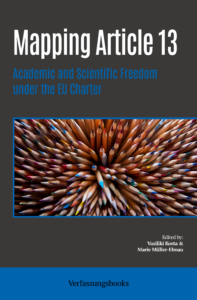
Mapping Article 13: Academic and Scientific Freedom under the EU Charter
Vasiliki Kosta & Marie Müller-Elmau (eds.)
Academic freedom is under pressure. Though protected by Article 13 of the EU Charter, academic freedom in the context of EU law received practically no or very little attention. As legal and political developments accelerate, the meaning of this right is taking shape in real time. This edited volume puts Article 13 of the EU Charter in the spotlight and reflects its potential in light of past and present threats to academic freedom.
Discover the potential of Article 13 EU Charter in protecting academic freedom here!
++++++++++++++++++++++++++++
Meanwhile, the Council of Europe is considering weakening protections for migrants under the European Convention on Human Rights. COLIN MURRAY (ENG) warns that this could undermine the core legal guarantees of the Belfast/Good Friday Agreement.
The credit extended to Ukraine is also being undermined. Viktor Orbán has blocked funds for Ukraine, despite having promised in December 2025 not to stand in the way. LUCAS SCHRAMM (ENG) explains why this time he may have gone too far.
Last week, the Court of Justice of the European Union ruled that leaving the Church alone does not justify dismissal by a church employer. HEIKO SAUER (GER) welcomes the judgement as a further step towards a constructive relationship between the CJEU and the Federal Constitutional Court. For ANNA KATHARINA MANGOLD (GER), the CJEU is right to strengthen equality rights and to set the Federal Constitutional Court new homework.
What actually happens if the homework is not done? The CJEU has now imposed a €10 million penalty on Portugal for failing to implement a 2019 judgement on the Habitats Directive. LAURA HILDT (ENG) describes how, even in a seemingly straightforward case, more than a decade can pass without the law being fully implemented on the ground.
And finally, some good news. The European Citizens’ Initiative My Voice, My Choice for safe and accessible abortion has been signed by more than 1.2 million people – a major success. On 26 February 2026, the Commission announced that abortion services would be linked to the European Social Fund Plus. Member states will therefore be able to use EU funds in future to provide corresponding services for women across the Union. LAURA FORYS (ENG) calls this a “masterclass” in EU-law legal mobilisation, which has, for the first time, opened the way to European budgetary funding for abortion services.
A small step towards gender equality – and with it a slight shift in the patriarchal tissue of inequality, equality and violence: not merely a plaster, but a small sign of healing.
*
That’s it for this week. Take care and all the best!
Yours,
the Verfassungsblog Team
If you would like to receive the weekly editorial as an e-mail, you can subscribe here.