






Anticipation Starts Now!
Concluding the Judicial Resilience Project
Suppose the Minister of Justice of a German Bundesland decides to take a new approach to recruiting judges. He wants to put an end to what he sees as detached elites in the courts – the state, he claims, needs judges who are in touch with the people and work efficiently. In particular, asylum proceedings need to move forward at a faster pace. For this reason, the new Minister of Justice has already issued a regulation consolidating all asylum proceedings from the most relevant countries of origin in a single administrative court. All that is missing now are capable judges for this court who can process these cases efficiently. He instructs his Ministry to launch the website “real-justice.de”. “The decision is yours!” it proclaims. “Help write a new chapter for the state. Apply today to become a deportation judge – competitive salary and secure pension included!”
Sounds too bizarre to be true? In the United States, this has recently become a reality: the website join.justice.gov openly recruits “deportation judges” – benefits included. This is not just another tasteless move by the second Trump administration, but an internationally known tactic called “court packing”, a favourite tool of authoritarian populists seeking to undermine the judiciary. Around the world, they pursue the goal of filling courts with like‑minded judges to govern without judicial oversight.
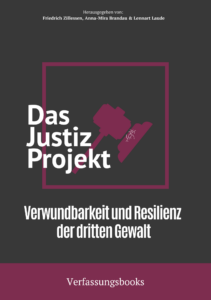
A similar scenario would be possible in Germany. The German judiciary is vulnerable – more so than commonly assumed. Over the past year, we have examined the potential avenues and methods by which authoritarian populists could intervene to weaken or even incapacitate the German judiciary. The findings are presented in our study “The Judicial Resilience Project: Vulnerability and Resilience of the Third Branch”, which we published this week (in German) on Verfassungsblog – open access, of course.
The authoritarian transformation of the judiciary through a combination of many small, often inconspicuous measures has been observed internationally for many years. Step by step, the judiciary is attacked, politicised, and reshaped until it no longer functions effectively as a check on the other branches of government. It is no coincidence, then, that in our scenario, the Minister of Justice wants to hire new judges precisely after reallocating areas of the politically highly sensitive field of migration law to a single administrative court under § 83(3) sentence 1 German Federal Asylum Law. This concentration allows him or her to create new chambers at that court devoted exclusively to asylum cases. And these chambers are busy, as they are now the only ones in the state competent to handle these asylum matters. How convenient, then, if one can also influence who these new judges are – without having to amend or bend existing law. In eight of the 16 states, the Minister of Justice ultimately decides who to appoint as a probationary judge. While he is bound by the principle of merit-based selection in Art. 33(2) Basic Law, its criteria are vague and open to interpretation; effective legal protection against such interpretations is extremely difficult (The Judicial Resilience Project, pp. 168–169). For the opposition and civil society, it is hard to identify these individual steps, understand them, and mobilise resistance.
The Judicial Resilience Project
During the last eleven months, we spent most of our time developing, reviewing, adapting, or discarding scenarios. The results illustrate the paths authoritarian populists might take in the future to attack the German judiciary. Inside and outside Europe, we observe that as long as courts function as institutions that limit power, they are attractive targets for authoritarian populists – at least until they have brought the courts under their control and can use them to legitimise their actions.
With our work, we wanted to move past purely doctrinal analyses. Our aim was to portray legal reality accurately and to subject the judiciary to a plausible stress test. In roughly 70 research interviews, we spoke with judges, court presidents, ministerial officials, scholars, and many other experts to examine court organisation, budget law, personnel and IT issues, and the state constitutional courts (for the methodology used, see: The Judicial Resilience Project, pp. 33–62).
The scenarios we developed are neither probability forecasts nor crystal‑ball predictions. They represent plausible and possible future developments. Their value lies in anticipating the cumulative effects of authoritarian populists’ measures – in this case, the death of an independent judiciary by a thousand cuts – and in illustrating the strategies and narratives they employ. Scenario analysis enables us to identify and discuss legal problems that were previously unrecognised. By recognising and understanding the path from an independent to a dependent judiciary can judges, politicians, the media, and the public effectively react to and counter authoritarian politics.
++++++++++Advertisement++++++++++++

Die Juristische Fakultät der Europa-Universität Viadrina besetzt zum 1.3.2026 eine Stelle als akademische:r Mitarbeiter:in (20 Std./Woche, bis EG 13 TV-L) an der Professur für Öffentliches Recht/Europarecht (Prof. Dr. Jelena von Achenbach).
Im Mittelpunkt steht die eigene Promotion. Weitere Aufgaben: 2 SWS Lehre sowie Mitwirkung an Forschung und Selbstverwaltung. Voraussetzung: mind. vollbefriedigende Erste Juristische Prüfung. Bewerbung bis 31.12.2025.
Alles weitere hier.
++++++++++++++++++++++++++++++++
“Enemies of the People”
One might object that our scenarios and the vulnerabilities they identify remain purely hypothetical in Germany. After all, there has not been a Minister of Justice who uses such abusive tools or openly recruits “deportation judges” on a large scale. It may seem that the authoritarian‑populist toolbox still sits unused in the corner.
But that view would be too short‑sighted. The attacks on the judiciary by authoritarian populists begin long before they come to power. Even in opposition, they use their discursive power to delegitimise the judiciary and its institutions. Courts offer a particularly convenient target: while they decide independently and “in the name of the people”, they can easily be portrayed as an elite caste imposing its own political preferences against the alleged will of the majority – especially when protecting minority rights. Thus, courts quickly become “enemies of the people”, or, in cruder terms, “shit courts”, as a CDU MP was anonymously quoted this year.
In fact, over the course of the Judicial Resilience Project, we increasingly observed that something is shifting in the relationship between the judiciary and politics in Germany: personal defamation of judges who rule government migration policies unlawful; a federal interior minister who continues these policies regardless; a politicised and derailed constitutional judge appointment; the federal government’s disobedience of administrative court decisions relating to the Federal Admission Program for Afghanistan; a judicial selection committee in Thuringia that has been unable to reconvene even a year after state elections because the AfD is blocking it with its veto power – none of this remains merely a scenario; rather, this is the reality in the Federal Republic.
What Now?
Especially in times like these, we hope our book contributes to protecting and strengthening the political culture of judicial independence (The Judicial Resilience Project, pp. 296–298). We are convinced that an institution proves particularly resilient when the people who work in and with it – as well as the broader public, civil society, and the media – are prepared; when they understand the strategies of authoritarian populists, and when they are aware of existing vulnerabilities. A robust judiciary requires preparation and anticipation. For this reason, we have spent the past months – alongside our work on the book – developing and conducting workshops to prepare judges, judicial trainees, and other judicial personnel to be resilient in the face of authoritarian-populist threats. In these workshops, as well as in our research interviews, we repeatedly observed that many people in the judiciary are willing to actively defend judicial independence. We will continue these workshops next year.
Our work on the Judicial Resilience Project, however, will end on 31 December 2025. A year full of insights, challenges, doubts, and short nights comes to an end. All of this was possible only through tireless teamwork and the conviction that increasing autocratisation can be countered through determined, effective action. It remains essential to monitor authoritarian populist actors with vigilance, understand their strategies, and anticipate their next moves. We hope to contribute to this endeavour. Whether our aspirations for our book are fulfilled now also lies in your hands. We wish you an insightful read.
*
Editor’s Pick
by MAXIM BÖNNEMANN
 Last week, I felt like watching a spy film. Conveniently, my neighborhood cinema was showing a movie whose title seemed a safe bet: The Secret Agent. Set in 1970s Brazil, it unfolds slowly and in rich colors—and, as I soon realized, is many things but not a spy film. At its center is Marcelo, a scientist on the run. It is the era of the military dictatorship, and Marcelo is not a dissident in the traditional sense, but rather the accidental target of a corrupt minister. He hides in the city of Recife, meeting people who offer help, comfort, and love—while assassins begin to close in. The Secret Agent takes its time with all this (2 hours and 40 minutes); spending Marcelo’s days in Recife alongside him draws viewers inevitably closer to him. That intimacy is moving, but it also casts an even harsher light on what 1970s Brazil was: a time marked by brutal violence.
*
The Week on Verfassungsblog
summarised by JANA TRAPP
The CJEU’s Trojan judgment sent ripples across Europe this week. The case originated with a complaint brought by two Polish men whose marriage abroad was to remain legally invisible at home. The referring Polish court asked whether such a refusal complies with EU law. The Court’s response was unequivocal: a (same-sex) marriage concluded in one Member State travels with you across borders. KONSTANTINOS LAMPRINOUDIS (ENG) explains how the Court combines free movement with the Charter’s prohibition of discrimination to set a more robust equality standard.
That EU legal obligations in Poland have effects well beyond symbolism is demonstrated by the analysis of ADAM PLOSZKA (ENG). Several municipalities recently adopted anti-migration resolutions explicitly opposing the relocation rules for asylum seekers set out in the EU Pact on Migration and Asylum. Yet soon after, the prospect of losing EU funding prompted a remarkably swift reversal.
While Europe is tightening its rule-of-law levers, SHAO-KAI YANG (ENG) reports a very different development from Taiwan: a constitutional court in institutional limbo, formally intact but substantively eroding in its protection of fundamental rights.
A further erosion of constitutional foundations is looming in India. ANMOL JAIN and SHASHANK MAHESHWARI (ENG) examine an Advisory Opinion of the Supreme Court that recalibrates the country’s federal architecture: governors, the Court suggests, may block state legislation at their own discretion and without any temporal limits. In effect, the Court establishes a de facto Union-level veto.
Germany, too, had a full constitutional agenda this week.
HALINA WAWZYNIAK (GER) criticises both the election challenge brought by the recently founded party BSW and the recommendation issued by the Bundestag’s electoral review committee – one for its formal and substantive shortcomings, the other for its excessive demands of substantiation.
In Hamburg, a new mandatory vetting procedure for the domestic intelligence service aims to bolster democracy. Yet as SARAH GEIGER (GER) shows, the exclusion of legal trainees introduces a striking asymmetry into the scheme.
Questions of equality also frame the debate over whether conscription for women would be compatible with Article 12a of the German Constitution. PAULINA BÖHM and ANTONIA STUMMVOLL (DE) criticise the fact that, under the new Self-Determination Act, trans* women may still be subject to conscription in situations of tension or defence, despite their legal status as women. They call for an inclusive concept of womanhood – one that does not pit self-determination against equality.
Institutional responsibility is at the centre of LUCA MANNS’ (GER) analysis of a Federal Administrative Court upholding disciplinary measures against a BND employee and professor whose statements delegitimised the state. The decision marks the boundary of academic freedom where educators also train future civil servants.
Sometimes, reform ideas turn out to be familiar concepts in new packaging. STEFAN KÜHL (GER) revisits “practice checks” in legislation, an idea that may look novel, until its earlier iterations and sobering side effects come back into view.
Turning to the European level, MICHAL CZERNIAWSKI (ENG) examines the Berlin Declaration on European Digital Sovereignty: an ambitious technological roadmap that, for all its scope, still lacks a firm grounding in fundamental rights.
Meanwhile, RENÉ MAHIEU (ENG) warns that the Commission’s Digital Omnibus proposal may narrow the right of access to documents – and with it the very tool that exposes failures in digital administrative systems.
Staying in the digital realm: STEFANIA DI STEFANO and SUZANNE VERGNOLLE (ENG) analyse the extent to which the Digital Services Act actually delivers transparency. The DSA promises a “safe, predictable and trusted online environment”, yet its transparency reports so far fall short of that vision. Drawing on interdisciplinary collaboration with hackers, archivists and other specialists, the authors map the existing gaps and offer four recommendations for making DSA reporting more resilient and more meaningful.
ERIK TUCHTFELD (GER) shows that this week’s Russmedia decision by the ECJ is questioning what is perhaps the most fundamental decision by the European legislator for the structure of the internet: the notice-and-takedown principle, which has been in force for 25 years. Instead of the established liability privilege, the Court declares platforms to be (jointly) responsible for data protection violations from the publication of content on. In effect, this creates an obligation to use comprehensive filter mechanisms for online speech—with a considerable risk of overblocking.
Finally, the structural question: ALAN BOGG and CYNTHIA ESTLUND (ENG) remind us that democracy does not end at the workplace door. When much of everyday life takes place within hierarchical corporate structures, modern societies face a democratic deficit that they must actively confront. Their answer is a programme for industrial democracy in the twenty-first century – a renewed model of codetermination adapted to a digitalised world of work.
As if this were not enough, we have also launched two blog symposia.
Today marks the opening of a symposium celebrating the 75th anniversary of the European Convention on Human Rights (ENG), based on a conference hosted by the Max Planck Institute for Comparative Public Law and International Law and the Federal Ministry of Justice and Consumer Protection. ALEXANDRA KEMMERER and NICOLA WENZEL set the scene. NANCY HERNÁNDEZ LÓPEZ, President of the Inter-American Court of Human Rights, reflects on judicial dialogue, and ARMIN VON BOGDANDY explores the relationship between the ECHR and European society. More contributions will follow over the weekend.
We have also launched our symposium “Algorithmic Fairness for Asylum Seekers and Refugees” (ENG), which brings to light the digital and algorithmic infrastructures shaping contemporary asylum and migration procedures. CATHRYN COSTELLO and MIRKO DUKOVIC introduce the project and show how automated decisions, digital visas and biometric tools increasingly structure – and subtly shift – these processes.
The subsequent contributions take up this dynamic from various angles: CATHRYN COSTELLO and MIRKO DUKOVIC warn of inequalities in the allocation of digital visas. MAYA ELLEN HERTZ, WILLIAM HAMILTON BYRNE and THOMAS GAMMELTOFT-HANSEN examine the epistemic uncertainties of AI-supported status determinations. LENKA DRAZANOVÁ presents findings from a five-country survey showing how differently citizens assess the fairness of “smart borders”. DEIRDRE CURTIN and LUDIVINE STEWART investigate the growth of secrecy in the migration domain. MATIJA KONTAK exposes the risks of unregulated biometric experimentation by Frontex. HERWIG C. H. HOFMANN demonstrates how classic guarantees such as access to the file or the right to be heard can evaporate when AI systems generate and weigh information in opaque processes. Anyone engaging with algorithmic fairness must therefore rethink the very notion of the “file” – as a matter of transparency, oversight and accountability. Closing out the week, ANGELIKA ADENSAMER and LAURA JUNG show, using Austria as a case study, the risks that AI tools pose in asylum proceedings. More to come next week!
After this week, one conclusion again stands out: stability requires scrutiny. Here’s to a good week ahead – and perhaps a small piece of chocolate in your shoe.
*
That’s it for this week. Take care and all the best!
Yours,
the Verfassungsblog Team
If you would like to receive the weekly editorial as an e-mail, you can subscribe here.