







Jambato, the Harlequin Toad, the Plaintiff
Enmeshments of Rights of Nature
Once again, frogs and toads are making headlines defending their constitutional rights. In a successful Rights of Nature (RoN) case in Ecuador, the Jambato (Atelopus ignescens) – a toad with an orange belly and black back – has now stopped an infrastructure project in Angamarca. RoN cases are often told as David vs. Goliath stories: Indigenous communities, grassroots environmental movements or even more-than-human species defeat overmighty mining companies or state agencies in court. The Jambato case illustrates that this narrative tends to oversimplify the conflicts behind RoN cases. They are often shaped by complex power dynamics and deep disagreements within the affected communities.
However, these tensions strengthen RoN, since they radically increase participation in environmental issues.
Jambato, the Harlequin Toad as Plaintiff
Since its legal success, the Jambato toad has been making headlines such as “In Ecuador’s battle of toad vs. road, toad wins” and “The fascinating story of the jambato and how it survives alone in Angamarca, Cotopaxi”. Also murals in cities such as Quito call for the toad to be saved.
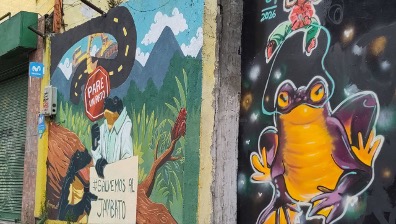
Photo: AG
The Jambato toad is an endemic species that only lives in the Angamarca area in central Ecuador. It was declared extinct in 2004, but rediscovered in 2016. Now it is supposedly endangered by the construction of the road Ambato-Guambeine-Angamarca, an important infrastructure project that will facilitate (human) access to locations that are currently difficult to reach. The construction works were supposed to enter into their critical phase on 5 January 2026, which would have meant massive excavation works.
Multi layered legal dispute
In order to stop this project and save the Jambato, environmentalists have unleashed a complex legal dispute. First, the Jambato sued the prefect of the region, Lourdes Tibán, among others for violating the toad’s constitutional rights. It directly addressed the entity responsible for the project and demanded that it be stopped. On 4 January, the local court of the Pujilí canton ordered, as preliminary measures (medidas cautelares), that the construction works be put on hold. It argued that “[t]his road poses an imminent and serious threat to the constitutional rights of this species” (p. 3), thereby violating nature’s right to existence, which the Jambato holds as part of nature. These measures were revoked several days later by the court, after the GAD (Autonomous Decentralized Government) submitted an environmental license, issued by the Ministry for the Environment and Energy (MAE).
In a second lawsuit against the MAE, this environmental license was challenged before the Unidad Judicial Penal con sede en el Cantón Riobamba, the competent court in this case. On 7 March, the lawsuit was upheld. The Riobamba court declared a violation of the Jambato’s rights (Juicio No. 06282-2026-00060).
A heated debate
The case sparked a heated debate. Several actors ridiculed the claims of the Jambato, questioning how a small animal could halt a significant infrastructure project. Prefect Tibán wrote on social media,
“No frogs, no toads, no greens, no blacks, no one can run me out… here we work for the people and for nature on equal terms and with respect…”.
At the heart of the conflict lies precisely this tension: balancing the need for a road to connect the parish – and for a “good life of going to see the frog” – with opposition to the “development” that the road would bring.
Many residents of the rural area also spoke out in favor of the road and against protecting the Jambato. At the same time, activists of the Jambato Alliance were criticized as outsiders who did not care about local needs. They faced hostility and threats. Without judging the respective positions, this debate serves as a stark warning against romanticizing and idealizing the positions of local populations. RoN and the interests of local populations are by no means always aligned.
María del Carmen Vizcaíno, Director of the Jambato Alliance – whose safety was threatened during this process by both the community and the prefectural state apparatus – seeks to reconcile these conflicting perspectives: “Protecting the jambato isn’t a romantic gesture; it’s a warning”. “We’re not against the highway,” she shared with us in a personal conversation.
Cooling things down
Against this backdrop of fierce controversy, the decision was made against the MAE. This ruling certainly has the potential to cool things down. Interestingly, it does not elaborate in depth on the material content of the Jambato’s rights. It affirms that the toad – as a wildlife species – forms part of nature protected by the Ecuadorian constitution and therefore has standing. What makes this case remarkable is that it focuses on a single species, the Jambato, rather than on an ecosystem, which is the usual approach in Rights of Nature cases. In the second ruling echoing the Constitutional Court jurisprudence, the court emphasizes that wild animals
“should not be protected solely from an ecosystemic perspective or with a view to human needs, but primarily from a perspective that focuses on their individuality and intrinsic value” (p. 60).
The court also affirms that the construction works pose a danger to the Jambato. However, it does not deal with substantive issues related to the project, but focuses instead on procedural questions.
The court declared that there had been a violation of “the rights of the Jambato Harlequin Toad (Atelopus ignescens) to legal certainty” (p. 65). It elaborates on the importance of environmental licenses in protecting nature’s rights. In this respect, RoN have a strong procedural dimension. Before authorising a project that affects nature, state agencies must carefully assess its possible impact. In doing so, they also have to take seriously observations from civil society actors, such as environmental NGOs. This may be read as an interpretation of Art. 71 para 2 of the Ecuadorian constitution, which allows everyone to “call upon public authorities to enforce the rights of nature”. Until now, this provision has been relevant primarily in the context of access to court. However, the ruling shows that it also implies that administrative authorities must take into account statements made on behalf of nature in the relevant administrative proceedings.
In the Jambato case, the authorities failed in this regard. The court states that the MAE issued environmental licenses based on inaccurate information submitted by the GAD. It further holds that it was the MAE’s duty to verify the information submitted by the GAD, either ex officio or, at the latest, after receiving complaints by the Jambato Alliance. By failing to observe the relevant procedural rules, the authorities violated the Jambato’s rights. In the words of the court,
“this failure on the part of the entity responsible for safeguarding the rights of nature – and specifically the Jambato in this case – has placed a species that was already classified as critically endangered by the International Union for Conservation of Nature, as noted, at even greater risk of extinction; consequently, it violated the rights of nature” (p. 65).
Participatory process
The ruling emphasizes the importance of gathering all relevant information in order to make a decision based on a comprehensive set of facts. In this regard, it also considers input from civil society to be valuable. Unlike in Germany, where such participation in planning procedures is currently viewed as a hindering factor (cf. Wulff), the court considers it essential to the protection of RoN.
The case also illustrates the importance of legal knowledge and reasoning in relation to biology, which cannot be considered in isolation but must be understood in conjunction with human communities and their needs as they inhabit aquatic and terrestrial habitats throughout the various life cycles of a species such as the Jambato. Biologists have documented that “the Jambato population in Angamarca faces multiple threats at the same time (high temperatures, drought, invasive species, fires)” (Vega-Yánez et al.), not just the road.
In the Jambato case, a collective of people (legal minga) and a corazonar (heartfelt thinking) work collectively to support the species by mobilizing the law. As Ecuador’s animalist movement posted on their social media: “This is not a victory for egos. It is a victory for science, for collective work, and for the rights of nature”.
Civil society movements defend these rights – and the constitutional subjects they protect – through consultations, in the streets, in legal parades with batucadas (a style of Brazilian percussion that draws on African influences) featuring people dressed as iguanas, bears, and jaguars drumming and rising up against an increasingly authoritarian right-wing government and approved mining projects of an urgent economic nature that are unconstitutional. This is an important potential of the RoN.
Conclusion
“Nature does not unite, it divides,” Bruno Latour and Nikolaj Schulz write (Latour/Schultz 2022, 11, our translation). Speaking about and for nature therefore creates disputes. The authors call on us to embrace these conflicts and view them as productive. The Jambato case shows exactly this: Things become complicated if toads have a say. Nevertheless, it demonstrates that participation in planning processes by affected humans and more-than-human beings has intrinsic value. RoN can help to channel these conflicts into legal processes and thereby pacify them. It also makes them public, allowing for broad participation, as the amicus curiae submissions show, and for media coverage as well.
Meanwhile, the conflict is far from resolved. After construction of the road was halted again by the second court ruling, the prefect Lourdes Tibán suggested relocating the toad population through a communal minga, a form of collective work, and that the toads be searched for with a magnifying glass. The Ministry of Environment has already rejected this possibility, noting that relocating the species would be ecologically unfeasible. Nevertheless, there seems to be a willingness to find ways both to protect the Jambato and to improve the human infrastructure. The excavators are still there.