







“Just the Illusion of Protection”
Five Questions to Friederike Wapler
The risks social media pose to children and adolescents are well-known: addictive design, algorithmically amplified harmful content, and mounting psychological strain. In December 2025, Australia became the first country to introduce a statutory age limit for social media; Spain, France, and the United Kingdom are advancing similar legislation. This week, German Chancellor Friedrich Merz indicated that he views similar proposals from the Social Democratic Party (SPD) and the Christian Democratic Union (CDU) with “considerable sympathy.”
Beyond the detailed regulatory questions underlying such a ban – EU competences, app design, enforceability – the debate raises fundamental constitutional issues: How does the German Basic Law allocate responsibility between the state, parents, and children? What is the role of protection, and where does paternalism begin? We spoke with Friederike Wapler, Professor of Legal Philosophy and Public Law at Johannes Gutenberg University Mainz.
1. When the debate about banning social media for children and adolescents emerged in Germany, what was your initial reaction?
My first thought was: once again, people are talking about children and adolescents without talking to them. A ban on using social media would deeply affect their everyday lives. Political parties and parliaments would do well to develop formats that allow them to engage directly with young people on issues that immediately concern them. Children and adolescents have a right to be heard.
Particularly when it comes to social media, it would be valuable to understand what young people actually do in digital spaces, how they deal with the risks they encounter there, and how they themselves assess the likely impact of bans. I am convinced that if policymakers ask children and adolescents how social media could be made safer for them, they will receive nuanced and constructive answers, including on how easily prohibitions can be circumvented. Developments in Australia illustrate this point.
2. How does social media influence the development of children and adolescents in a constitutional democracy? Given that much of young people’s social life takes place online, could a ban actually do more harm than good?
For children and adolescents, as for adults, social media is both a blessing and a curse. It offers connection, information, and entertainment, but it can also foster addiction, expose users to disturbing content, and distract from more important matters. Its significance for a democratic state is equally ambivalent: social media enables access to information and participation, yet it also spreads misinformation and can trigger or accelerate radicalisation.
++++++++++Advertisement++++++++++++
Out now!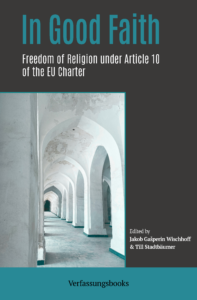
In Good Faith: Freedom of Religion under Article 10 of the EU Charter
Jakob Gašperin Wischhoff & Till Stadtbäumer (eds.)
Freedom of religion, its interaction with anti-discrimination law, and the autonomy of churches are embedded in a complex national and European constitutional framework and remain as pertinent and contested as ever. This edited volume examines the latest significant developments and critically assesses the interpretation of freedom of religion in EU law.
Get your copy here – as always, Open Access!
++++++++++++++++++++++++++++++++
For some children and adolescents – and for some parents – a ban would undoubtedly bring relief. But it may also have negative consequences. As long as older teenagers and adults continue to use social media, younger children will have incentives to bypass prohibitions. Platforms then become something to use in secret, something best kept away from adults. At the same time, platforms would have even less reason to invest in child protection – after all, young users are not supposed to be there in the first place.
If that is the outcome, a ban may create just the illusion of protection. It deprives those who comply of valuable opportunities for participation while leaving those who circumvent it to navigate digital spaces on their own.
3. How does the German Basic Law allocate responsibility for protection, upbringing, and self-determination between the state, parents, and children?
When it comes to media, the constitutional framework is as follows: children and adolescents possess fundamental rights. Their freedom of information entitles them to seek information from generally accessible sources. Their constitutional right to the free development of their personality encompasses the use of media for entertainment, relaxation, and social interaction. In addition, Article 17 of the UN Convention on the Rights of the Child grants them a right of access to media. That is the starting point.
However, media literacy does not develop on its own; it has to be cultivated. Supporting and guiding children in acquiring it is, first and foremost, the responsibility of parents. Parents and children are entitled to determine – free from undue state interference – what form of social media use is appropriate in their specific circumstances. That may result in a ban within the family, but it may also take the form of various limitations and monitoring arrangements.
A statutory blanket prohibition on social media use for minors would interfere not only with children’s fundamental rights but also with parents’ right to raise their children. Like any interference with fundamental rights, such a ban would require constitutional justification. Rigid age thresholds like those currently under discussion require particularly weighty reasons. The legislature would have to demonstrate that children below the age of 14 or 16 typically lack the necessary insight and support to use social media responsibly – or that social media use is highly likely to cause them harm. The constitutional permissibility of a ban hinges on this evidentiary basis.
4. Against this background, is it a good idea to shift responsibility for media literacy to the state?
A ban is an attempt by the state to avert danger, not to foster media literacy. Media literacy grows through practice. Those who are barred from digital spaces cannot learn how to navigate them competently.
That said, I am not suggesting that the state should withdraw from this field. Parents and guardians should not be left alone with the task of cultivating media literacy. Many adults struggle to keep pace with developments in the digital sphere and are often unaware of how strongly children influence one another. The state has other tools at its disposal: it holds an educational mandate in schools and can support extracurricular youth work.
What matters is enabling children to learn through meaningful experience. For instance, we do not keep children indoors just because they might be hit by a car. Instead, we teach them traffic rules, practice safe behaviour, and regulate road traffic so that children can move about safely on their own. Ideally, skill development in the family, educational efforts in daycare centres, schools, and youth services, and state-enforced child protection measures work in concert.
5. The risks that children and adolescents face in digital spaces have long been known. Why is this debate gaining traction now? And is it a coincidence that calls to lower the age of criminal responsibility are being raised at the same time?
We may be witnessing what is often described as symbolic legislation: when policymakers cannot resolve a complex problem, they signal decisiveness through a seemingly simple solution. The underlying causes remain unaddressed.
In the case of social media, it would be more effective to create safer digital environments for children and for all. Nobody can seriously claim that social media functions smoothly even for adults. Enforcing child protection and broader protections of individual rights in the digital sphere, however, is far more demanding than enacting a prohibition.
As for juvenile delinquency among children under 14, even a cursory glance at the relevant literature shows that criminal law is not the answer. A more promising approach would be to equip child and youth welfare services to prevent further offending. This requires both professional expertise and substantial resources.
Taken together, the two demands reveal how debates about children often rely on contradictory stereotypes: on the one hand, the immature child is deemed incapable of grasping the consequences of their actions and is therefore barred from following their favourite band on Instagram; on the other, the delinquent child is expected to bear full responsibility for wrongdoing. Neither narrative does justice to the diversity of children’s and adolescents’ lived realities.
*
Editor’s Pick
by EVA MARIA BREDLER
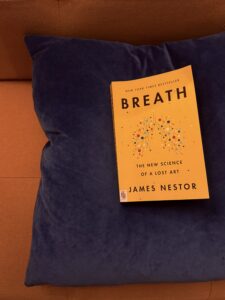
We get a great many things wrong in life. But breathing? That thought had never crossed my mind before I read James Nestor’s Breath. Don’t take this personally, but – statistically speaking – you are probably guilty too: 90 per cent of us breathe incorrectly, exposing ourselves to a host of chronic conditions – asthma, ADHD, depression, burnout, you name it. As Nestor himself suffered from some of these, his doctor sent him to a breathing class. What happened there sent him on a decade-long journey researching the art and science of breathing. The result is a book that changed my life (and not just mine).
Nestor writes with precision and wry humour. He takes nothing at face value and tries everything himself: nasal breathing, “Tummo” (a technique brought to Europe in the 1920s by the Belgian-French anarchist and opera singer Alexandra David-Néel), the methods used by Olympic athletes, and much more. I read it in sheer astonishment – and embarrassed that I know more about the organs of the state than about my own.
I have given the book away countless times, and nearly everyone who receives it passes it on. It is, in the best sense, a snowball system of bodily enlightenment. If it has not yet found its way to you, it is well worth seeking out.
*
The Week on Verfassungsblog
summarised by EVA MARIA BREDLER
It is not only teenagers who struggle to escape the dopamine trap of endless feeds – and not only teenagers who suffer the psychological consequences. A new category of harmful content makes it even worse: since Musk integrated the AI tool Grok into X, vast numbers of sexualised deepfakes of real women and minors have been generated and circulated. How does (criminal) law allocate responsibility here – and how should it? SUSANNE BECK and MAXIMILIAN NUSSBAUM (GER) explore the answers.
++++++++++Advertisement++++++++++++
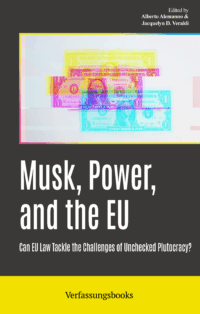
Musk, Power, and the EU: Can EU Law Tackle the Challenges of Unchecked Plutocracy?
Alberto Alemanno & Jacquelyn D. Veraldi (eds.)
“In a viable, participatory democracy, no person, corporation or interest group – no matter how loud, wealthy, or powerful – stands above the law. This collection of important research explores vital, vexing questions of how to defend the rule of law in the European Union against a frontal challenge by oligarchic forces claiming to act in the interest of Western ideals. It is an uncomfortable debate but one that the authors confront with intellectual vigor and admirable European self-awareness.”
– David M. Herszenhorn, Editor at The Washington Post
Get your copy here – as always, Open Access!
+++++++++++++++++++++++++++
Karlsruhe, too, mapped responsibility last week – albeit in a different context. The German Federal Constitutional Court declined on procedural grounds a constitutional complaint brought by a Palestinian living in the Gaza Strip challenging export licences for military equipment to Israel. The detailed order of non-admission was published just in time for the Munich Security Conference and prompted FLORIAN MEINEL (GER) to reflect on pseudo-fundamental rights protection and the constitutional law of hybrid warfare.
Palestine was also before the English High Court. After the Home Office had proscribed “Palestine Action”, the Court has now lifted the ban – to the surprise of many, given the British courts’ traditional restraint in matters of national security. ALAN GREENE (ENG) analyses the dangers of expansive executive discretion and the judgment’s implications for counter-terrorism law.
The hearing on the merits before the International Court of Justice in The Gambia v Myanmar also attracted considerable attention, concluding on 29 January. The focus lay on genocidal intent. But what follows from a genocide judgment? For KHAN KHALID ADNAN (ENG), this is the most difficult question – and it leads him (and us) into the law of remedies.
The United States has not accepted the ICJ’s compulsory jurisdiction for almost 40 years. Now it appears intent on distancing itself more broadly from the UN system. On the sidelines of the World Economic Forum in Davos, Trump announced the creation of a “Board of Peace” as a counter-model to the UN. Europe responded with scepticism, and Merz pointed to constitutional concerns. VALENTIN VON STOSCH (GER) shows that those concerns are far from unfounded.
Perhaps, however, the United States believes it can dispense with peace organisations altogether. After all, Trump declared – just days before Maduro’s abduction – that “we’re protected by a thing called the Atlantic Ocean.” The remark hints at the core idea of the new US National Security Strategy, centred on hemispheric dominance. CARL LANDAUER (ENG) explains how it revives old spheres of influence and fixates on a projected “Western civilisation.”
Trump may not be entirely confident, however. Ahead of the forthcoming midterms, he is now pushing to “nationalise” US elections – despite having no constitutional authority to do so. JOSHUA SELLERS (ENG) warns that the proposal could further erode public trust and fuel disinformation about the integrity of the vote.
Germany, too, is once again debating electoral integrity: the parity debate has returned. While it has regained political momentum, the academic legal discourse appears to have reached an impasse. FABIAN MICHL (GER) explains why a historical perspective may offer a way forward.
History also looms large elsewhere: in December, after 25 years of negotiations, the EU and four Mercosur states reached agreement on the EU–Mercosur Agreement. Now a narrow majority in the European Parliament has asked the Court of Justice to assess its compatibility with EU law. For GESA KÜBEK (ENG), Parliament may have shot itself in the foot, forfeiting important participatory rights.
Participatory rights, by contrast, have been secured for individuals who identify between genders but do not exhibit somatic intersexuality before the Austrian Constitutional Court. The Court has recognised their entitlement to a distinct gender marker – such as “inter” or “diverse” – or to have the entry removed altogether. ELISABETH HOLZLEITHNER (GER) discusses this welcome judgment delivered amid a rather less welcoming debate.
Meanwhile, in her Opinion, Advocate General Ćapeta proposed that the Court annul the Commission’s decision to release EU funds to Hungary that had previously been suspended. In situations of systemic rule-of-law deficiencies, compliance cannot be measured by legislative text alone. For TÍMEA DRINÓCZI (ENG), this approach offers guidance for constitutional reconstruction after illiberal regimes.
To prevent matters from reaching that point in the first place, Germany’s Länder constitutional courts are now to be made more resilient – following the example set by the Federal Constitutional Court in 2024. CHRISTIAN WALTER and SIMON FETSCHER (GER) assess how successfully the Berlin Justice Senator’s current draft achieves this aim.
ANNA LUMERDING and MELANIE MAURER (ENG) analyse the climate complaint with the charming title Fliegenschnee and Others v Austria, which the European Court of Human Rights declared inadmissible.
Finally, our symposium “Reflexive Globalisation and the Law” (ENG) also came to a close. PEER ZUMBANSEN reads disaster law as methodology and considers lawyers responsible for exposing law’s role in rendering this ongoing violence as normal. JULIA ECKERT closes the symposium by exploring the purpose of reflecting on colonial legacies in law.
Thank you for reading this far – despite dopamine-dominated attention spans. We continue to do our best to reduce harmful content (the state of the world does not make it easy, though). Then again, perhaps an endless feed is not such a bad idea after all.
*
That’s it for this week. Take care and all the best!
Yours,
the Verfassungsblog Team
If you would like to receive the weekly editorial as an e-mail, you can subscribe here.