







“NATO Would Be Dead”
Five Questions to Marko Milanović
“Anything less” than U.S. control of Greenland is “unacceptable.” With those words this week, President Donald Trump reignited fears that a U.S. annexation of Greenland could move from rhetoric to reality. As European governments move to reassure Denmark of their support and solidarity, one thing is already clear: if the Greenland annexation scenario were to materialize, nothing would be the same again.
We spoke with Marko Milanović, a professor of public international law and a leading expert on security law and international humanitarian law, about how international law would respond to such a scenario – and what a Greenland annexation would mean for the future of NATO.
1. Let’s begin with some context: why does Greenland hold such strategic importance today – not just for the United States, but for other major powers as well?
Well, there are some genuinely objective reasons. Its geographic position, which was during the Cold War key for nuclear defence. The fact that Arctic ice is melting due to climate change. The fact that there are rare earths and other minerals in Greenland, which are not only valuable as such but also strategically, in that they could lessen dependence on China for these minerals. So there are very good reasons why various great powers, including the US and China, not to mention the EU, would have an interest in Greenland. But, frankly, I think that in the current environment, these reasons are all secondary in explaining the coercive approach of the United States. What explains those policies is the extortionist personal nature of the US president, who has on the one hand developed an idée fixe about the importance of “owning” Greenland and leaving his mark in history as some kind of great figure before whom the world trembles, including by expanding US borders, and on the other hand has managed to so completely neuter his own political party that he can do so many of these things without any kind of internal checks and balances. Plus, he is being enabled by a whole bunch of willing yes-men in his administration. So there we are. We really mustn’t overthink this. All of the objective strategic benefits the US could want from Greenland it could easily get through peaceful cooperation with Denmark and Europe. What we have instead is this kind of mafioso approach.
++++++++++Advertisement++++++++++++

An der Professur für Öffentliches Recht, Wirtschafts-, Finanz- und Steuerrecht (Prof. Dr. Johanna Wolff) am Fachbereich Rechtswissenschaften der Universität Osnabrück sind zum nächstmöglichen Zeitpunkt Stellen für zwei wissenschaftliche Mitarbeiter*innen (m/w/d) (Entgeltgruppe 13 TV-L, 50 %) zu besetzen.
Zu den Aufgaben gehören u.a. die eigenständige wissenschaftliche Forschungsarbeit mit dem Ziel der Promotion und Lehre im Umfang von 2 SWS.
Bewerbungsschluss ist der 28. Januar 2026.
Weitere Informationen hier.
++++++++++++++++++++++++++++++++
2. If we assume the worst-case scenario and imagine a U.S. annexation of Greenland, several overlapping systems of collective security would be implicated – from the UN Charter to EU law and NATO. Could you briefly walk us through which of these frameworks would come into play, and how they would relate to one another?
The worst-case scenario is one of total collapse of the international order as we know it, and in particular of the Western alliance.
First, any US invasion and annexation of Greenland would breach the prohibition on the use of force in Article 2(4) of the UN Charter. Indeed, it would constitute the most severe form of prohibited force – aggression. It would be no different from what Russia did to Ukraine. There is no conceivable justification that the US could offer for such a use of force – for instance, the criteria of self-defence could not apply under any plausible view.
Second, the annexation would also breach the related norm prohibiting conquest, i.e., the acquisition of territory through force. This would equally be the case whether the US did a formal, de jure annexation through an act of Congress, or whether it enacted a series of de facto policies that were tantamount to annexation (the advisory opinion of the International Court of Justice on the legality of Israeli annexationist policies in Palestinian territories usefully sets out the law on this point).
Third, in the eyes of international law any such annexation would be a nullity. Fourth, all of this would also violate the right of the people of Greenland to self-determination.
Fifth, as the victim of a continuing armed attack, Denmark would have the right to self-defence under Article 51 of the Charter. This right is both individual and collective – Denmark would have every right to ask other states to assist it, and all states in the world would have the right to act on the basis of such a request (whether and what they would do is, of course, a different matter). Again, the position would be no different than with regard to Russia and Ukraine.
Sixth, an invasion of Greenland would destroy NATO. I don’t see how that organization could survive – at least not in its present form. There have been some historical tensions between NATO allies, e.g., Turkey and Greece, that could have resulted in war. But the whole point of NATO is to exercise the Charter right to collective self-defence. Article 5 of the North Atlantic Treaty turns the right of every member state to assist the victim of an armed attack into an obligation. And here we would have the most powerful member of the alliance do the exact thing that the alliance was designed to prevent, behaving like an imperial overlord.
Finally, there’s the EU. Article 42(7) of the Treaty on the European Union is similar to Article 5 of the North Atlantic Treaty, in that it creates an obligation of assistance, not just a right. There has been some debate about whether this provision would cover Greenland, because it is an overseas territory that is not part of the EU (the issue is ably explored here). Frankly, as a legal issue this matters little – if EU states are not able to get their act together and push back against the conquest of a member’s territory, we can just forget about European solidarity.
++++++++++Advertisment++++++++++++
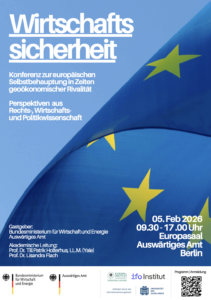
Das Bundesministerium für Wirtschaft und Energie (BMWE) und das Auswärtige Amt laden gemeinsam mit Prof. Dr. Till Patrik Holterhus (ab 1. Februar 2026 Universität des Saarlandes) und Prof. Dr. Lisandra Flach (ifo Institut) zur wissenschaftlichen Konferenz „Wirtschaftssicherheit: Europäische Selbstbehauptung in Zeiten geoökonomischer Rivalität“ ein.
Die Konferenz findet am 5. Februar im Europasaal des Auswärtigen Amts, Berlin statt.
Anmeldung, Programm sowie weitere Informationen finden Sie hier.
+++++++++++++++++++++++++++
3. Within that landscape, NATO looms largest. If the United States were to use force to take Greenland, would this qualify as an “armed attack” on Denmark under Article 5? And how is Article 5 meant to function when the alleged attacker is a member of the Alliance?
Well, what looms largest here is Article 51 of the UN Charter. It is that article, as well as customary international law, that recognizes Denmark’s right to defend itself and the right of other states to assist it. There is no doubt that an invasion, followed by annexation, would constitute an armed attack – this is not some kind of marginal case. Again, every state in the world would have a right to assist Denmark, including through the use of force. Every state would also have the duty not to recognize the situation produced by the US invasion as lawful. What Article 5 of the North Atlantic Treaty does is create a duty to assist. Its drafters never imagined that its most powerful member would start conquering the territory of another member. As a purely legal matter, Article 5 would equally oblige other NATO states to assist Denmark against an American attack as it would against a Russian attack. What that means in practice is obviously a different thing.
4. Since Washington could block any decision in the North Atlantic Council, what options would realistically remain for Denmark and other allies? Some point to the EU’s mutual assistance clause you mentioned, Article 42(7) TEU. How much weight would that clause actually carry in an annexation scenario?
Honestly, we can forget about this. A US invasion would just destroy the very core of the mutual commitments of NATO states. Who cares about the North Atlantic Council from that point? And all of these formalities don’t matter at all. Remember – every state in the world would have the right to assist Denmark, regardless of NATO or EU membership. Even China! The question is whether they would want to do so, and how. The same goes for Article 42(7) TEU. Whether European states would find the strength to group together, support Denmark, and resist American imperialism does not depend one bit on the interpretation of that provision. It is a question of basic political commitment and courage.
5. You’ve said that a Greenland annexation would most likely destroy NATO. Could you elaborate on that a bit – what do you think would actually happen to the Alliance if such an annexation were to occur?
The most likely outcome would be the death of NATO. The alliance would be no more; it would cease to be; it would join the choir invisible; it would be an ex-alliance. There are two possibilities for its nominal survival. The first would be for it somehow to continue limping on until there is a change of administration in Washington, which would then repudiate and provide reparation for Trump’s imperialist policies. However, the breach of trust would have been so drastic that somehow I don’t think this restoration could ever work. And of course this assumes that the next US administration would be saner than Trump’s. The second would be for NATO to transform into the Warsaw Pact and for the (remaining) states in it to become nothing more than American servants. But NATO as we know it today would be dead.
*
Editor’s Pick
by JANA TRAPP
 What we tend to call “urban security architecture” is often little more than organized reaction to violence: more light, more police, more control. Crime is confronted when it becomes visible – but rarely where it originates.
Leslie Kern’s Feminist City turns that perspective on its head. She doesn’t ask how cities should respond to violence, but how they themselves create the very spaces in which fear, insecurity, and assault can take root in the first place.
As a criminal lawyer, I read this book with a kind of electrified unease. Kern weaves everyday experience into a radical thesis: that safety is not chiefly a product of more policing or harsher punishment, but of justice in urban design – from public transport that truly accommodates strollers to public restrooms that are not zones of panic.
Feminist City reveals what many may already suspect in their daily lives: that a just city might, in fact, be the safest kind of all.
*
The Week on Verfassungsblog
summarised by EVA MARIA BREDLER
In German, there is this little saying that every politically minded person knows: Wenn Du nicht mehr weiter weißt, bilde einen Arbeitskreis (“When in doubt, set up a working group”). The meeting between the US, Greenland and Denmark in Washington, intended to ease the Greenland crisis, reached the very same inconclusive end: Trump stubbornly clings to his latest toy. “We agreed to disagree,” Danish Foreign Minister Lars Løkke summed up dryly. Now a “high-level working group” is supposed to find solutions.
Just to be safe, we set up our own high-level working group this week. ALBERTO ALEMANNO (ENG) surveys the many legal questions raised by a possible annexation of Greenland – spanning international law, NATO, EU law, and Danish law. ULLA NEERGARD (ENG) zooms in on the EU: Greenlanders are EU citizens – so Europe must decide whether its solidarity remains mere lip service, or develops into genuine “defence solidarity”. STEVEN BLOCKMANS (ENG) is not particularly optimistic. Instead of banking on EU or NATO cohesion, he argues, Europe should build a coalition of the willing – a European pillar that complements NATO and, if necessary, can act without the United States. After all, the US increasingly pursues geopolitical goals through economic coercion: “It’s geoeconomics, stupid!” ANDREA OTT (ENG) unpacks what this geoeconomic shift means for Europe and how the EU should navigate this “brave new world of geoeconomics”. Our working group is still at work – more fascinating contributions are on the way. You can find them all in our new Spotlight on Greenland.
It is unlikely to be our last Spotlight on Trump’s escapades. On 7 January, Trump ominously announced in a memorandum that the United States would withdraw from 66 international organisations. Sigh. The message has landed, but what will actually change? JEAN GALBRAITH (ENG) traces the practical consequences and explains why the damage will be hard to undo.
What Trump thinks of international law was clear long before the memorandum – but certainly since his cloak-and-dagger abduction of Nicolás Maduro. Why bother with a prohibition on the use of force if you can simply impose your own moral code? CHRISTOPH SAFFERLING (GER) describes how criminal law becomes a stage for redrawing international law’s boundaries, and how international law itself risks degenerating into a little more than a fig leaf for violent regime change.
One almost longs for the days when the permanent members of the UN Security Council merely paralysed the UN – rather than busily dismantling its principles. For ITAMAR MANN (ENG), this makes a reinvention of the UN indispensable: if the Charter can no longer discipline its guarantors, we urgently need institutional imagination.
Meanwhile, constitutional judges in Montenegro are demonstrating remarkable institutional imagination of their own. They are ruling on the end of their own terms in office – effectively able to block the constitutional renewal of the court. How convenient! But dangerous: JANKO PAUNOVIĆ (GER) explains, this jeopardises not not only the court, but the constitutional order itself.
++++++++++Advertisement++++++++++++

Die Universität Kassel, Fachgebiet Öffentliches Recht, IT-Recht und Umweltrecht (Prof. Dr. Gerrit Hornung), sucht zum nächstmöglichen Zeitpunkt:
Wissenschaftliche:r Mitarbeiter:in (m/w/d), EG 13 TV-H, befristet (für 3 Jahre mit der Möglichkeit zur Verlängerung), Vollzeit (teilzeitfähig)
zur Mitwirkung in Lehre und Forschung, insbesondere in einem Projekt zur KI-Regulierung (Aufsicht über KI-Anbieter nach der KI-Verordnung)
Bewerbungsfrist: 30.1.2026; weitere Informationen im Ausschreibungstext.
++++++++++++++++++++++++++++++++
The good news: the last judicial appointment in December 2025 went through, and the Venice Commission of the Council of Europe has issued recommendations for Montenegro’s Constitutional Court. Also in December, the Venice Commission updated a number of its own instruments – notably its Rule of Law Checklist. MARCO LO NARDO (ENG) explains how this tool works, and highlights the most important updates, especially regarding the rule-of-law relevance of major digital platforms.
That relevance is also contested in Taiwan. In December, Taiwan’s Interior Ministry imposed a one-year ban on the Chinese social media platform Xiaohongshu (Rednote), which has become a key source of information for young people in particular. How can cybersecurity and freedom of expression be reconciled? YINN-CHING LU and SHAO-KAI YANG (ENG) offer some answers.
Later this year, parliamentary elections will be held in Hungary and Israel – two countries that are becoming increasingly autocratic and close allies of Trump. GÁBOR HALMAI (ENG) explains what the prospects for democratic and constitutional regeneration in both states depend on.
Ecological regeneration, too, depends on the rule of law. Unlike the Federal Constitutional Court, the Bremen Constitutional Court has now recognised the climate crisis as an “exceptional emergency”, thereby paving the way for debt-financed climate protection compatible with the debt brake. EMMANUEL SCHLICHTER (GER) analyses the judgment and its implications.
Military conscription is also designed for exceptional emergencies. After intense debate, France and Germany have decided against reintroducing compulsory national service. Instead, both are turning to new voluntary military schemes while developing structures that could support conscription if needed. ARNE WEGNER (GER) explores under which conditions these hybrid models can be viable in peacetime.
++++++++++Advertisement++++++++++++

Die Universität Greifswald, Rechts- und Staatswissenschaftliche Fakultät, Lehrstuhl für Strafrecht, insb. Medizinstrafrecht, Strafprozessrecht und Rechtsphilosophie _(Frau Prof. Dr. Grischa Merkel), sucht zum 01.04.2026:
Wissenschaftliche*r Mitarbeiter*in (m/w/d), EG 13 TV-L Wissenschaft, Teilzeitbeschäftigung (50 v.H.), befristet für die Dauer von 3 Jahren,
zur Mitwirkung in Lehre und Forschung sowie Unterstützung der Organisation und Selbstverwaltung des Lehrstuhls. Die Stelle dient der Qualifizierung in der ersten Qualifikationsphase.
Bewerbungsfrist: 06.02.2026; weitere Informationen im Text.
++++++++++++++++++++++++++++++++
Two major decisions have kept us occupied this week. One is Europa Way S.r.l. v. Italy, in which the ECtHR for the first time required national courts to set aside laws that violate EU law. CASPER VANSPAUWEN (ENG) explains how the judgment better aligns the EU and ECHR systems.
The other is Egenberger. While HEIKO SAUER saw it as a “course correction in European constitutional law”, BENEDIKT RIEDL (ENG) stresses that ultra vires review remains indispensable: the solution is not less review, but institutionalised review.
HANS MICHAEL HEINIG and FRANK SCHORKOPF (ENG) consider Egenberger both smart and balanced: the Federal Constitutional Court “neither fossilised ecclesiastical labour law and abandoned its established case-law, nor initiated a trial of strength with the European Court of Justice or denied the primacy of EU law.”
MARTIJN VAN DEN BRINK (ENG) concludes the symposium “In Good Faith: Freedom of Religion under Article 10 of the EU Charter”. In his contribution, he criticises the CJEU’s case-law on religious dress for discriminating against Muslim women.
When all else fails, we can still place our faith in international law, in higher powers, in better people in power, or in a really, really good working group.
*
That’s it for this week. Take care and all the best!
Yours,
the Verfassungsblog Team
If you would like to receive the weekly editorial as an e-mail, you can subscribe here.