






Nice, Peaceful Days
At the End of a Year Full of Horrors
What is there to say about 2025? The less, the better. To recapitulate all the grim highlights of this year, as one would normally expect of an end-of-year editorial, feels inappropriate to me. Not because I can’t take it anymore and just want some peace and quiet, assuming the same of you. But because there is a powerful and dangerous pull exerted by the relentless doom and gloom – the endless predictions and diagnoses of disaster that have relentlessly filled news outlets and social-media feeds all year. Nothing gets better if we all end up mentally unwell.
“Last summer in peace”: I’ve learned that this phrase circulated among Polish and Baltic students in the summer of 2025. To me, it sounds neither cynical nor fatalistic, but refreshingly alive – precisely because it harbours no illusions. The best antidote to despair is still a clear, open and unsparing look at the world around us and at what may be coming.
This year, we carried out the Judicial Resilience Project. In dozens of conversations, we asked officials working in the judiciary what comes to mind when they start thinking seriously about the question: what happens if they are coming for us? We developed scenarios of what it might look like if authoritarian populists were to put their strategy into practice and close in on the independent judiciary. My deep respect and thanks go to Friedrich Zillessen, Anna-Mira Brandau, Lennart Laude, Juliana Talg, Etienne Hanelt, Emma Bruhn, Janos Richter, Jakob Weickert, Sophie Sendrowski, Jonathan Schramm, Annika Perlebach, Zita Nogrady and Vincent Kühler, who made this project happen (and most of whom had already worked on the Thuringia Project before). My sense is that all of them emerged stronger from this experience – just like the people in the judiciary they spoke with.
++++++++++Advertisement++++++++++++
Research Fellow in Rule of Law, Accession and European Security
The Bingham Centre for the Rule of Law at BIICL is seeking a skilled and motivated Research Fellow to contribute to a strategic programme exploring the relationship between rule of law standards, European Union (EU) accession processes, and the evolving security challenges in Europe.
For full details of the role, person specification and application process, please visit our recruitment portal at: https://hr.breathehr.com/v/research-fellow-in-rule-of-law-44353 .
It is expected that interviews will take place in late January 2026.
++++++++++++++++++++++++++++++++
I am equally grateful to all the individuals and institutions whose donations made this project, and indeed the work of Verfassungsblog as a whole, possible. As an organisation, we have taken a huge step forward (thank you, Schmid Foundation and Robert Bosch Foundation!) – in management, HR, finance and communications, and in our ownership structure. We are more professional, more effective and more efficient than before. Our reach has grown dramatically: 3.5 million visits to our website, almost a million more than last year (and some of them from the International Court of Justice). We further developed our blog symposia and published twelve Verfassungsbooks, many of which sparked strong responses both in academia and beyond. My special thanks go to my long-time companion Evin Dalkilic, who played a crucial role in building Verfassungsblog as a publisher and as a voice in the open-access landscape – and who is now, after seven intense, adventurous and exhausting years, setting off for new horizons.
We are heading into the new year stronger, more resilient and – yes – more hopeful than we were a year ago. We will continue to make public what is known, and what needs to be known, about the state and future of democracy, the rule of law and human rights. Text by text – and soon also in a new design, on a cleaner, more functional and more modern website (finally!). We will continue to invest in developing scenarios and preparing for the strategies of institutional abuse through which authoritarian populism seems to be gaining power at an alarming pace. Next, we will turn our attention to knowledge institutions – universities and the media – and to their specific vulnerabilities. We will prepare for the state elections in Saxony-Anhalt and Mecklenburg-Western Pomerania, and for the possibility that the AfD may soon exercise executive power in those states. We will not be intimidated. We will resist the temptation to retreat into comforting fictions, identitarian nostalgia, escapism, denial, exclusion and hatred. We will equally resist the pull of despair. We will stay with this world and everything that happens in it: its beauty and its violence, including the harms for which our own country, our own government, and we ourselves bear responsibility. We will keep looking, keep asking, keep thinking. Eyes open, backs straight.
In that spirit: happy holidays! Let’s enjoy the time ahead. I mean it.
P.S.: None of this would be possible without your donations, of course. Please follow this link.
P.P.S.: The editorial now pauses for the holidays. We’ll be back on 9 January.
*
Our Favourite Pieces of 2025
Boredom is a scarce resource. We’re already looking forward to the days when, after one mulled wine (or two), we can simply watch the fire in the fireplace burn for hours on end. But, as with any resource, overdosing is never a good idea. To spare you an intoxication during our Christmas break, we’ve put together our favourite texts of the year for you.
MAXIM BÖNNEMANN
Much of what we do revolves around law: texts, norms, and the force of the better argument. This focus is very reasonable, but it can also obscure the fact that political communities often seek meaning beyond reason and rational discourse. For decades, PAUL W. KAHN has written about these blind spots in liberal theory. This year, he made his debut on Verfassungsblog with a piece on faith and violence in the United States. The secular US constitutional project, he argues, has always been a political-theological one. But as its appeal wanes, Christian nationalists are now moving to the centre of politics. Their message is not one of love, but of violence: “America’s civil wars are not yet done.” Dark reading – but anyone who wants to counter the promises of authoritarianism must first understand their appeal.
EVA MARIA BREDLER
What do we do when the law is crumbling in our hands? It’s a question we’ve all been grappling with for years, but this year it’s been particularly acute. I’ll spare you the depressing annual review – you’ve witnessed it all. Instead, let me invite you to read ITAMAR MANN’s answer. Even if the title doesn’t sound particularly uplifting, he manages to choreograph a dance of animals “in the graveyard of international law” that makes me believe, once again, in its resurrection. For a successful performance, we need ostriches (who keep their heads deep in the international legal sand), owls (who, wise with age, recognise the problems and dream of a better law) – and, crucially, octopuses (who, serious yet playful, imagine and apply the law in entirely different ways). Which one(s) are you?
CHARLOTTE HERBERT
In my year as a digital editor, I have read and learned a great deal about transatlantic dependencies – by 2025, “digital sovereignty” had become an omnipresent buzzword: its absence is blamed for almost all of today’s technical, digital, and geopolitical ills. Dusty Europe meets thriving private companies, foremost among them Starlink.
In my favourite text of the year, Alina Utrata untangles the threads between state efforts toward digital independence, the growing political power of private companies, and private control over critical infrastructure. She examines the historical continuity of dependency between states and corporations – from imperial trading companies to modern cloud providers – all without losing the necessary dark, English-style sarcasm.
Frank but entertainingly, she argues that private companies must finally be recognised as political actors – and calls for nothing less than their democratisation: “CEOs should no longer be allowed to run their companies as petit-monarchs.”
JASPER NEBEL
Reading groups can be tricky – one person forgets to read, another doesn’t like the book, and before you know it, the reading group is a thing of the past. Now imagine that, for once, everything is going great – until the intelligence agency shows up and says: “Nope, your reading group is unconstitutional.”
That’s what happened in Hamburg. The intelligence agency office in Hamburg listed a Marxist reading group as unconstitutional in its annual report. And in its ruling, the Hamburg Administrative Court likewise casts doubt on Karl Marx’s loyalty to the constitution. BRUNO LEIPOLD took a closer look at the whole affair – and dismantles the ruling with scholarly precision. Meticulously, Leipold examines every sentence of the judgment, uncovers blatant misunderstandings, points out the non-diversity of sources (the court cited – if at all – only a single source), and arrives at the unsurprising conclusion: “Ironically, the judges of the Hamburg Administrative Court would benefit from a Marx reading group to better participate in just such a debate.”
++++++++++Advertisement++++++++++++
We are delighted to announce that our next Max Planck Masterclass with Dr. Ana Bobić is now open for applications (deadline 22 March).
The Masterclass on “Hegel and EU law” will take place on 26 – 29 Mai 2026 at the Max Planck Institute for Comparative Public Law and International Law in Heidelberg, Germany.
More information can be found here.
++++++++++++++++++++++++++++++++
MAXIMILIAN STEINBEIS
Are scholars who use their authority and expert status to protest against authoritarian and illiberal politics compromising their scholarship? “Scholactivism” is the keyword under which this debate is being conducted. One of those who have spoken out particularly vehemently against activist scholarship is the Prague-based EU law scholar (and contributor to Verfassungsblog since 2012) JAN KOMÁREK. In the spring, while he was preparing for a fellowship at NYU, he felt the time had come for a gesture of resistance: in his VB Editorial of 4 April, he explicitly and publicly went on record with his views on Donald Trump and US policy towards Israel and Gaza – as an inspiration for other scholars who feel tempted to censor themselves out of fear for their entry visa, and as “an act of self-protection of my own dignity, since I may not have the courage to say these things when (and if) I enter the U.S. in the fall. … I have yet to apply for my J1 visa. If I am denied, I will know why. But I will not participate in the act of submission that Trump and his people demand of all of us who wish to come to the United States as we knew it before their unconstitutional coup.”
JANA TRAPP
There are texts that strike so precisely at one’s unease that their clarity almost startles: suddenly, what was blurred comes into focus, and what was only dimly felt finds its words. This is one of them. With surgical precision and an unfailing radar for self-serving nonsense, CHRISTINE MORGENSTERN lays bare a criminal policy in which the state’s “protection against violence” is framed in tellingly punitive terms. Her analysis shows how feminist criminology treads the fine line between carceral feminism, migration policy, and authoritarian temptation — and reminds us that nuance is not the luxury of coddled liberals but a democratic necessity: a way to redeem clarity from confusion. For me, this piece is a compass amid the tempests of criminal policy — offering precision where others trade in slogans.
JAKOB GAŠPERIN WISCHHOFF
The full-scale invasion of Ukraine by Russia over the past nearly four years has shaped political shifts and changes in Europe and beyond. NATO capabilities in Europe, strained transatlantic alliances with unfriendly tariffs, and a renewed awareness of the need for strong and independent European foreign and security policy are all consequences of the requirements of these new realities. One of the issues still occupying European politicians and EU institutions is the frozen Russian funds. ANTON MOISEIENKO, in one of my favourite pieces this year, soberly situates the issue within a legal and political perspective – clear and straightforward.
*
Editor’s Pick
by CHARLOTTE HERBERT
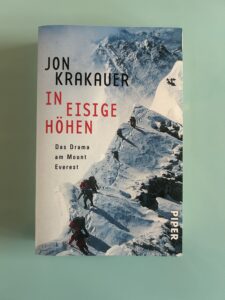
White Christmas is a rare phenomenon in Germany – a wishful scenario which now seems even less likely than Friedrich Merz managing an international trip without a scandal. On the Zugspitze, Germany’s highest mountain, temperatures are expected to reach seven degrees today; I’ve traded my coat for a denim jacket, and if you look closely, you can already spot the first baby crocuses pushing their way through the asphalt.
In this decidedly un-Christmassy mood, even several overly hot mulled wines offer little resistance, so I recently returned to my favourite (winter) book: Into Thin Air. Jon Krakauer recounts how, in 1996, he set off as a journalist with a small group to climb Mount Everest – an experience still relatively exclusive at the time. As Krakauer reveals right at the beginning of the book, the expedition is caught in a fierce storm which not all of them will survive. Krakauer himself gradually loses his grasp on reality at the summit due to the cold and lack of oxygen. With remarkable intensity, he captures both the chaos unleashed by nature’s ruthlessness and the absurdity and hubris of those who convince themselves they can master it.
An absolute reading recommendation for anyone looking to curl up over the holidays, to learn to appreciate those five degrees of drizzle they had been cursing just moments before – or simply in need of a book that reliably distracts from the strains of family Christmas.
*
The Week on Verfassungsblog
summarised by EVA MARIA BREDLER
As a child, the end of the year was a time of “Dezemberträume”. These days, it feels more like December fever –quite literally. Here in the editorial team, we’re taking turns being ill. But also metaphorically: everyone seems determined to reach their 2025 goals within the last few weeks, giving it all, doing burpees, working through the night. A pre-Christmas pressure cooker for us – but a reading feast for you. Here we go:
For weeks, the debate revolved around whether frozen Russian state assets could be used to secure a loan for Ukraine. Today, an agreement has been reached on a €90 billion loan – for now without directly tapping those frozen Russian funds. Still, the question remains relevant for the future. SIMON GEIERSBACH (GER) argues that even frozen assets can be used, and explains why an EU reparations loan to Ukraine could be both legally and fiscally sound.
This week, the EU also wrapped up another contentious issue just in time for Christmas. On Tuesday, the European Parliament adopted the controversial Omnibus I package, reshaping the CSDDD – and, by extension, Germany’s Supply Chain Act. DANIEL SCHÖNFELDER and MICHAELA STREIBELT (ENG) summarise the most important practical changes for companies, particularly with regard to reporting and transparency obligations.
Transparency was also at the heart of the EU’s Digital Services Act. Article 40 opens up platform data for researchers – but for whom exactly? DAPHNE KELLER (ENG) argues that everything hinges on how “publicly accessible” data are interpreted, and makes the case for a broad reading to fulfil the DSA’s transparency goals.
In early December, the European Commission issued its first DSA decision, criticising X’s blue tick as allegedly misleading. For MARC ANDRÉ BOVERMANN (ENG), this misses the platform’s deeper structural problems and does little to rebuild trust.
Speaking of trust: TOMMASO PAVONE, SILJE SYNNØVE LYDER HERMANSEN and LOUISA BOULAZIZ (ENG) draw on a new dataset of almost 7,000 ECJ rulings from 1962 to 2016 to analyse whether the Court protects the weak or the powerful more often. Their finding: individuals win more frequently than companies – in part because the ECJ actively offsets resource asymmetries.
Questions of power shifts also lay at the heart of the German Federal Constitutional Court’s Egenberger judgment. For HEIKO SAUER (GER), it marked a turning point in European constitutional law. BENEDIKT RIEDL (GER) disagrees: even if Karlsruhe avoided open conflict with the ECJ this time, ultra vires review remains indispensable.
++++++++++Advertisement++++++++++++
Over the course of a year, Are We Europe, together with 28 journalists from over 15 EU countries, explored what it means to have your fundamental rights protected in the European Union (EU) today. The result is FOCUS, a digital and print publication which seeks to raise public awareness of the Charter of Fundamental Rights of the European Union (the Charter), its value, and its potential for broader application in day-to-day life. Telling stories that highlight the Charter’s workings – and shortcomings – is a key part of that.
Find out more at focus.areweeurope.eu and buy your print magazine at https://archive.areweeurope.com/store/p/focus-magazine/ .
++++++++++++++++++++++++++++++++
The Federal Constitutional Court also dealt with press freedom: Der Spiegel was allowed to name suspects in its reporting on Wirecard, as the Court has now confirmed. LIAM DRAF and GUNNAR DUTTGE (GER) warn that this weakens personality rights and exposes those concerned to the risk of public pre-judgment.
A very literal form of public pre-judgment is currently unfolding in the United States, KAI AMBOS (ENG) observes with concern. The US government has sanctioned the (then) Chief Prosecutor of the International Criminal Court and ICC judges for pursuing proceedings against Trump allies. “The US sanctions policy thus proves to be not only an attack on the ICC, but an attack on the law itself.” Ambos explains the far-reaching effects of these sanctions – and why the EU must now respond.
Judicial independence is also under threat in Romania. On Monday, the ECtHR ruled in Danileț that judges cannot, in principle, be disciplined for publicly defending the rule of law. IURIE PATRICHEEV (ENG) welcomes the judgment as a timely intervention and explains what it means for Romania’s strained judiciary.
Unfortunately, the ECtHR itself is increasingly under pressure. More and more member states are threatening to withdraw from the ECHR – particularly over migration policy. Last week, Council of Europe ministers met to discuss how migration-related issues under the Convention might be recalibrated. JASPER KROMMENDIJK and LINA SOPHIE MÖLLER (ENG) analyse the December meeting, internal divisions among states, and the implications for the Court.
Poland, too, is now flirting with an ECHR exit – under none other than former pro-European Prime Minister Donald Tusk. His rhetoric increasingly echoes that of Viktor Orbán, even though Poland was once seen as a beacon of democratic resilience and recovery. WOJCIECH ZOMERSKI (ENG) sounds a warning: no political force is immune to the temptations of populism – not even those that claim to save us from it.
In Germany, many hope to fend off populism by banning the AfD. JOHANNES MAURER and NIKLAS SPAHR (GER) point to an alternative: under Article 21(3) of the Basic Law, even large parties like the AfD can be excluded from state funding.
Berlin, meanwhile, will have to tread more carefully when it comes to cutting off public funding: according to the Federal Constitutional Court, the city has underpaid many of its civil servants. SINAN KURT (GER) explains why this issue will continue to matter far beyond Berlin.
++++++++++Advertisement++++++++++++
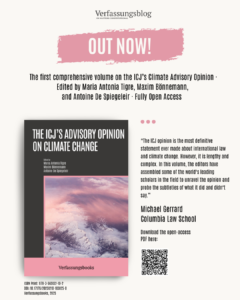
The ICJ’s Climate Advisory Opinion is one of the most significant developments in international climate law. This new volume shows why – and explores its implications for global climate governance.
Get your free copy here: https://verfassungsblog.de/book/the-icjs-advisory-opinion-on-climate-change/
++++++++++++++++++++++++++++++++
Just before the year draws to a close, we launched two new symposia.
The first asks: “Who owns science?” –and who should? Although knowledge is, in principle, a public good, access to academic publications and infrastructures is constrained by economic and legal structures. Between commercial publishing models, public funding, and community-driven open-access initiatives, fundamental questions arise about ownership, responsibility, and academic independence. The symposium emerged from the project “Acquisition Logic as a Barrier to Diamond Open Access”, funded by the German Federal Ministry of Research, Technology and Space. EVIN DALKILIC (ENG) opens the debate by arguing that the “open access revolution” has failed to deliver on its promises –but that all is not lost. Why we should rely on amateurs, and what Sputnik 1 has to do with the journal crisis, she explains in her contribution. Against this backdrop, the past and present are marked by state information control, censorship, and disinformation. For nationalist governments, PAUL T. JAEGER (ENG) writes, the internet amplifies their ability to marginalise and dehumanise minorities and political opponents.
Our second symposium, “In Good Faith: Freedom of Religion under Article 10 of the EU Charter” (ENG), examines the latest significant developments from an EU perspective, placing freedom of religion at the centre of analysis and critically assessing its operationalisation and interpretation in light of the EU Charter. JAKOB GASPERIN WISCHHOFF and TILL STADTBÄUMER kick off the debate. ERICA HOWARD argues that the CJEU’s approach in the headscarf cases overemphasises neutrality and neglects the intersectional dimension of the headscarf cases. Given the CJEU‘s narrow reading of religious freedom, ANDREA PIN warns that the CJEU, in the name of neutrality and anti-discrimination, risks undermining religious freedom – especially for Muslim minorities – while ignoring diversity across Europe. Conversely, RONAN McCREA argues that the Court’s deferential approach in workplace discrimination cases is wise in light of rapid religious change in Europe. Now that Austria has banned headscarves in schools for girls under 14 (again!), MICHAEL LYSANDER FREMUTH highlights how this may protect the girls‘ autonomy, prevent segregation, and promote integration and gender equality. For PETER BUSSJÄGER, however, the headscarf ban itself produces stigmatisation.
There are more great pieces to come in both symposia. For now, though, you’ll have to explore them on your own until we return from the Christmas break on 9 January. Think of it as an extended Advent calendar, with a new door to open every day. A bit like Rolf Zuckowski: “Christmas – what was that again? Think quickly, think it through. The memory will surely come alive again in your heart.” Ah, December dreams.
And with that: happy holidays – and merry everything!
*
That’s it for this week. Take care and all the best!
Yours,
the Verfassungsblog Team
If you would like to receive the weekly editorial as an e-mail, you can subscribe here.