






Shaista Suhrawardy Ikramullah
From Purdah to Parliament
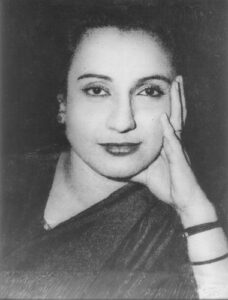
Begum1) Shaista Suhrawardy Ikramullah was a seminal figure in the 20th-century landscape of South Asian and international politics. Her life unfolded at the intersection of private transformation and public upheaval. Born into a family shaped by both Islamic tradition and colonial modernity, she moved between seclusion and Western education before emerging as a scholar, writer, politician and diplomat. She played a role in the formation of Pakistan, the conclusion of the Universal Declaration of Human Rights and the Genocide Convention, as well as in the literary exploration of these political events and the cultural changes of the time.2)
Between Tradition and Colonial Modernity
Born in Calcutta on 22 July 1915, Shaista Suhrawardy Ikramullah belonged to a distinguished family that synthesized Islamic traditions with Western professional advancement. Her father, Hassan Suhrawardy, was a physician working for the East India Railway Company and a committed anglophile who sought to bring his family into the modern age. Because of his job, the family often lived in railway colonies designed after European suburbs and predominantly inhabited by British people. Conversely, her mother, Begum Sahibzadi Shah Banu, belonged to the landed gentry of the former Mughal court in Bengal, maintaining the strict culture of purdah: the seclusion of women from the public gaze by means of screens, curtains, high walls, concealing clothing and by segregating women from men in society. This upbringing created what Ikramullah described as a “dual pattern” of education. On the one hand, she attended kindergartens intended for the children of British colonialists, was looked after by British governesses and thus learned English at an early age. On the other hand, she received a more traditional education through homeschooling and lived under strict purdah from the age of nine. She moved effortlessly between these two worlds.
Despite early family resistance to her formal education, she graduated from the University of Calcutta in 1933 with a Bachelor of Arts degree in English literature. Just a few days later, she married Mohammed Ikramullah as arranged by her parents.
Because of her husband’s job – he worked for the Indian Civil Service – her father and husband agreed that she needed to accompany him to mixed social events. Thus, she left the custom of purdah, an experience she initially found distressing as she felt embarrassed by being looked at by hundreds of men.
Her husband’s job was also the reason why the family moved to London in 1936. Ikramullah felt freer than ever and was able to continue her education. In 1939, she achieved a historic milestone as the first Muslim woman to earn a PhD from the University of London. Her doctoral thesis, Development of the Urdu Novel and Short Story, provided a critical survey of South Asian literature, analysing the shift from static tradition to a realism influenced by Western contact.
Entering the Political Arena: The Pakistan Movement
In 1939, Ikramullah, her husband and their three children returned to the British Raj, which then extended over almost all present-day India, Pakistan, Bangladesh and Myanmar. They found themselves in a region where tensions between Islam and Hinduism were mounting. Ikramullah noted that the divide between Hindus and Muslims had widened compared to three years earlier, when they had left the city of Delhi. These rising communal tensions catalysed her political awakening. Initially not very interested in politics, she was drawn into the Pakistan Movement, which campaigned for the creation of Pakistan as an independent Muslim homeland in the predominantly Muslim regions of the former British Raj. The greatest influence on her in this regard came from Fatima Jinnah and her brother Muhammad Ali Jinnah, who later became Pakistan’s first Governor-General.
In 1942, she co-founded the Muslim Women’s Students Federation and was appointed its first convener, arguing that the demand for a separate Muslim state was an assertion of an independent religious and cultural existence. During the violent Partition of the British Raj in 1947, Ikramullah transformed from a society woman into a dedicated social worker. As her family home in Calcutta became a refugee centre, she worked tirelessly to feed survivors and inoculate refugees against cholera. This experience solidified her commitment to the foundational ideals of the new state.
Amidst these events, her father died of an illness. Ikramullah and her cousin had previously decided to take him to a local hospital, even though the family were against it, as the staff were predominantly Hindu. Ikramullah found that the entire hospital staff treated them with the utmost kindness, consideration and compassion – she did not confuse politics with people.
Framing a New Nation: The Constituent Assembly
After the British had left India in February 1947 and Pakistan was granted independence from India in August 1947, comprising what is now Pakistan and Bangladesh, but excluding the region of Kashmir, the most vibrant phase of Ikramullah’s public life began. She was an active member of the Red Cross, the Anti-Tuberculosis Society, UNICEF, a founding member of the All-Pakistan Women’s Association and of PEN in Pakistan. Moreover, she was elected as one of only two women to the first Constituent Assembly of Pakistan, the parliamentary body responsible for day-to-day lawmaking and the drafting of Pakistan’s constitution. In this role, she championed the representation of her Bengali constituency, the rights of religious minorities, and the legal status of women. Her primary legislative victory was the Muslim Personal Law of Shariat (1951), which drew on Islam to grant women full inheritance rights that went beyond those provided for under customary practices.
Ikramullah felt she was ‘on trial’ during her time at the Assembly: the delicate balance between her career and her family life put her under considerable pressure. And yet, she refused to let her male colleagues take the wind out of her sails. When Prime Minister Liaquat Ali Khan dismissed her support for the proposal that Parliament should sit alternately in Karachi (present-day Pakistan) and Dhaka (present-day Bangladesh), saying, “Women never understand the practical difficulties,” she retorted, “If we had, we would not have Pakistan today.” Yet despite these difficulties, Ikramullah was determined to embark on the “new road […] in which one could taste the joys of achievement as well as the bitterness of failure, to know both hope and fear, disillusionment and attainment”, as it was undoubtedly a “richer, fuller and more rewarding way of life”.3)
The Universal Declaration of Human Rights
“The ideas emphasized in the Declaration of Human Rights are far from being realized, but there is a goal, to which those who believe in the freedom of the human spirit can try to reach.”4)
In addition to her role as a national politician, she was also appointed as a delegate to the United Nations in 1948, where she represented Pakistan in the Third Committee of the General Assembly. This placed her at the centre of the debates surrounding the Universal Declaration of Human Rights. Alongside other non-Western women delegates like Hansa Mehta and Minerva Bernardino, she challenged the gender-biased “Rights of Man” discourse, arguing that such language could be used by states to restrict women’s liberties. Ikramullah was a pivotal voice in the revision of Article 1, insisting that the phrase “all men are born free and equal” be replaced with “all human beings” to ensure women were not excluded by implication.5) In the contentious deliberations on Article 16, she championed equal rights in the private realm, specifically regarding marriage and divorce. She argued that the Declaration must protect women from child marriage and guarantee their dignity and property rights after the dissolution of marriage.6) While Saudi Arabia abstained from voting for the Declaration on religious grounds, Ikramullah argued that its tenets were entirely compatible with her faith. She strategically employed Quranic principles to advocate for progressive legal standards.
The Genocide Convention
“We cannot today sit in the comity of nations and behave in the accepted international manner and yet in our domestic matters (if it suits us) revert to barbaric practices and refuse to give an explanation of our conduct on the score of it being an internal matter.”7)
Ikramullah was also temporarily a member of the Fifth Committee of the General Assembly, which was responsible for drafting the Convention on the Prevention and Punishment of the Crime of Genocide. In this context, she was a strong advocate for establishing an international court or tribunal with the power to impose sanctions on those who violate the Convention. She also campaigned for cultural genocide to be explicitly recognised and prohibited. Against the backdrop of her experiences with the conflict between the Muslim and Hindu populations in her home region and her commitment to the protection of minorities, she dismissed the argument that cultural genocide is not as terrible as physical genocide, remarking that anyone who says such a thing clearly has no experience of such atrocities. To her regret, neither of these aspects was included in the Convention. Nevertheless, she believed that both the Convention and the Declaration represented a significant step forward.8)
Ikramullah returned to the UN General Assembly in 1956 as the head of Pakistan’s delegation and 1982 as a delegate. In between, in 1964, she was appointed Ambassador to Morocco, making her the first woman to serve as a diplomat of that rank for Pakistan and the first female ambassador received by the Moroccan kingdom.
The “Voice of Conscience”
Beyond her political and diplomatic career, she was a prolific author whose works sought to bridge the cultural gap between East and West. Her autobiography, From Purdah to Parliament (1963), remains a vital record of her transition from seclusion to the global stage. She also wrote Letters to Neena (1951), in which she addresses the fears and accusations levelled at Muslims in India and Pakistan through a series of open letters to Indians, embodied by the character of Neena. In it, she strongly criticises the situation in Kashmir. The northernmost region of the Indian subcontinent was predominantly Muslim but joined India following a decision by the then non-Muslim ruler during the partition of India, a move that led to the First Indo-Pakistani War. In Behind the Veil (1953), which, unlike Letters to Neena, focuses not on Pakistani politics but on culture, she explores the traditions of the late Mughal period and sets out to refute Western myths about the “dull and drab”9) lives of Muslim women.
When East Pakistan seceded in 1971, this saddened her deeply, as it had been her constituency at the time and she had fought for the rights of East Pakistanis in the Constituent Assembly. By 1971, she had withdrawn from active politics. Nevertheless, she remained an unflinching critic of military rule and a “voice of conscience” for her nation until her death on 11 December 2000. Posthumously, she was awarded the Nishan-e-Imtiaz, Pakistan’s highest civilian honour.
Further Readings
- Rachel Fell McDermott et al. (eds.), Sources of Indian Traditions: Modern India, Pakistan, and Bangladesh. 3rd ed., Columbia University Press, 2014.
- Muneeza Shamsie, And the World Changed: Contemporary Stories by Pakistani Women, Feminist Press at CUNY, 2015.
- Bonnie G. Smith (ed.), The Oxford encyclopedia of women in world history. New York ; Oxford University Press, 2008.
References
| ↑1 | Honorific title from Central and South Asia. On the Indian subcontinent, it was used by Muslim women of high social status, accomplishment or rank. |
|---|---|
| ↑2 | The portrait is based primarily on Shaista Ikramullah’s autobiography ‘From Purdah to Parliament’ (The Cresset Press, 1963) and the article “‘From Purdah to Parliament’ – The Twentieth Century According to Shaista Ikramullah” by M. Reza Pirbhai, Journal of Women of the Middle East and the Islamic World 14 (2016) pp. 278–309, which is why repeated references to these two sources have been omitted. |
| ↑3 | Shaista S. Ikramullah, From Purdah to Parliament 167 f. |
| ↑4 | Ibid. 192. |
| ↑5 | Rebecca Adami, Women and the Universal Declaration of Human Rights (Routledge 2019) 114. |
| ↑6 | Ibid. 134. |
| ↑7 | Shaista S. Ikramullah, From Purdah to Parliament 191. |
| ↑8 | Shaista S. Ikramullah, United Nations Discussion on Human Rights and Genocide, Pakistan Horizon Vol. 1 Nr. 4 (1948) 228, 231 ff. |
| ↑9 | Shaista S. Ikramullah, Behind the Veil: Ceremonies, Customs, and Colour (Oxford University Press 1992) 95. |