






“A Perfect Constitutional Storm”
Five Questions to Ming-Sung Kuo
Taiwan’s situation is getting more precarious. During Trump’s China visit, he publicly described approved arms sales to Taiwan as a “bargaining chip” with Beijing, while Xi Jinping warned Trump of “clashes and even conflicts” if the Taiwan issue were not handled properly. But also internally, Taiwan is facing conflict: on Wednesday, Taiwan’s Legislative Yuan voted on a motion to impeach President Lai Ching-te. The KMT and TPP, which lead the opposition in parliament, accused Lai of undermining the constitutional order. The motion fell short of the required two-thirds majority, as expected, but it is symptomatic of a deeper crisis: a protracted conflict between the executive and the legislature, a deadlocked Constitutional Court, and a polarised society. We asked Ming-Sung Kuo, a Reader in Law at Warwick Law School, how Taiwan is navigating this moment.
1. After Trump’s summit with Xi in Beijing last week, the US President declared he was “not looking to have somebody go independent” on Taiwan and left a pending $14 billion arms package in open-ended uncertainty. What is the public mood in Taiwan after the Trump-Xi meeting right now?
Generally speaking, the public mood in Taiwan is gloomy and mixed with feelings of anger and disappointment. A distinction can be further drawn between politicians and the public, though. It is also worth noting that President Trump’s remarks concerned two related but distinct issues: the US position on Taiwan’s political status and the US continuing support of Taiwan in the face of China’s military threat through arms sales. His suggestion that the pending $14 billion arms deal is now “a very good negotiating chip” in his dealings with China is an obvious deviation from one of the Six Assurances Ronald Reagan communicated, via his envoy in Taipei, to the Taiwanese government in 1982 after the signing of the August 17 US-China Communiqué. Despite the 1982 Communiqué’s reference to the United States intending gradually to reduce its sale of arms to Taiwan, Taiwan was assured that the United States had not agreed to consult with China on US arms sales to Taiwan under the Six Assurances. Trump’s further denigration of the 1982 Six Assurances as something in “a big, far distance” is even more alarming and damaging, although the government put up a “keep calm and carry on” front, maintaining that it had been kept posted on the US-China negotiations. I should also note that the public mood uplifted a bit at Trump’s suggestion that he would soon speak to President Lai Ching-te on the arms deal but is again dampened by a US official’s confirmation before a Senate hearing that the US is now ‘doing a pause’ on the pending $14 billion arms package.
With respect to Trump’s remarks that “I’m not looking to have somebody go independent”, the reaction has been different. It divides along the party line, reflecting Taiwan’s societal polarization. Supporters of the ruling party, the independence-leaning Democratic Progressive Party (DPP), are disappointed, although the government has strenuously insisted that it has been assured that the US policy on Taiwan remains unchanged, and that its policy of defiance against China was only to maintain the status quo of the Republic of China – Taiwan’s official name – on Taiwan as a sovereign independent nation, instead of seeking Taiwan’s de jure independence. In contrast, the pro-unification opposition and its supporters have cheerfully received Trump’s stern message and interpreted it as a blunt warning against President Lai and the DPP government. It is worth noting that the DPP and the opposition have long traded accusations that the other side has tried to change Taiwan’s status quo as a self-governing constitutional democracy without amending the Constitution, which is officially dubbed Constitution of the Republic of China. This legacy legal instrument was adopted amidst the Chinese civil war and still equivocates on the legal relationship between Taiwan and China, even after it has been amended by some Additional Articles since 1991. Thanks to such constitutional equivocation, both the DPP and the opposition have been able to frame their opposite positions around the Constitution and align themselves with Trump’s newfound conciliatory attitude towards China emerging from his meeting with Xi.
2. Taiwan produces more than 90 per cent of the world’s most advanced semiconductors – a concentration that has long been treated as a strategic shield against Chinese aggression. Will this “Silicon Shield” still hold when the United States is simultaneously relocating TSMC production to its own soil?
I’m not quite sure how effective the Silicon Shield will be in deterring Chinese aggression or, to put it bluntly, I’m never convinced by the very idea of Silicon Shield. As the US-Israel war on Iran continues to play out, the economic fallout of such military action does play a role in decision-making, but only to a certain degree. What determines China’s decision on a forceful takeover of Taiwan, in my view, is its political calculation of whether it will prevail over its rival in such eventualities, not whether the United States and its allies will intervene to protect the semiconductor foundries in Taiwan or how much it has to pay economically to win the war. That said, the TSMC’s decision to move part of its chip production to the United States will undoubtedly have long-term implications to Taiwan. It will eventually weaken Taiwan’s geoeconomic posture. The silver lining is that it will be a protracted process fraught with technical hurdles and other less tangible challenges if the story of Taiwan’s chip miracle can teach us anything. Even if nothing precipitous is coming out of the erosion of the so-called Silicon Shield, it nevertheless makes the Taiwanese society feel less secure and more distrustful of the United States.
++++++++++Advertisement++++++++++++

Tagung Namensverfassungsrecht – 19. Juni 2026 – Heinrich-Heine-Universität Düsseldorf
Jeder hat einen Namen. Dieser ist von Anbeginn „Ausdruck der Identität und Individualität“ (BVerfG). Dennoch ist das Namensverfassungsrecht ein unterreflektiertes Gebiet. Vor diesem Hintergrund widmet sich die von Prof. Dr. Katharina Lugani und Prof. Dr. Johann Justus Vasel ausgerichtete Tagung in rechtsvergleichender Perspektive den verfassungsrechtlichen Vorgaben, die vom allgemeinen Persönlichkeitsrecht über Gleichheitsaspekte bis hin zum grundrechtlichen Schutz von Ehe und Familie reichen und bezieht europa- und völkerrechtliche Aspekte mit ein.
Anmeldung und Informationen unter: https://www.jura.hhu.de/dozenten/lugani/tagung-namensverfassungsrecht
++++++++++++++++++++++++++++
3. Europe is notably absent. Why should this conflict matter more to Europeans than it currently seems to, and what would a credible European Taiwan policy look like?
Apart from the geoeconomic reasons I’ve already mentioned, Europe cannot afford to see the island democracy of Taiwan succumb to China’s increasingly coercive measures when Europe strives to establish itself as a value-based, credible global geopolitical player of strategic autonomy amidst uncertainties of great power competition. Given the geographical distance and Europe’s strategic posture in the Indo-Pacific region, it would be a big ask for European countries to intervene in conflicts across the Taiwan Strait militarily. Still, a credible European Taiwan policy should include more coordinated robust efforts among European countries to counter China’s lawfare aimed at turning the Taiwan question into a Chinese domestic affair. More diplomatic engagement will be welcomed, including the institutionalization of dialogues with Taiwanese government officials on individual policy areas such as mutual legal assistance and cooperation on development issues concerning the Global South. And, of course, the existing trade relations and cooperation in science, education, and other areas between Europe and Taiwan should continue, and need be deepened and broadened at both the European Union and the national level.
4. Let’s turn to domestic politics. This week, Taiwan’s legislature held the first presidential impeachment vote in the island’s history. And since late 2024, the Taiwan Constitutional Court (TCC) has been left with only eight of its fifteen justices – falling below the quorum required to issue binding decisions – after the opposition-controlled legislature blocked President Lai’s nominations to fill the vacancies and raised the quorum. Three of the remaining eight justices have since accused the court itself of acting unlawfully. Can you walk us through the constitutional conflict that led to this point?
It’s a winding path to the perfect constitutional storm that is still very much engulfing the Taiwan Constitutional Court. Under the Constitution, the TCC shall have 15 justices of staggered terms; all of them are nominated and then appointed by the president once a majority of MPs agree. Before seven justices left the court at the end of their eight-year term on 31 October 2024, all the 15 justices were appointed by the then president TSAI Ing-wen of DPP, who stepped down on 20 May of the same year. During her two-term presidency from 2016 to 2024, the TCC rendered several landmark decisions, including the Same-Sex Marriage Case, while upholding a series of reform legislation pushed by the DPP but strongly contested by the opposition.
Against this backdrop, the TCC was portrayed as a partisan player. So, after winning a majority of seats in the parliament in the 2024 general elections, the opposition further rode on the popular reaction against the TCC’s restrictive judgment on the death penalty and passed a bill to amend the Constitutional Court Procedure Act on 20 December. Four days later, the parliament rejected all seven justice nominations by the current president, Lai Ching-te. Before the amendment, the quorum for the TCC was two-thirds of all sitting justices, and the TCC would still be able to function with the presence of six justices, even if it was left with only eight justices. Yet, under the new procedural rule, the quorum for a merits-based decision was fixed at 10, regardless of the number of sitting justices. The TCC was thus virtually brought to a halt under the new quorum requirement. It’s also worth noting that the parliament rejected another seven justice nominations by the president in July 2025, amidst a heated political campaign aimed at recalling all constituency-elected opposition MPs.
The TCC’s interregnum only ended on 19 December 2025 with a landmark decision of five justices that struck down the amendment, while three justices, for some unknown reasons, boycotted the proceedings. In this way, the TCC eventually brought itself back to normal operation. The trouble is that under the pre-amended procedural rule, at least six justices must be present to satisfy the quorum. Thus, the three dissident justices have since continued to boycott the TCC proceedings and denounced all the TCC judgements (including the 2025 landmark decision) rendered by five justices as null and void in a series of extrajudicial statements. The legitimacy of the TCC is thrown into doubt by justices themselves. As far as I can see, there is no end in sight to this judicial palace tragedy before the current vacancies are duly filled but the zero-sum struggle between President Lai of DPP and the opposition-controlled parliament seems set to continue into the 2028 general elections. Before then, an even larger cloud is gathering around the TCC: four of the eight sitting justices are due to step down at the end of September 2027. It’s hard to see how a TCC of four justices could live up to the constitutional expectation.
++++++++++Advertisement++++++++++++

Richtig mitbestimmen: Als Führungskraft des Polizeivollzugsdienstes nehmen Sie maßgeblichen Einfluss auf die Ausrichtung und Gestaltung der von Ihnen geleiteten Bereiche.
In einem zweieinhalbjährigen prüfungsfreien Traineeship lernen Sie bei voller Bezahlung verschiedene Arbeitsbereiche der Polizei NRW kennen, um auf Ihre Aufgaben und Tätigkeiten vorbereitet zu werden.
Jetzt noch bis zum 29. Mai für eine Einstellung zum 1. April 2027 bewerben.
++++++++++++++++++++++++++++
5. On top of this domestic pressure, China has been quietly assembling a legal toolkit against Taiwan for years: criminal investigations against Taiwanese legislators on charges of “separatism”, deportations of Taiwanese citizens from third countries to face trial on the mainland, and a sustained campaign to reinterpret UN General Assembly Resolution 2758 as international recognition of its sovereignty claims over Taiwan. How should Taiwan and its allies respond to a form of pressure that is designed to look, to much of the world, like routine law enforcement?
As you rightly noted, the legal toolkit assembled by China includes different measures. So I would suggest distinguishing between two implications of such a legal toolkit in conceiving of possible responses. The first implication is direct and it is to individuals, including MPs. In this regard, the government should better communicate to the people the risk of being deported to China from countries entering into extradition arrangements with China. Notably, some EU members – Spain, for instance – are amongst the rest. The government should coordinate travel agencies to minimize the transit via such countries in arranging itineraries of overseas group tourism. Also, the government should liaise with the parliament with respect to relevant MPs travelling overseas.
The second implication is to the status quo of Taiwan. The contested UN General Assembly Resolution 2758 is, of course, China’s foremost choice from its legal toolkit. Yet it is just part of China’s lawfare to create the impression that China is exercising effective control over Taiwan through the assertion of legislative and enforcement jurisdiction, even for extraterritorial criminalities committed by Taiwanese. To this, Taiwan can do a better job by making it clear that none of China’s symbolic jurisdiction assertions can translate into effective control. With respect to China’s reinterpretation of the UN General Assembly Resolution 2758, the Taiwanese government could emphasize the fundamental change of circumstances surrounding it, including Taiwan emerging as a full-fledged self-governing democracy. It should also urge its allied governments (as opposed to legislatures or individual MPs) to set out their legal positions on the Resolution. Moreover, with its allies, Taiwan should endeavour to reach out to the Global South countries on the battle over the Resolution, despite China’s enormous influence on those countries.
*
Editor’s Pick
by JANA TRAPP

Copyright: Jana Trapp
Is there an age when we finally feel like we have it all together? Isabel Klee’s memoir, “Dogs, Boys and Other Things I’ve Cried About”, might not provide definitive answers, but it offers a pretty good clue: probably not. A wonderfully charming journey through the emotional chaos of your twenties, caught somewhere between New York dating disasters and gently rebuilding broken canine souls.
Reading it brought me immense relief. When Klee describes celebrating the tiniest milestones of her rescue dogs with infinite patience, she holds up a healing mirror to us all: those who carry scars from life are allowed the time it takes to heal them. The book is a beautiful reminder that, amidst the constant ups and downs of life, there is one thing we must learn above all else: how to forgive ourselves. A deeply touching, sweet comfort for the soul in these heavy times.
*
The Week on Verfassungsblog
summarised by EVA MARIA BREDLER
Perhaps Trump played too much Monopoly as a child. It would certainly explain why everything looks like a bargaining chip to him. Ming-Sung Kuo describes above, in our interview, what that means for Taiwan. The same logic is at work in the Strait of Hormuz: depending on how Iran behaves, Trump moves his military pieces around the board – and destabilises the international order in the process. CÉCILE TOURNAYE (ENG) sketches what a post-war freedom of navigation regime in the Persian Gulf could look like across four scenarios, showing that the Gulf’s riparian states share the same risks and cannot act in isolation.
The member states of the Council of Europe appear to have reached the same conclusion with the opposite result when it comes to migration: they share the same risks, but prefer to tackle them alone. With the new Chișinău Declaration, they are pushing for a reinterpretation of the European Convention on Human Rights – and pressing the European Court of Human Rights to adopt a stricter approach to migration law. VERONIKA FIKFAK and MIKAEL RASK MADSEN (ENG) read the Chișinău Declaration as a stepping stone towards hardening domestic stances on migration and forging a common political cover for doing so.
Last month, Irish farmers demonstrated what a common political position can look like: they blocked roads, ports and refineries across the country with their tractors to protest fossil fuel prices. Suryapratim Roy characterised the protests as “a marriage of fossil capital and racial capital”. In his reply, PATRICK O’BRIEN (ENG) argues it is rather more complicated: the far right hijacked a real national archetype – “Men with Tractors”.
The far right, as we know, not only hijacks national archetypes but also national institutions. Yet the danger may arise even before they resort to that less-than-subtle strategy. Strategic parliamentary inquiries, politically charged demands for neutrality, and the deliberate delegitimisation of state bodies and civil society organisations place authorities under pressure. The executive thus becomes a site of political capture well before any authoritarian takeover, warn DANIELA HOMBACH, RAINER MÜHLHOFF, and JUSTUS DUHNKRACK (GER).
Culture, too, is coming under increasing pressure, as the German Haber proceedings illustrate. The Haber procedure allows German federal ministries to request information from the domestic intelligence service about organisations applying for public funding or awards. The service responds only with a yes or no as to whether it holds relevant intelligence; a positive answer is routinely treated as grounds to withhold funding. Culture Minister Weimer had invoked the procedure to justify his decision not to award prizes to bookshops he deemed far-left, calling their owners “political extremists”. The Berlin Administrative Court has now ruled that Weimer may not label bookshops as “extremists”. FELIX THRUN (GER) explains why information obtained through this procedure cannot justify an interference with fundamental rights.
++++++++++Advertisement++++++++++++

Your ad — for your community and for independent constitutional debate
Hiring? Hosting a conference? Publishing a Call for Papers or a new book? Place your ad in the Verfassungsblog editorial.
You’ll reach almost 20,000 subscribers directly via newsletter — and thousands more through the website. Fellow scholars, practitioners, constitutional law nerds. And your ad helps us continue doing what we do: independent, expert-driven, rigorous, timely, readable.
Get in touch, we’ll walk you through the options! advertise@verfassungsblog.de
+++++++++++++++++++++++++++
Meanwhile, the European Union continues to wrestle with its own values – and the CJEU has injected some much-needed caffeine into a rather sluggish debate with Commission v Hungary. JULIAN SCHOLTES (ENG) pursues a question not yet addressed on our blog: what does it mean when Article 2 TEU becomes part of “the very identity of the Union as a common legal order”? He warns that identity claims may justify expanding the CJEU’s jurisdiction beyond its existing limits.
“The lies that bind” – that is how Kwame Anthony Appiah described identity in his widely read book. How far those ties extend can always be debated with reference to one particular piece of cloth: the headscarf. The Federal Labour Court has now ruled on a headscarf ban imposed on an airport security officer. SHINO IBOLD (GER) shows why the standards set by the court reach beyond the airport – and why the effective functioning of the police speaks against blanket bans.
Blanket solutions are rarely a good idea – though, on occasion, too much differentiation is not the answer either. The legislature sought to strengthen the rights of biological fathers through a reform of paternity contestation, implementing a Federal Constitutional Court ruling. Biological fathers who unsuccessfully contested another man’s legal paternity may now seek reopening of proceedings once the social and family relationship between the child and the legal father has ended. No comparable right exists for biological fathers who did not previously contest paternity. CHRISTIAN RÜSING (GER) identifies an incoherence in this that violates both the principle of equality and the constitutional right to parenthood.
A constitutional incoherence may also be creeping into customs law. The state wants to crack down on suspicious assets and build the customs authority into a powerful instrument against financial crime – but in attempting to straddle the line between preventive policing and criminal law, it risks contradictions that would largely neutralise its own efforts, argue MOHAMAD EL-GHAZI, KILIAN WEGNER, and TILL ZIMMERMANN (GER).
++++++++++Advertisement++++++++++++
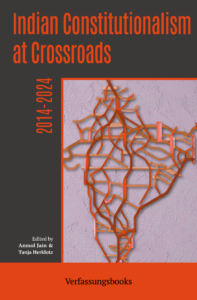
Indian Constitutionalism at Crossroads: 2014-2024
Anmol Jain & Tanja Herklotz (eds.)
Over a decade now, academics, politicians, judges, and members of civil society have been articulating concerns for the state of India’s Constitution. Given the absence of any significant formal amendments to undermine it, how could the Constitution be said to be under threat? A litany of excellent scholars grapple with different dimensions of this challenge in this rigorous, thought-provoking, and insightful collection. A must-read not only for anyone interested in Indian constitutionalism, but also for scholars of constitutional democracy generally.
– Tarunabh Khaitan, London School of Economics and Political Science
Get your copy here – as always, Open Access!
+++++++++++++++++++++++++++
This week, we also continued our symposium “On Law and Politics in the Hungarian Transition” (ENG). KIM LANE SCHEPPELE argues that EU law’s primacy gives Magyar a lawful path to sideline every veto player Orbán left behind. KATI CSERES explains that restoring democracy is not enough, calling for the dismantling of politically captured markets and the rebuilding of open market governance. In a similar vein, MACIEJ BERNATT advocates for restoring the independence of competition institutions and eliminating political interference. MARCIN BARAŃSKI warns how quickly new governments abandon the reforms they promised, using Poland’s media reform as a case in point. More contributions are coming next week. Stay tuned.
By the way, the literary world was also talking about Taiwan this week. Yáng Shuāng-zǐ’s Taiwan Travelogue has won the Booker Prize. The historical novel poses as a fictional translation of a rediscovered text and follows a Japanese writer travelling through Taiwan in 1938 – then under Japanese rule – who falls in love with her Taiwanese interpreter. It is, at its heart, a story about power in all its forms: colonial, professional, romantic, intimate. One wonders what the world might look like if Trump had spent less time on Monopoly and more time with Yáng Shuāng-zǐ.
*
That’s it for this week. Take care and all the best!
Yours,
the Verfassungsblog Team
If you would like to receive the weekly editorial as an e-mail, you can subscribe here.