







“Selvar” the Courts
Intercultural Justice in an Amazonian Territory
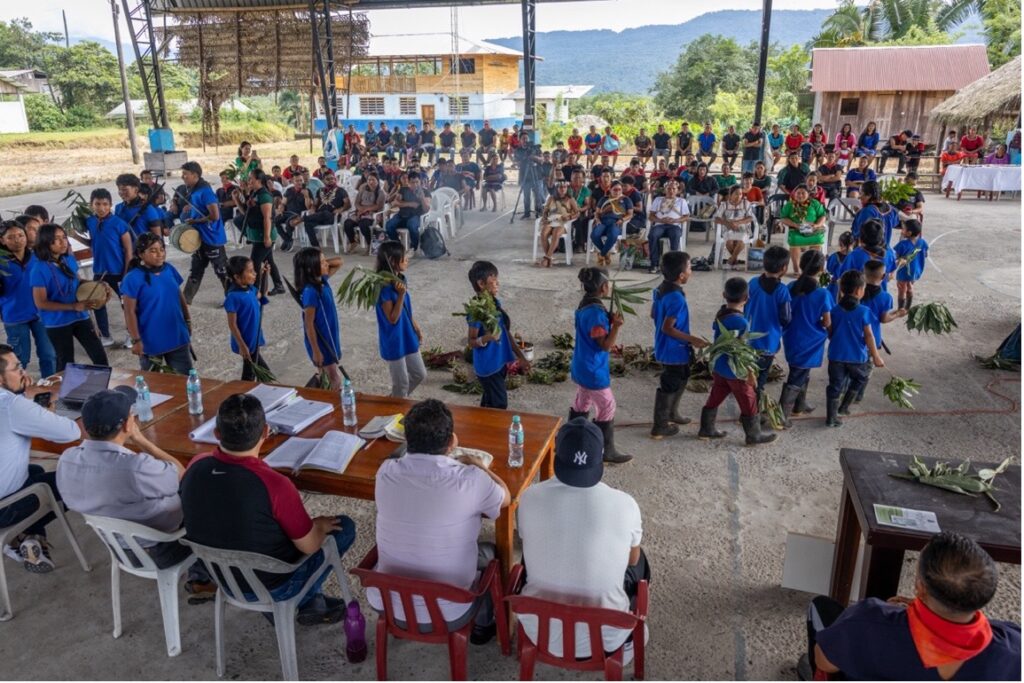
A’i Cofán Sinangoe Community, 20th of February of 2026, intercultural legal hearing. Credits: Nixon Andy
The scent of palo santo (Bursera graveolens) still lingered in the air on February 20, 2026, in the A’i Cofán community of Sinangoe, in the Ecuadorian Amazon. That day, three judges from the Provincial Court of Sucumbíos arrived in the territory to hold an intercultural dialogue hearing as part of a protective action filed by the community to demand respect for their ancestral property rights and the allocation of 63,755 hectares of ancestral land.
It was not only about the physical territory, but also about memories, ancestral practices, the transmission of ancestral knowledge, and A’i Cofán ways of “heartfelt thinking” the world that sustain the territory and collective life.
This hearing reveals something deeper than a mere legal proceeding: when the courts move into Indigenous territory, the law shifts its setting and its conditions of production. In this space, not only judges and lawyers are involved, but also community authorities, ritual practices, and plants like the yoco (Paullinia yoco).
Applying Law from a Different Perspective
Intercultural hearings held on-site allow the courts to be “selvadas,” or forested, that is, to open the judicial process to the material realities, textualities, relationships, and authorities that co-produce and co-compose law in Amazonian Indigenous contexts. In other words, the act of “selvar” involves applying the law from the perspective of the forest itself, with the participation of all the entities that comprise it and their own legal systems. Only in this on-site encounter can the tensions and the possibilities for dialogue between state law and Indigenous legal systems become more clearly visible.
In Ecuador, this possibility has a constitutional basis. The 2008 Constitution recognizes the country as a plurinational and intercultural state (art. 1). However, in judicial practice, tensions persist between state law and the legal systems of Indigenous Peoples and Nations.
The hearing in Sinangoe offers a window into how these systems can engage in dialogue when justice is transferred to the territory. On February 20, the day began at 4:00 a.m. with the taking of the yoco plant, a practice that connects with the forest, the spirits, and the memory of the elders. The yoco is not just a plant, but a plant authority that participates in co-governance.
During the hearing, the A’i Cofán traditional authorities performed a harmonization ceremony with ritual elements and the participation of the community, including children, integrating their own practices into the judicial process. Woven baskets filled with chonta palm (Bactris gasipaes) and achiote (Bixa orellana) were placed in the center of the hearing. We shared stinging nettles (Urtica dioica), and burned palo santo to harmonize the spirit. Then Chipiri Tsampi’ma kuirasunde’khu (a group of children, young guardians of the forest) entered, dressed in traditional A’i Cofán clothing, singing to the rhythm of the drums: Who are we? What do we defend? Strength, strength. Guard, guard. The cry of the forest, uuuu.
A Community That Has Already Changed the Jurisprudence
The A’i Cofán community of Sinangoe belongs to an Amazonian Nation whose ancestral territory was declared part of the Cayambe-Coca National Park in 1970 without prior consultation. In 2018, the community achieved a historic victory by successfully annulling mining concessions granted without their consent. Subsequently, the Constitutional Court of Ecuador consolidated this case in ruling 273-19-JP/22, establishing important standards regarding prior consultation, territory, and the Rights of Nature. The Court determined that prior, free, and informed consent is mandatory even when extractive activities are located outside the communities’ territory but may affect them.
In November 2021, judges of the Constitutional Court held an intercultural Amazonian hearing on the community’s territory. More than 300 leaders of Indigenous Peoples and Nations participated in a process that sought a national precedent on free, prior, and informed consent linked to self-determination and the Rights of Nature. It was a true legal minga, an act of listening that opened a historic opportunity to interpret rights on-site.
Despite these precedents, formal recognition of the ancestral territory remains pending. For this reason, the community filed a new constitutional action to demand the adjudication of its territory.
The Territorial Map as a Source of Own Indigenous Law
One of the fundamental issues discussed at the hearing on February 20, 2026, was who has the authority to determine the dimensions of the community’s territory and under what conditions.
Between 2018 and 2021, Kuirasunde’khu (Indigenous guard) carried out a territorial mapping process. They walked through the rainforest to record rivers, sacred sites, and memories passed down by elders. The result was a map with nearly 5,000 points documenting the ancestral territory.
But for the community, this map is not simply a technical instrument: it is a collective legal act. The rivers, the sites of yagé (Banisteriopsis caapi) ceremonies, the stories of grandparents, and the places inhabited by spiritual beings are all part of this map: slopes, mountains, sacred places, and beings like Atiambi a’i, Kukuya, Vajos, and Kuankuas.
In this sense, mapping is not merely describing the territory, but rather creating legal rights. In the Amazon, borders have historically been fluid, and the movement of rivers and wildlife is an integral part of this living territory. Consequently, territorial mapping must be understood from an ecosystemic and intercultural perspective, as part of the communities’ own legal rights and Law, and fundamental for the formalization and granting of property titles.
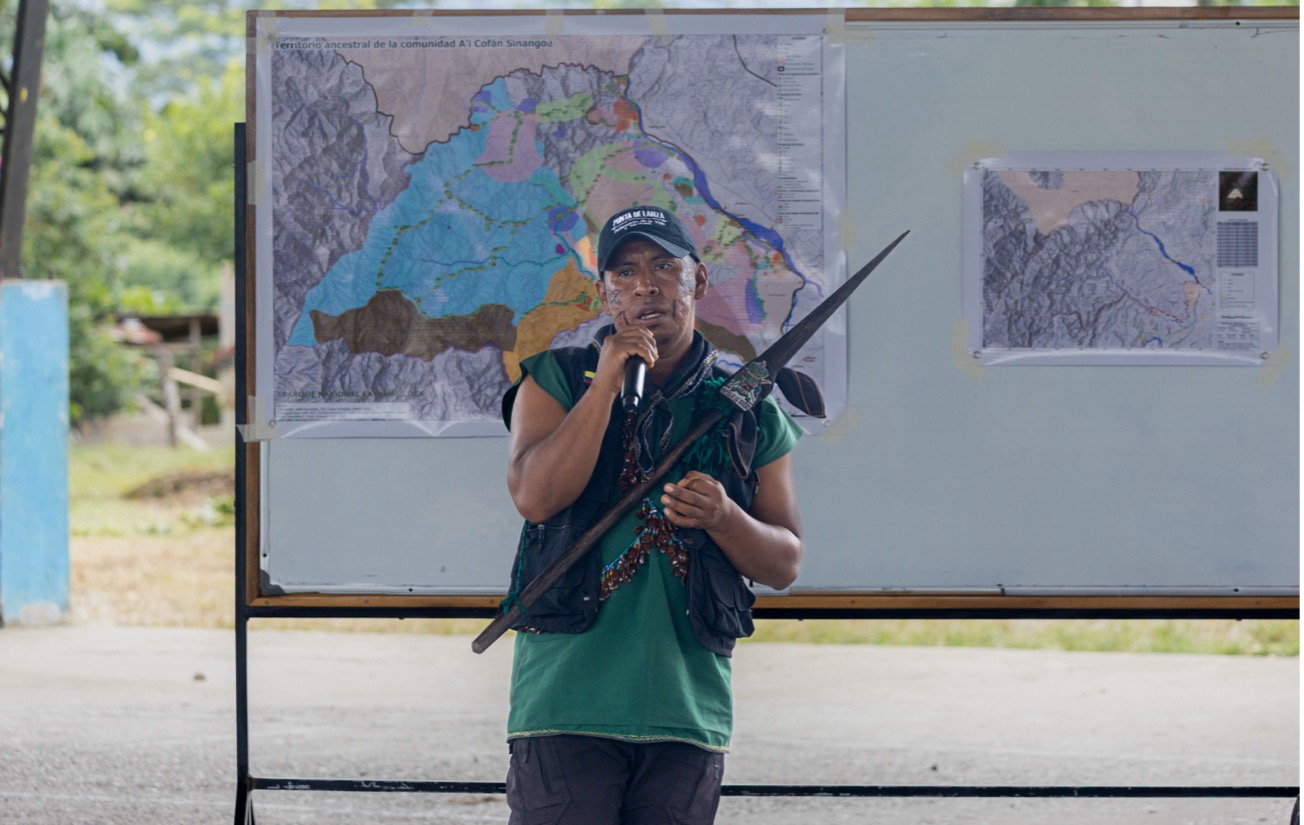
A’i Cofán Community of Sinangoe, February 20, 2026, Holger Quenamá Coordinator Kuirasunde’khu explaining the territorial mapping. Credits: Nixon Andy
The jurisprudence of the Inter-American Court has recognized that the ancestral possession of Indigenous Peoples, who existed before the creation of nation-states, constitutes a title of full ownership, and what corresponds to the States is its formalization and registration.
From an anthropological perspective, mapping allows us to show how Indigenous Peoples conceptualize territory within their cosmologies. In Sinangoe, mapping expresses a relational understanding where humans, animals, plants, rivers, mountains, and spirits are all part of a living territory. After all, “there are no straight lines in nature.” The territory is also recognized through sounds: bird songs, the buzzing of insects, the flow of rivers, and even the presence of spirits. It is a sensory and relational mapping that cannot be interpreted using the same parameters as conventional state cartography.
As Australian Indigenous jurist Christine Black has pointed out, Indigenous law is a living jurisprudence expressed through song, ceremony, storytelling, dance, and the relationship with the land. The law emerges from the territory. Within this framework, the taking of yoco, nettle, face painting, and the voice of Kuirasunde’khu (Indigenous guard), along with territorial mapping, constitute the expression of this living jurisprudence.
Setting Jurisprudence from the Heart A’I Cofán
In the Amazonian intercultural hearing, listening to and “heartfelt thinking”, the law continues to establish living jurisprudence, grounded in what some have called a “constituent power of nature.” The very performance of the hearing transforms what counts as evidence and who can speak. In this space, entities from the plant world also participate. The evidence was not limited to the materiality of the paper: the map was accompanied by plants present, by lines drawn on bodies, and by an illustration of a tree and fish that embodies the creation myth of the Amazon basin.
When intercultural hearings take place in a specific territory, another form of horizontality emerges. What is often questioned in other courts – who has expertise or what evidence is valid – takes on a different dimension here.
Children also participated (Chipiri Tsampima Kuirasundekhu). They not only spoke, but also sang about the ancestral territory their grandparents had walked. Then they presented the judges with a map they had painted themselves: the rivers where they bathe and play, the paths they have traveled, and the stories they have heard from their elders.
Amazonian Indigenous Peoples and Nations such as the Siekopai, Waorani, and Shipibo-Conibo of Peru, along with various amici curiae, supported the case through interventions and expert opinions. However, representatives from the Ministry of Environment and Energy participated virtually, refusing to hold an intercultural dialogue on-site. As one community member pointed out, this decision was perceived as disrespectful: “When you talk about the territory, you have to come to the territory, walk through the forest, listen to the river, and look the community in the eye.” As another community member expressed, “Are they afraid of the yoco or the nettle?” In this sense, they refused to “selvar” the law, failing to uphold the constitutional obligation of intercultural dialogue.
What is at stake is not just a territorial delimitation, but self-determination, the legal security of ancestral territory and the exercise of one’s own rights in the face of extractive threats.
While awaiting the court’s decision, the A’i Cofán community of Sinangoe continued to walk their territory, listened to the voices of the rivers and teaching children to care for the rainforest. Because there is something that cannot be learned in a courtroom: the land is not a piece of paper; the land is spirit, it is home, and it is life. And as long as the forest lives, the A’i Cofán community of Sinangoe will stand firm, caring for and defending life and territory. May more legal professionals be inspired to bring the forest into the courts.
The Provincial Court of Sucumbíos ruled on the 28th of May in favour of the A’i Cofán community of Sinangoe to get their land titles in 30 days. The act of mapping was mentioned as one of the key elements in favour of a positive ruling as an “ethnographic tool capable of showing how Indigenous Peoples conceptualize the place inside of their cultural systems and cosmologies”.
This article first appeared in Latin American Spanish on Agenda Estado de Derecho. The article is part of a collaboration between AED and Verfassungsblog.