




No One is Illegal on Stolen Land
A History of Hometown, USA
In “My Hometown,” part of his Born in the U.S.A. album, Bruce Springsteen sings nostalgically about growing up in Freehold, his hometown, in the 1950s. What is striking about this song is that the same story could be told about thousands of towns in the country. Indeed, as a key site during the Revolutionary War (1775-1783) and the inspiration for Springsteen’s 1985 classic, Freehold Borough is invested in its authenticity as an historic and “all-American” city. Several texts have been published arguing that there is much about the United States that can be learned from this emblematic small town in the middle of New Jersey.1) In a 2025 New York Times article about the Trump administration’s crackdown on cities housing Latin American folks, the empty hiring hall along the railway where Latinx workers usually stand in Freehold is mentioned as a prime illustration of the increasing fear among immigrants in the United States.2)
Drawing on this poetic potential for abstraction, my work as Senior Fellow in the Centre of Advanced Studies in Reflexive Globalisation and the Law (RefLex) at Humboldt-Universität zu Berlin proposes Freehold as a site of inquiry and a point of departure: an unexpected yet auspicious site from which to appreciate important linkages between the colonial past and the colonial present of the United States. A place that emerged in the 21st century as ideal for the settlement of undocumented immigrants from Latin America, Freehold offers a relevant lens through which to examine current discussions about the illegalisation of immigrants in the country. Freehold – which owes its name to the common law concept of freehold tenure, the freest possible title of land tenure under the English monarchy – is thus explored historically as well as figuratively in my project.
By narrating the history of Freehold since its establishment in 1693 vis à vis a genealogy of freehold tenure, a crucial component of the English colonial venture, I argue for an understanding of the relation between colonialism and the production of immigrant illegality in the United States that contributes to scholarship on race and property in North America.3) Today, when Immigration and Customs Enforcement (ICE) agents are being daily deployed under a “zero tolerance” immigration policy, targeting everyone from toddlers to pregnant people to citizens for incarceration and deportation or death, my research follows immigrants’ rights activists who say that “no one is illegal on stolen land” as I focus on the historical processes that resulted in the categorisation of certain immigrants as “illegal” in the first place.
Researching Freehold
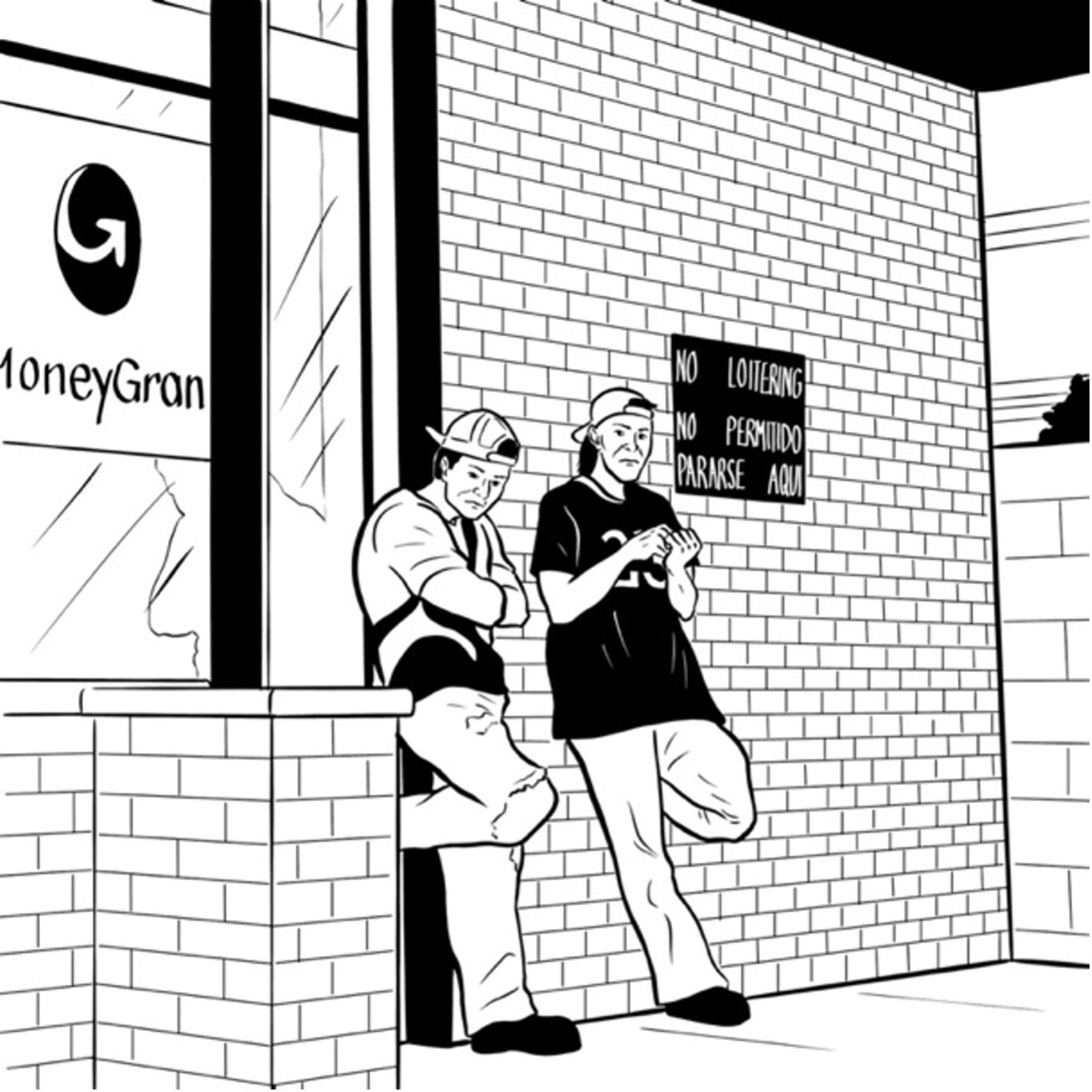
Day labourers wait for work in front of a no-loitering sign. Freehold, 2014. Art by Peter Quach.
With a population of around 12,500 residents, Freehold Borough is a cluster of colourful wood-frame houses and stone storefronts centred around a town hall, set amidst suburbs, farmlands, industrial parks and shopping malls. There is a historic Main Street, a stately courthouse with white pillars fronting a trim green lawn, and many beautiful old homes with porch swings. A predominantly white town where racial minorities were almost exclusively Black American until the mid-1990s, over the past thirty years Freehold has changed demographically with the settlement of undocumented Latinx immigrants who live in town and work in the surrounding suburbs. In response, in the early 2000s the municipality enforced local anti-loitering legislation to rigorously constrain the lives of its undocumented population. However, in 2003, local residents and Latin American immigrants filed a lawsuit in Federal Court against the town’s anti-loitering ordinances on behalf of its Latinx day labourers, and in 2004 a federal judge ruled in their favour. The people – Latinx, Black American, and white – who came together to fight the municipality formed Casa Freehold, an immigrants’ rights advocacy organisation where I conducted ethnographic and archival research between 2011 and 2015.
I arrived in Freehold as a visa-holding Colombian lawyer and doctoral student of Women’s and Gender Studies at Rutgers University, and as a research assistant for an ethnographic project based in Casa Freehold. I had community organising experience with undocumented folks, and I was interested in what Foucauldian migration scholars call the production of immigrant illegality.4) Immediately after hearing the story of Casa Freehold, I wished to write about it: What sparked the potential for this powerful coalition between Latinxs and Black Americans and white people to emerge? And what could we learn in the immigrants’ rights movement from their experience? I soon found out that a 2003 anti-loitering ordinance that closed the hiring hall where Latinx people waited for work along the rail tracks had actually been created to target Black Americans arriving in Freehold during the 20th century, and in particular during the Civil Rights Movement in the 1950s and 60s. As has been extensively argued, vagrancy and loitering laws, a colonial import from Victorian England, have been used against Black and other non-white people since the foundation of the United States.5)
The origins of Casa Freehold demonstrated to me that the production of immigrant illegality is not limited to new legislation and novel biopolitical mechanisms of surveillance; various forms of immigration regulation include legislation that was not originally designed to stop immigration from outside the US, including laws created to hinder Black American lives. Further, the right to appropriate land and therefore access citizen rights through participation in government was reserved for white men from the very beginning of the European colonial project in New Jersey, and the usage of local ordinances to stop Latinx people from settling in Freehold must be understood within the larger context of the use of the law, such as anti-loitering legislation, to exclude Indigenous and Black people from land tenure.
Motivated by these beliefs, I have visited the archives at the Freehold Public Library, the Monmouth County Historical Association, the Freehold Town Hall, the New Jersey Public Library, and the New York Public Library to research the history of Freehold. From 2011 to 2013, I studied with anthropologist Daniel Goldstein how immigration became a “homeland security” issue in New Jersey.6) With this purpose, we volunteered at Casa Freehold weekly. In 2013, we hired two Freehold undocumented residents who were highly active in Casa Freehold to work with us as ethnographers for the next two years: Mirian Mijangos García and Lucia López Juárez, from Guatemala and Mexico, respectively. We wrote thousands of pages of weekly fieldnotes, and we conducted over 50 interviews among the Freehold population.
We authored a book about our ethnographic practice, Decolonizing Ethnography: Undocumented Immigrants and New Directions in Social Science.7) Opening with an investigation of the relationship between ethnography and what has been termed the “decolonial turn” in Cultural Studies, the book explores how undocumented immigrants in Freehold theorise their own experiences of legal status by asking how/if they access the law in cases of work accidents, wage theft and domestic violence. It charts the strategies of resistance carried out by subjects rendered “illegal” by the law with limited access to legal recourse, and it concludes with a bilingual play about the rights of undocumented immigrants in the US, introducing collaborative theatre as a germinal method for collecting data and disseminating research findings.
Legal Roots, Colonial Routes
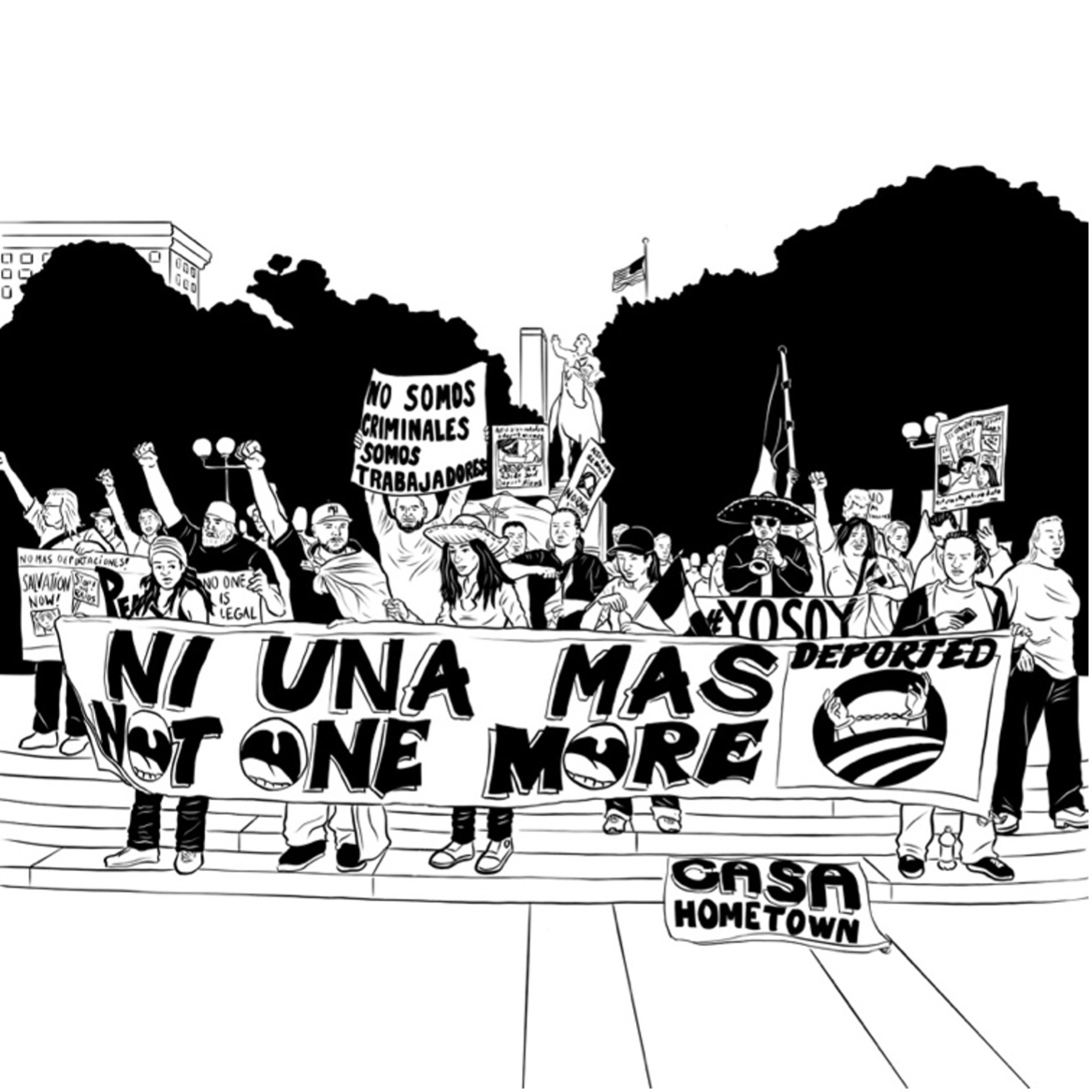
Casa Freehold members march on May Day in Union Square. New York City, 2014. Art by Peter Quach.
We gave Freehold the pseudonym “Hometown” to offer some protection to Lucy and Mirian, both of whom disclosed their names as co-authors. After extensively discussing this with them and Daniel, we have agreed to change the name of the town now, more than ten years after the research ended. Lucy and Mirian argue that we should name the town so that people in New Jersey can learn the history of discrimination preceding the present-day increasing criminalization of Latinx peoples in the state. Additionally, the information is already public: I did not use the pseudonym in my doctoral dissertation, published in 2017, and that same year sociologist Robyn Rodriguez published a chapter called “My Hometown” about the creation of Casa Freehold in her book on New Jersey, “In Lady Liberty’s Shadow”.8) My co-authors and I believe that if we are to propose “Hometown” as a case study to understand the production of immigrant illegality, it is vital to tell the story of the town from a more exact perspective than what is possible under a pseudonym.
Eve Tuck and K. Wayne Yang argued in “Decolonization is Not a Metaphor” that decolonial projects are those particularly oriented around stopping the further settlement of Indigenous lands and toward the restitution of land to colonised Indigenous peoples.9) Calling upon decolonisation without addressing Indigenous people’s rights to their ancestral lands is what they call a “settler move to innocence”: relieving the settler from feelings of guilt or responsibility regarding the continuation of the colonial project, without her giving up her power, land or privilege. For instance, my coauthors and I were referring to the decolonisation of ethnography as a method, while writing from the perspective of four ethnographers operating within the settler colonial context of New Jersey who were not directly contributing to the restitution of land to Lenape people. And yet, as I have argued elsewhere, we must not flatten the category of the settler and should consider that my coauthors are women of Indigenous descent forced to migrate to the United States due to the 200-plus years of colonial dispossession enforced by the United States in their countries of origin.10) So, given the increasing co-optation of the decolonial struggle, what is the material relation between the decolonisation of methods and the decolonisation of Indigenous lands? In engaging the colonial history of our book’s field site, my project takes that reflection as a point of departure.
When talking about undocumented immigration in the United States it is important to consider colonial history – and therefore the histories of Native Americans and Black Americans – for at least two reasons: First, there is a very pervasive nativist anti-immigration sentiment based on the argument that Europeans arrived in the country “legally.” This mythical past, in which white Europeans came to the United States “in the proper way,” has served to justify the erasure of Indigenous people and the increasing discrimination against immigrants of colour. Examining the history of genocide and dispossession that came with this supposed “legal” immigration reveals the underside of this highly racialised nativist argument. Second, illegality and dehumanisation form two aspects of the same colonial weapon, first mobilised against Black and Indigenous people during the colonisation of the US when exclusionary biopolitics and the circumscription of legal subjectivity underlay the foundation of the settler colonial state.
Based on these reflections, as RefLex Fellow I drafted a manuscript, “Legal Roots, Colonial Routes: Olde Freehold in Lenape Land.” Drawing on philosopher Sylvia Wynter,11) sociologist Aníbal Quijano12) and anthropologist Nicholas De Genova13), it argues that the European colonial project in what is today Freehold supposed an essential distinction between European Man and his others based upon a particular prescriptive and descriptive statement of the human as capable of acquiring private property and therefore becoming a freeholder. This statement legally excluded the Indigenous and Black peoples of the Americas, and it currently serves to exclude Latinx immigrants. The text centers an alternative song about Freehold to Bruce Springsteen’s. It is called “Sangre de Inmigrante” (Immigrant Blood) and it was written in 2020 by my co-author Mirian after a white man told her on the streets of Freehold to go back to her country. I translated it with her permission, and, because no one is illegal on stolen land, I close my blogpost with the first verse of her song:
¿No tienes sangre de inmigrante? / Don’t you bear immigrant blood?
¿Qué haces en este país? / What are you doing in this country?
Si no eres originario / If you are not native
entonces no eres de aquí / then you are not from here
References
| ↑1 | Jeannette Blair, Freehold Township: The First 300 Years (The Freehold Township Committee, 1993); Kevin Coyne, Marching Home: To War and Back with the Men of One American Town (Penguin, 2003); Barbara Pepe, Freehold: A Freehold History (Arcadia Publishing, 2003); Robyn M. Rodriguez, In Lady Liberty’s Shadow: The Politics of Race and Immigration in New Jersey (Rutgers University Press, 2017), DOI: 10.2307/j.ctt1q1cr27.4. |
|---|---|
| ↑2 | Rebecca Davis O’Brien and Miriam Jordan, A Chill Sets In for Undocumented Workers, and Those Who Hire Them, New York Times, 10.03.2025, https://www.nytimes.com/2025/03/09/business/economy/immigrant-workers-deportation-fears.html?smid=url-share, last accessed 11.08.2026. |
| ↑3 | See Brenna Bhandar and Nicholas Blomley, Laying Waste: Pre-Emption, Dispossession, and Deputization in Colonial British Columbia, Antipode, 58 (2026), DOI: 10.1111/anti.70162; Cheryl I. Harris, Whiteness as Property, Harvard Law Review, 106 (1993), DOI: 10.2307/1341787; K-Sue Park, Property and Sovereignty in America: A History of Title Registries & Jurisdictional Power, The Yale Law Journal, 133 (2024). |
| ↑4 | Nicholas P. De Genova, Migrant “Illegality” and Deportability in Everyday Life, Annual Review of Anthropology, 31 (2002), DOI: 10.1146/annurev.anthro.31.040402.085432. |
| ↑5 | See Douglas Blackmon, Slavery by Another Name: The Re-Enslavement of Black Americans from the Civil War to World War II (Anchor, 2009); Khalil Gibran Muhammad, The Condemnation of Blackness: Race, Crime, and the Making of Modern Urban America (Harvard University Press, 2011), DOI: 10.2307/j.ctvjsf4fx; Risa Goluboff, Vagrant Nation: Police Power, Constitutional Change, and the Making of the 1960s (Oxford University Press, 2016); Kristin O’Brassill-Kulfan, Vagrants and Vagabonds: Poverty and Mobility in the Early American Republic (New York University Press, 2019). |
| ↑6 | Daniel M. Goldstein and Carolina Alonso-Bejarano, E-Terrify: Securitized Immigration and Biometric Surveillance in the Workplace, Human Organization, 76 (2017), DOI: 10.17730/0018-7259.76.1.1. |
| ↑7 | Carolina Alonso Bejarano, Mirian A. Mijangos García, Lucia López Juárez and Daniel M. Goldstein, Decolonizing Ethnography: Undocumented Immigrants and New Directions in Social Science (Duke University Press, 2019), DOI: 10.1215/9781478004547. |
| ↑8 | Rodriguez, Fn. 1. |
| ↑9 | Eve Tuck and K. Wayne Yang, Decolonization Is Not a Metaphor, Decolonization, Indigeneity Education & Society, 1 (2012). |
| ↑10 | Beja Protner, Engaging with Coloniality Through Alternative and Decolonial Methodologies: Interview with Carolina Alonso Bejarano and Peter Quach, The Centre for Research in the Arts, Social Sciences and Humanities (CRASSH) at the University of Cambridge, 01.05.2024, https://www.crassh.cam.ac.uk/blog/debordering-futures-conference-interview-with-carolina-alonso-bejarano-and-peter-quach/, last accessed 11.08.2026. |
| ↑11 | Sylvia Wynter, Unsettling the Coloniality of Being/Power/Truth/Freedom: Towards the Human, After Man, Its Overrepresentation – An Argument, CR: The New Centennial Review, 3 (2003), DOI: 10.1353/ncr.2004.0015. |
| ↑12 | Aníbal Quijano, Coloniality of Power and Eurocentrism in Latin America, International Sociology, 15 (2000), DOI: 10.1177/0268580900015002005. |
| ↑13 | De Genova, Fn. 4. |