






Kosovo’s Justice Gap
A Thaçi Verdict and the Defendants Not in Court
The countdown clocks in Kosovo are ticking. The public protests have begun.
On September 16, the EU-backed Kosovo Specialist Chambers in The Hague will deliver a much-awaited verdict in the war crimes trial of former President Hashim Thaçi and three co-defendants, and Kosovo is poised to react. The four men – senior figures in the Kosovo Liberation Army (KLA) – are charged with war crimes and crimes against humanity, including murder, torture, and enforced disappearances committed during and after the 1998-99 Kosovo war.
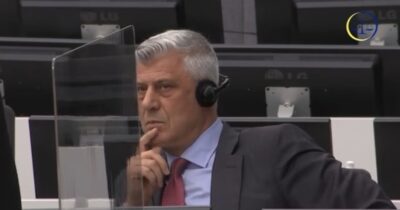
Screenshot from the Kosovo Specialist Chambers.
Convictions will spark outrage in Kosovo: these heroes were defending the nation, and Serbian forces committed monstrous crimes. Acquittals will bring bitter relief: these men are vindicated but lost years of their lives.
Whatever the verdict, one fact stands clear: the foreign governments and international forces in Kosovo at the time largely watched as these crimes took place.
Impunity Reigns
Kosovo Albanians have grounds to gripe. The overwhelming majority of war crimes during the conflict were committed by Serbian and Yugoslav forces, and the list of atrocities runs long. For those crimes, few have been held to account.
Consider, for instance, the organized police action in 1999 to exhume and transport nearly 1,000 bodies from Kosovo to Serbia in a plan to hide the crimes – as the recently deceased Ratko Mladic did after his forces killed about 8,000 men in Srebrenica. The Kosovo Albanian victims were reburied in Serbia, some of them inside police bases, but to date no one has been charged.
At the highest level, former President Slobodan Milosevic and a small cohort of senior officials faced trial at the UN war crimes tribunal, and at the lowest level a few cases have crawled through the war crimes court in Belgrade. But in between spreads a vast and barren land of impunity, where mid-level commanders and senior officials responsible for atrocities continue to roam.
All Sides, One Law
As European and US officials who demanded the Kosovo court have repeatedly stressed, however, all parties must respect international law, regardless of whether they are the aggressor or the aggrieved, the large or the small. The actions of one side – or the failure to act – do not justify action or inaction by the other.
“Certain individuals who fought for the just cause of Kosovo’s freedom committed egregious crimes against others for which they must be held accountable,” the US ambassador to Kosovo said in 2017.
The word “individuals” deserves stressing here because the Kosovo special court, as it is commonly known, like the UN war crimes tribunal before it, was created to adjudicate individual criminal responsibility, and not to besmirch the KLA or Kosovo independence cause.
The EU investigative body that preceded the court, the Special Investigative Task Force (SITF), run by a former US war crimes ambassador, made that abundantly clear. “This investigation and any charges that result from it, are directed at the criminal actions of individuals within distinct groups not at the KLA as a whole,” the SITF chief prosecutor concluded in 2014.
The subsequent indictment and court statements stress that point, highlighting the court’s focus on individuals and “not ethnic groups, not organizations, and not communities.”
The indictment includes another essential fact that critics of the court typically overlook: the victims of these crimes came from all ethnic groups – Serbs, Roma, other minority populations, and Kosovo Albanians. This included perceived collaborators with Serbs, supporters of other political parties, and those who declined to join the KLA.
The pressure not to talk about this fact in Kosovo runs high, so the issue of Albanian-on-Albanian murders has largely been ignored. How this promotes democracy or rule of law no one has explained.
Nor do Kosovo pundits and politicians talk about the sharp contradiction that the Thaçi defense has raised. At home, the KLA has been touted as the forceful liberating army of an aspiring state. In the courtroom, it has been presented as a disorganized and uncoordinated group.
Still, no one disputes that the crimes laid out in the indictment took place during and after the war – both in Kosovo and northern Albania. Roughly 1,600 people remain missing from the war, about two-thirds of them Albanians and one-third Roma and Serbs. The question of whether Hashim Thaçi and his co-defendants are held legally responsible for those crimes will be answered on September 16, and likely adjudicated in subsequent appeals. He also faces additional charges of trying to influence witnesses while in detention.
The Defendants Not in Court
What we will not see this month is accountability for the wider political and security decisions made during the time when these crimes took place. The key decision-makers were not the Kosovars alone, but rather the foreign governments and international bodies that had responsibility for governing, policing and securing Kosovo just after the war.
When Serbian and Yugoslav forces left Kosovo on June 12, 1999, the international forces stormed in – military and civilian. The KLA established a provisional government, with Thaçi at its head, but the country was formally run by the United Nations Interim Administration Mission in Kosovo (UNMIK), with nearly 10,000 civilian personnel, nearly half of them police. NATO deployed roughly 45,000 soldiers (KFOR) with participants from about 30 countries, most prominently the US, UK, Germany, Italy, and France. The Organization for Security and Cooperation in Europe had a mission with about 1,500 local and international staff in 15 field offices and five regional centers to promote institution building, human rights, and rule of law.
As documents from that time show, these governments and international organizations knew that certain individuals in the KLA were committing crimes after the war, motivated by politics, business, or revenge. They largely watched, documented, and at times raised concerns privately, but ultimately stayed publicly mum because the KLA was viewed as a partner from the war and a factor for stability.
The major exception was the OSCE’s large report from October 1999 called As Seen, As Told – Volume II, following its first volume about the predominantly Serbian and Yugoslav war crimes committed during the war. It covered the post-war crimes in detail but stopped short of naming individual KLA perpetrators, noting that “close scrutiny by the international community is needed to prove, or disprove” the extent of their involvement.
A former official from the OSCE’s Kosovo mission testified for the prosecution at the Thaçi trial, as did various former staff from UNMIK and KFOR. In Kosovo, attention fixed instead on the seven high-level international witnesses called by the defense, the only witnesses it called, including then-NATO commander Wesley Clark.
Granted, tensions ran high after the war, and governments rightly worried about the conflict’s spread to neighboring Macedonia, with its large ethnic Albanian population. Indeed, fighting did erupt there and was contained. The cynical and pragmatic policy of ethnic separation also played a role: after so much bloodshed, it was easier if Serbs and Roma simply left.
Limits of a Humanitarian War
In the end, the war crimes and crimes against humanity of murder, torture, persecution, and disappearances – for which Thaçi et al. have been charged – were tolerated by the governments that had intervened militarily against Milosevic’s forces due to – as US President Bill Clinton put it – the “moral imperative.”
Whatever verdict lands from the Thaçi case, serious crimes were committed in Kosovo under the international community’s watch. Consider them the defendants not in court.
Going forward, this week’s verdict, regardless of outcome, offers a chance to challenge the ongoing impunity. It could renew demands for accountability, especially with pressure on Serbia, and inject energy into the search for missing persons.
That could lay a foundation for progress on reconciliation, regional cooperation, and EU-led negotiations on Kosovo’s still-unresolved status, which have failed to address past crimes.
Transparency notice: The author covered the Kosovo conflict for Human Rights Watch and testified for the prosecution in the war crimes trials of Slobodan Milosevic, Sainovic et al., Vlastimir Djordjevic, and Thaçi et al.

This article is part of VB Security and Crime: A Cooperation Project of Verfassungsblog and MPI-CSL. Subscribe to the newsletter to stay informed.