






What Comes to Mind
Behind the Scenes of Our Texts
In the beginning, there was no Word – only a blank page. This editorial was no exception. And look, three sentences already! As readers, you usually encounter only the finished product, while our authors, and we at Verfassungsblog, have to face that blank page. So what actually happens before a text is published here? This question has been on our minds all the more since AI seems to be filling the blank page for us. We’ve therefore made it our job to protect this endangered creative process. Our strategy is the same as in conservation biology: visibility. Instead of cute photos of orang-utans, we’ll be sharing short pieces from our editorial team and from our authors describing the creative process: how do we come up with ideas? Where are we when ideas come to us? How do we sow and water them, and how do we know when they’re ripe? I have the honour of making the beginning today.
Creativity, then. I grew up believing that there are people who are creative and people who are not. What a dreary world that would be! By now, I’m convinced that creativity is our state of nature: we don’t lie in wait for each other like hungry wolves – we scrawl funny figures on cave walls, rub twigs against each other until they burn, and then dance around it.
The German word for idea – Einfall, literally an “in-falling” – captures it nicely: an idea suddenly falls into my head. I used to think I had to do more: read more, know more, write more, more more more (it was a tough PhD phase). And please get everything right. But here’s what I’ve learned: fear chases what’s right; joy finds what’s true. I don’t really have to do all that much – I just have to be there at the right moment and joyfully catch the idea as it falls. Creativity is a way of being, as Rick Rubin sums it up in my creative bible. In beguilingly simple words, he reminds us how we perceived the world as children: playful and curious. Oh, right, that’s how it was – back then, in our state of nature.
And indeed, my creative process begins with the very first of my inner recordings. The material is out there: forest landscapes, adventure novels, snatches of conversation, colours, shapes, scholarship. My body files away a selection – obeying an inscrutable Zettelkasten system I’ll never fully understand. But it works. Time and again, I’m struck by what I find in the archives of my subconscious – and by what gets sent up the dumbwaiter unwanted (2000s ad jingles during my law exams, for instance). The name says it all: just waiting like an idiot. Something is happening down there in the archive, and if I wait long enough, a tidy and surprising file package comes up.
++++++++++Advertisement++++++++++++


Der Lehrstuhl für Öffentliches Recht, Verfassungstheorie und interdisziplinäre Rechtsforschung von Herrn Prof. Dr. Julian Krüper an der Juristischen Fakultät sucht zum nächstmöglichen Zeitpunkt eine*n Wiss. Mitarbeiter*in (m/w/d) mit 19,9150 Std./ Woche für die Dauer von 3 Jahren; TV-L E13.
Am Lehrstuhl steht das Verfassungsrecht im Mittelpunkt. Sie unterstützen den Lehrstuhlinhaber in Forschung und Lehre und führen Arbeitsgemeinschaften durch. Die Möglichkeit zur Promotion ist gegeben.
Alles Weitere und Bewerbung hier.
++++++++++++++++++++++++++++
The timing is out of my control. When does an idea come? In Big Magic, Elizabeth Gilbert imagines ideas as autonomous beings whirring about us, looking for a willing human partner. Once they’ve found someone, they try to make themselves noticed. I like that: ideas as wilful, flighty creatures, the creative process as teamwork between inside and out. Perhaps my archive staff are simply responding to the call of these bats – a call I can’t hear myself. That is my experience: sometimes an idea is just ripe, and if I don’t want to connect with it, it’s not unusual that it’ll materialise somewhere else a few months later – exactly the text I’ve sent back down into my archive basement, as an unwritten draft.
Stephen King advises descending into the basement yourself. That’s where his muse lives, as he writes in On Writing: “There is a muse, but he’s not going to come fluttering down into your writing room and scatter creative fairy-dust all over your typewriter or computer station. He lives in the ground. He’s a basement guy. You have to descend to his level, and once you get down there you have to furnish the apartment for him to live in.”
And it’s true, we have to make it cosy for the muse. A nice environment helps me. Right now, for instance, I’m sitting in my favourite coffeeshop; soulful jazz is playing softly, there’s pottery being thrown next door, and the air smells of wet clay and pistachio cake.
My archive staff also don’t seem to work well when I’m watching them too closely over the shoulder, stopwatch in hand. The moment I put myself under pressure, they go on strike. What helps instead is pretending I’m busy with something else: keeping the creative task gently present while I get on with undemanding things.
In a way, I’m a bit like Claude – a black box with insane computing power, untraceable chains of associations, and plenty of hallucinations. I don’t process every file package that arrives. And here I differ (thankfully!) from Claude: I have a body. My stomach has to tingle, my fingers have to itch – the idea has to move me, or nothing comes of it. That’s why good things often come to me in motion: walking, washing up, hanging out the laundry. And if the idea then won’t let me go, I have to make space for it: the blank page.
++++++++++Advertisement++++++++++++

Das Fachgebiet Just Transitions beforscht Fragestellungen einer möglichst gerechten sozial-ökologischen Transformation in transnationalen Kontexten. Themenschwerpunkte sind dabei unter anderem die Ökologisierung des Rechts und Resilienz von Demokratie und Rechtsstaats. Zur Verstärkung unseres Teams suchen wir zum 1.9. zwei Wissenschaftliche Mitarbeiter*innen.
Näheres und Bewerbung hier.
++++++++++++++++++++++++++++
I do use AI, but only as an additional service to my own archive. It can look up the redacted passages for me, the memory gaps in my files (very handy!), and otherwise check whether what I’ve written is nonsense. Should both my natural and my artificial intelligence end up hallucinating, I’m counting on you to tell me.
With the blank page, the process becomes more active – but even here, I never quite take the lead. It’s like partner dancing: I hold the frame while the idea dances on its own. Every dance is different – one light-footed, the next more ponderous – but you always end up somewhere other than where you started, a little sweaty, with a full heart. If you take me for a romantic now, you’re absolutely right. Which is also why it remains a mystery to me why anyone would rather use AI than dance.
*
Editor’s Pick
by JAKOB GAŠPERIN WISCHHOFF
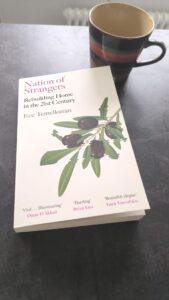
Ece Temelkuran’s Nation of Strangers is a deeply personal, melancholically poetic journey of the unhomed. Written as letters over the last three years – to all of us, estranged – Temelkuran searches for and creates her new belonging. She finds it in a collective bound by being Odysseus: displaced, still searching for the way (back) home. Whether escaping fascism, losing a house, or simply running away, the quest leaves the same haunting questions: Why did I leave? How will I survive? Will I ever go home?
Her profoundly honest account put the right words to so many feelings I recognised as my own. So perhaps she is right: there is a bond among us, the unhomed strangers. I hope we all find our Ithaca in the end.
*
The Week on Verfassungsblog
summarised by EVA MARIA BREDLER
Law, too, is a creative – and collective! – process. We could watch that happen in real time recently in the Ecuadorian Amazon: on 28 May, an Ecuadorian court ruled in favour of the indigenous A’i Cofán Sinangoe community, granting them formal title to 63,755 hectares of Amazonian territory. The ruling came after an intercultural hearing held in the rainforest itself: it began at 4 a.m. over a brew of yoco and ended with children showing the judges hand-painted maps of the rivers they swim in and the paths their grandparents walked. WIDER GUARAMAG UMENDA, ALEXANDRA NARVÁEZ UMENDA, and JENNY GARCÍA RUALES (ENG) report first-hand.
What might creative climate policy look like in Germany? Probably not like the Heating Act. But it is better than nothing – a view the legislator apparently does not share, busy as it is hollowing out the Act until rather more hot air than hot water remains. Is the legislator allowed to do that? CHRISTIAN CALLIESS (GER) sets out the limits the Constitution places on climate policy, and analyses when the legislator may roll back climate and environmental protections.
Until now, constitutional scrutiny of climate policy has revolved around upper limits of atmospheric warming. But what happens when those limits are exceeded? The question is now playing out in several pending proceedings. GERD WINTER (GER) puts forward a proposal that shifts the focus away from calculating and allocating emissions budgets and towards what is technically, economically and socially feasible.
The Federal Constitutional Court, too, has been navigating between budget allocations and social feasibility. In its most recent ruling on the Asylum Seekers’ Benefits Act, the Court has now largely upheld lower social benefits for asylum seekers. For LUISE FREITAG (GER), the decision relativises the constitutional existential minimum on migration-policy grounds.
While German migration law is fought over questions of community, belonging and exclusion; German labour law is being tested by new forms of work that don’t fit its categories: no establishment, no works council. For delivery riders in the platform economy, this creates real protection gaps – and calls into question the very concept of “establishment” on which the Works Constitution Act rests. FELIX HARTMANN (GER) accordingly argues for a modular alternative.
++++++++++Advertisement++++++++++++

Stellenausschreibung
An der Professur für Bürgerliches Recht, Handels-, Gesellschaftsrecht, Compliance und Nachhaltigkeit (Prof. Jan-Erik Schirmer) ist eine Qualifikationsstelle mit dem Ziel der Promotion als Akademische*r Mitarbeiter*in (Kenn-Nummer 1104-26-02) zu besetzen.
Bewerbungsschluss ist der 14.06.2026.
Unser ausführliches Stellenangebot: www.europa-uni.de/stellenangebote
++++++++++++++++++++++++++++
Participation of a different kind came before the Indian Supreme Court: last week, it ruled on the powers of the Election Commission of India to conduct the Special Intensive Revision (SIR), a large-scale clean-up of the electoral rolls. ANMOL JAIN (ENG) draws out comparative constitutional lessons for fourth-branch institutions and electoral management bodies.
The member states of the Council of Europe have got creative too: with the Chișinău Declaration, they have set out to co-define the substantive content of the ECHR’s guarantees. LINA SOPHIE MÖLLER (ENG) argues that this crosses a line no diplomatic moderation can neutralise.
More creative still is the idea of reviving the 1952 European Defence Community. In his rejoinder to Federico Fabbrini and Franz C. Mayer, ROBERT SCHÜTZE (ENG) takes a clear position in our debate on its revival: “Again, the European Defence Community Is Dead, Let It Rest in Peace.”
More popular is the idea of a new corporate form for the EU: the debate around the proposed EU Inc. has become one of the liveliest in European corporate law. The draft regulation, however, faces sharp criticism over its legal basis under Article 114 TFEU. WOLF-GEORG RINGE (ENG) shows how the constitutional debate misses the point: where there is political will, European integration has always found a legal way.
Political will can damage the values of European integration just as easily: European judicial and professional networks continue to count Poland’s PiS-captured “courts” among their members. LAURENT PECH and OLIVER MADER(ENG) argue that this normalises lawlessness – and that the European Commission should act.
Some good news from Poland: following the CJEU’s Trojan ruling, Polish courts now transcribe same-sex marriagesconcluded abroad. MATEUSZ WĄSIK (ENG) shows how they are also recognising “weekend marriages” – grounding recognition in constitutional and ECtHR reasoning that reaches well beyond EU free movement.
++++++++++Advertisement++++++++++++

What is the future of criminal and security law? Keeping up requires more than just headlines. Once a month, our new VB Security & Crime Dossier brings the essential debates straight to your inbox: featuring sharp commentary at the intersection of constitutional, criminal and security law, a comprehensive debate review, and a brief “Memo” from our editors for a quick takeaway. In-depth, curated, and straight to the point.
Subscribe now for free: https://verfassungsblog.de/newsletter-mpi/ (available in German only)
++++++++++++++++++++++++++++
Meanwhile, Hungary needs money to rebuild the rule of law. Unfreezing EU funds is one option, and John Morijn and Kim Lane Scheppele recently called for stricter procedural discipline in pursuing it. JOANNA DEMOPOULOU (ENG) argues that the real question is not how to depoliticise this mechanism, but who should exercise its discretion.
Hungary’s fresh start risks unwittingly repeating the mistakes of 1989. GÁBOR HALMAI (ENG) explains why popular enthusiasm must be channelled into this constitutional moment.
Our symposium “On Law and Politics in the Hungarian Transition” (ENG) keeps turning over exactly this question. LÁSZLÓ DETRE observes that Hungary’s Constitutional Court failed to prevent rule-of-law backsliding and argues for replacing its composition – but only through cross-partisan nomination, not by reproducing the very logic one seeks to undo.
And finally, for our June Outstanding Women portrait, MUSKAN KAKKAR (ENG) tells the story of Shirin Ebadi – the first Muslim woman and the first Iranian to win the Nobel Peace Prize, in 2003. Her life shows how legal training can become a form of resistance, and how a person stripped of all institutional power can still use the law as a tool for justice. As she put it: “I have a tongue in my mouth, and I will not keep quiet until the day I die.” For her, too, the creative process seems to be a bodily one.
*
That’s it for this week. Take care and all the best!
Yours,
the Verfassungsblog Team
If you would like to receive the weekly editorial as an e-mail, you can subscribe here.
Thank you so much for the truly meaningful words you’ve written. I’m in the final stages of my PhD, and I have gone through (or perhaps am still going through – I’m trying to stop, I think) a phase where I constantly felt behind, and where reading, studying, publishing all the time seemed the only way to keep up and not feel “out of the game”. It gets to the point where nothing else fits in the “basement” and nothing else comes to mind, because the little guy down there can’t even move for all the stuff being thrown at him from “upstairs”. It’s not easy to tell yourself to slow down (even if the bigger picture promises it’s for the best), but having an extra voice reminding you certainly helps. Thank you again!