







“Detention Has Become an Industry in Libya”
Five Questions to Allison West
In May 2026, the International Criminal Court concluded its confirmation of charges hearing against Khaled El Hishri, a former senior officer of Libya’s Special Deterrence Force (SDF/RADA). Fifteen years after the UN Security Council referred the situation in Libya to the Court, he is the first suspect to appear in The Hague. That gap says as much about Libya and EU migration policies as it does about the ICC: a landscape where lines of authority are perpetually blurred, and where the question of who can be held responsible is often inseparable from the question of who constitutes “the state” and what role European actors play.
German authorities arrested El Hishri in July 2025 and transferred him to the ICC in December of that year. While the charges are directed at an individual for acts committed at Tripoli’s Mitiga prison between 2014 and 2020, they emerge from a system that is much harder to disentangle. Mitiga was formally recognized as part of Libya’s detention system while effectively controlled by an armed group with its own chain of command and economic interests.
From that perspective, Mitiga offers a particularly revealing example of how power has operated in Libya since 2011. If anything, the El Hishri case forces a more uncomfortable question than whether accountability is possible: accountability for what kind of order and who evades accountability entirely? We asked Allison West, Senior Legal Advisor at European Center for Constitutional and Human Rights, ECCHR, to unpack the complexities of this case and situate it within the broader struggle for justice in Libya.
1. The El Hishri case is the first from the Libya situation to reach the ICC since the 2011 referral – and it sits at the very intersection of state authority and armed group that defines Mitiga prison. Could you walk our readers through the case: what is alleged and why does it matter beyond this one defendant?
El Hishri, referred to by one of his victims as the “angel of death”, is accused of 17 counts of crimes against humanity and war crimes, carried out principally against detainees at Mitiga Prison in Tripoli. He is alleged to have been a senior figure in the powerful Tripoli-based militia SDF/RADA, affiliated with the Libyan Presidential Council, and a top prison commander at Mitiga. Notably, the ICC Prosecution alleges that he not only ordered, oversaw or allowed harrowing abuses against men, women, boys and girls – Libyan and non-Libyan – in his leadership role at the prison, but that he also directly perpetrated all 17 counts of the crimes alleged, including torture, murder, rape and other sexual violence, enslavement and persecution. In other words, he led by example.
The case matters because, for the first time in 15 years of ICC investigation into Libya, a suspect has been surrendered to the Court and confronted with charges. For survivors, affected communities, and civil society organizations that have worked for years to expose atrocities at Mitiga and other detention sites across Libya, this is the first real opportunity to have such crimes legally characterized and adjudicated before an international court and to enable survivors to be heard and participate. Beyond punishment, this participatory and truth-establishing dimension of international justice is incredibly meaningful.
The case also matters beyond one defendant and one prison because Mitiga reflects broader patterns across Libya’s detention system, where captivity has become a source of power and profit, especially with respect to Black African migrants and refugees who are enslaved and subjected to particularly severe forms of systematic exploitation and abuse. The Prosecution’s intersectional approach in its charging is noteworthy in that it recognizes how crimes at Mitiga were shaped and compounded by factors such as race, nationality, ethnicity, gender, age, migration status, and other vectors of identity, whether actual or perceived.
++++++++++Advertisement++++++++++++

Die “Lage der Nation” ist der Politikpodcast für alle, die wissen wollen, was hinter den Schlagzeilen steckt – und wie das Zeitgeschehen juristisch zu bewerten ist.
Der Journalist Philip Banse und der Jurist Ulf Buermeyer analysieren das politische Treiben hierzulande und in der Welt, sezieren gesellschaftliche Konflikte und betrachten sie auch aus juristischer Perspektive.
Die Lage der Nation ist kein juristischer Fachpodcast, sondern liefert Fakten und politische Analyse mit juristischer Expertise. Hier hören.
++++++++++++++++++++++++++++
2. The El Hishri case puts Libya back on the ICC’s radar, but international attention to Libya often feels episodic, spiking with crises and fading just as quickly. From your perspective, what structural dynamics make accountability so persistently elusive, even when the evidence of atrocity is overwhelming?
Evidence of international crimes in Libya, and often of the perpetrators behind them, has been well documented for years by survivors, Libyan and non-Libyan civil society, journalists, UN bodies, and human rights organizations. Knowledge is not the problem. Accountability remains elusive because powerful actors continue to profit, politically and economically, from these crimes.
Detention itself has become an industry in Libya and a key part of the country’s post-2011 conflict economy. People deprived of liberty are commodified through extortion, forced labor, ransom, trafficking, or as a means of securing resources in the name of migration control. Many detention actors profit from both state-linked roles and overtly criminal activity. This is especially true of migrant and refugee detention, but it also affects Libyans.
Domestic accountability is complicated by the fact that alleged perpetrators are often part of militias or armed groups that operate through, alongside, or in place of state institutions. Even when victims report abuses, often at great security risk, the judiciary remains fragmented, frequently threatened, and largely unable to secure credible accountability. This makes recourse to the ICC crucial as a court of last resort.
Yet the ICC can only function if states cooperate. El Hishri is in The Hague because Germany arrested and surrendered him. By contrast, also in 2025, Italy arrested Osama Elmasry Njeem, another ICC suspect wanted for alleged crimes at Mitiga, but released and returned him to Libya. The ICC has since found that Italy breached its cooperation obligations, and ECCHR is now supporting a pending case before the European Court of Human Rights by a survivor of Elmasry’s torture to challenge Italy’s failure to cooperate. For all of these reasons, accountability remains difficult, despite overwhelming evidence.
3. When Libya is discussed in international legal and political debates, it is often reduced to shorthand: “collapse,” “militias,” “detention,” “migration.” Which of these dominant narratives do you think most distorts the picture of what is actually happening on the ground and what do outside observers systematically miss as a result?
The most distorting shorthand is “collapse”, because it suggests that the widespread violence in Libya is chaotic or disorganized. Of course, Libya’s authority structures have been profoundly fragmented since 2011. What outside observers often miss, however, is that, even in this fragmented context of ongoing armed conflict and multiple, shifting centers of power, there are structured systems of organized violence, including Libya’s detention industry, through which different actors compete for influence, seek profit, and consolidate power. Mitiga Prison under SDF/RADA is a prime example of this. The “collapse” narrative also obscures the role of international actors whose cooperation with Libyan authorities often sustains these structures rather than challenging them.
4. International actors, particularly in Europe, have helped fund, train, or otherwise support Libyan actors in the name of migration control – even as abuses in detention have been widely documented. To what extent have these policies contributed to the very structures of violence now coming under scrutiny in cases like El Hishri?
European migration management and border control policies are key to understanding how many migrants and refugees came to be detained and abused in Mitiga and other detention sites across Libya.
For years, EU Member States, institutions and agencies such as Frontex have helped build and sustain a system of pullbacks to Libya, as part of a broader plan to prevent crossings to Europe through containment in Libya. Since 2016, they have increased support for the so-called Libyan Coast Guard, including through funding, patrol boats, equipment, training, surveillance, and the sharing of coordinates of boats in distress. This has enabled Libyan actors to capture people at sea and forcibly return them to the same detention industry now under scrutiny in the El Hishri case.
In a comprehensive submission to the ICC in 2022, ECCHR argued that such interceptions and forced returns constitute the crime against humanity of severe deprivation of physical liberty, for which high-ranking EU and Member State officials bear responsibility as co-perpetrators. For many participating migrant and refugee victims in the El Hishri case, it is crucial that this trial also helps expose how European policies fed into the abuses they suffered at Mitiga. This was clear during and around the confirmation of charges hearing, where they drew attention to how European-supported interceptions returned them and others directly into the very detention center we now see before the Court.
++++++++++Advertisement++++++++++++

What is the future of criminal and security law? Keeping up requires more than just headlines. Once a month, our new VB Security & Crime Dossier brings the essential debates straight to your inbox: featuring sharp commentary at the intersection of constitutional, criminal and security law, a comprehensive debate review, and a brief “Memo” from our editors for a quick takeaway. In-depth, curated, and straight to the point.
Subscribe now for free: https://verfassungsblog.de/newsletter-mpi/ (available in German only)
++++++++++++++++++++++++++++
5. Looking beyond the courtroom, what would meaningful accountability in Libya actually look like and is there any realistic path toward that in the current political climate?
Meaningful accountability will always hinge on the effective participation of survivors and victims, who should be supported to drive such accountability processes. And while a trial can establish individual responsibility, justice also requires attending to more complex aspects, like truth, recognition, reparations, protection, and political change to guarantee the same system will not simply continue to produce new victims. To this day, RADA continues to control Mitiga Prison, meaning there is still much work to do.
However, survivors who attended or followed the confirmation of charges hearing against El Hishri expressed that it gave them renewed hope that justice is possible. That hope must now be matched by continued investigations by the ICC Office of the Prosecutor, including into crimes in Eastern Libya and into the responsibility of EU and Member State officials for crimes against migrants and refugees, including the severe deprivation of liberty that begins when they are intercepted at sea and pulled back to Libya. It must be matched by Libya and ICC States Parties’ full cooperation in executing ICC arrest warrants and surrendering suspects to The Hague; by real policy change in Libya and Europe; and by sustained support for the survivor-led and civil society efforts that made this step possible.
*
Editor’s Pick
by MAXIM BÖNNEMANN
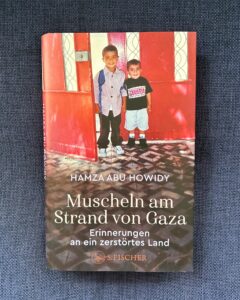
What does it mean to grow up under Hamas’s dictatorship? Hamza Abu Howidy was born in Gaza in 1997 and went to school there. The regime’s ideology and violence run through every part of society — from neighborhood streets to classrooms and lecture halls. Critical questions are punished, and those who nonetheless dare to take to the streets against the Islamist regime are picked up and imprisoned. Abu Howidy himself ends up in Hamas detention cells after taking part in a demonstration. Following repeated imprisonment and torture, he manages to flee to Europe, eventually making his way to Germany. In this book, he recounts everyday life under Hamas’s dictatorship, stories of love, courage, and resistance — and the loneliness of a Palestinian dissident who not only stands against Hamas but also criticizes the war crimes of the Israeli government. “Muscheln am Strand von Gaza” (“Shells on the Shore of Gaza”) is many things at once: an eyewitness account, a childhood memoir, and above all a fantastically told book about the insatiable hunger for freedom.
*
The Week on Verfassungsblog
summarised by EVA MARIA BREDLER
Some laws are undead – their practical force long gone, but never quite laid to rest. France put one such creature to rest only yesterday: a full 178 years after abolishing slavery, the National Assembly unanimously repealed the Code Noir. This undead law turned human beings into non-humans: into property. Unbelievable that the haunting lasted this long.
Indonesia’s criminal law has its own ghosts, if rather less dramatic ones. For two decades, the Constitutional Court dismantled provisions that enabled arbitrary prosecution. Since January 2026, new criminal and criminal procedure codes are in force. The legislature has used them to expand state power and revive constitutional conflicts once thought buried, argues SIMON BUTT (ENG).
In Peru, parliament has been reaching for power too. The presidential runoff on 7 June will decide between Keiko Fujimori and Roberto Sánchez – but the office itself has been hollowed out. Parliament has impeached four presidents since 2020 and rewritten the constitution to introduce a powerful new Senate, set to begin functioning on 28 July. RODRIGO MARUY (ENG) describes this Senate as “constitutionally anti-constitutional”: its powers systematically undermine the very checks and balances that liberal constitutionalism exists to protect.
In Germany, the dispute is over executive power: The Berlin Administrative Court has ruled that the domestic intelligence agency, the Verfassungsschutz, was not permitted to describe the Jüdische Stimme für gerechten Frieden in Nahost as extremist in its annual report. For MALTE STEMKOWITZ (GER), the case illustrates the narrow line the Verfassungsschutz must walk – between words and deeds – and demonstrates judicial sensitivity rather than nerves.
Nerves dominated two judicial nominations – and brought them down. The collapse of Frauke Brosius-Gersdorf’s candidacy for the Federal Constitutional Court and the historic rejection of Jorge Messias for Brazil’s Supreme Court. DIEGO PLATZ PEREIRA (ENG) sees the problem not in the politicisation of judicial selection as such, but in what Brazilians call politicagem – the subordination of judicial appointments to short-term electoral logic.
++++++++++Advertisement++++++++++++
An der Professur für Öffentliches Recht mit dem Schwerpunkt Völkerrecht (Prof. Dr. Thomas Kleinlein) an der Goethe-Universität Frankfurt am Main sind 2 Stellen als Wiss. Mitarbeiter*in (m/w/d) (halbtags) zunächst befristet auf 3 Jahre zu besetzen. Schwerpunkte der Professur sind das Allgemeine Völkerrecht und die Grundlagen, Menschenrechte, das Recht der Verträge, die Friedenssicherung, das EU-Verfassungsrecht und das Außenverfassungsrecht.
Die Bewerbungsfrist endet am 10.6.2026. Weitere Informationen finden Sie hier.
+++++++++++++++++++++++++++
What follows long-term electoral defeat is precisely what Europe is watching in Hungary. Following Fidesz’s loss, the country’s new political leadership has pledged to dismantle the structures that enabled sixteen years of democratic backsliding. Yet one of the most powerful obstacles may be the constitutional powers of President Tamás Sulyok. If he chooses to deploy them aggressively, Hungary could face an unprecedented constitutional crisis, warns GÁBOR MÉSZÁROS (ENG).
Rebuilding also costs money. Hungary’s new government needs billions in frozen EU funds – fast. JOHN MORIJN and KIM LANE SCHEPPELE map the legal and political obstacles to unfreezing them without melting the rule of law in the process.
As Hungary slowly finds its way back towards the European rule of law, the question of how its neighbour Ukraine might join that order remains unresolved. Friedrich Merz recently proposed a status of “associate membership” for Ukraine – an intermediate step towards full accession. The political inspiration is clear. The legal translation, as PETER VAN ELSUWEGE and ROMAN PETROV (ENG) show, is anything but: the proposal assumes that such status could be granted without ratifying an Accession Treaty or amending the EU Treaties.
In Germany, reports of drone swarms over Bundeswehr sites and critical infrastructure have been mounting. May the Bundeswehr intercept surveillance drones flying over civilian infrastructure? No, says FELIX LANGE (GER) – under the Basic Law, that is a matter for the police. This need not, however, amount to a gap in protection, nor does it require amending the constitution.
The European Digital Fairness Act, which the Commission will table at the end of 2026, is being drafted in the grammar of consumer protection. For adults, that grammar holds – for children, it does not, argues CHAYMA DRIRA (ENG) and demands a fourth layer of personal integrity for minors.
Children are also being failed by the school system, especially those with special needs. The government now wants to reform the Eingliederungshilfe – Germany’s statutory system of individual entitlements to support services for people with disabilities – and has tabled a draft that would largely abolish the existing individual right to school accompaniment. MICHAEL WRASE (GER) explains why the draft violates both international and constitutional law, and proposes alternative wording.
School is where we first encounter state authority – and where social inequality becomes most visible. SUSANNE BECK (GER) finds similar questions lurking in the debate over Schwarzfahren (using public transport without a ticket): its criminalisation does not merely protect property interests but stabilises a social order of access, with far-reaching consequences for belonging and the experience of state control.
++++++++++Advertisement++++++++++++
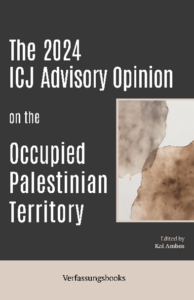
The 2024 ICJ Advisory Opinion on the Occupied Palestinian Territory
Edited by Kai Ambos
“This volume includes a wealth of expert analyses of this historic ICJ opinion. Readers will be struck equally by the range of perspectives, by the nuance and insightfulness of the contributors’ reflections, and by the speed with which this book has been put together. It is a timely and important contribution.”
– Tom Dannenbaum, Stanford Law School
Get your copy here – as always, Open Access!
+++++++++++++++++++++++++++
This week, we also continued our symposium “On Law and Politics in the Hungarian Transition” (ENG). After six years of captured public broadcasting and silenced journalism, BERNÁT TÖRÖK argues that rebuilding media regulation requires not just new rules but a genuine shift in institutional culture. And since Hungary’s courts remain packed with Orbán’s judges, DAVID KOSAŘ urges Magyar not to play tit-for-tat but to innovate: restructure appointments, limit the chief justice’s powers, and build a judiciary that earns public trust.
The subheading of Kosař’s piece makes for a nice send-off into the weekend: Don’t Imitate – Innovate. Good advice for Hungarian presidents, Sunday outfits, and barbecue recipes alike.
*
That’s it for this week. Take care and all the best!
Yours,
the Verfassungsblog Team
If you would like to receive the weekly editorial as an e-mail, you can subscribe here.