



A General Strike against the Spanish Opposition?
On 11 November 2026, Spain went on a general strike – for the first time in 14 years. The last one had taken place in November 2012, against the austerity measures adopted by the Partido Popular government. This time, the general strike and the ensuing demonstrations were called for the housing crisis. While the left considered the strike legitimate, the right and far right saw in it yet another trick of the Spanish Prime Minister, Pedro Sánchez, to hurt the opposition: “It is a strike against the opposition, so therefore we do not support it”, said Alberto Núñez Feijóo, the leader of the Popular Party. But was it really a strike against the opposition? It was not, although this answer comes with some qualifications.
The Spanish Right to Strike
Article 28 of the Spanish Constitution of 1978 establishes the right to strike. As it stands, it is a fundamental right with the highest level of protection in the Spanish legal order. Although article 28.2º, together with article 81.1º of the Spanish Constitution, states that the right to strike will be regulated by an Organic Law, Spanish political forces have not been able to agree on this law. As a matter of fact, the right to strike is regulated by a pre-constitutional Royal Decree-Law (RD-Law 17/1977). The Spanish Constitutional Court, in its ruling 11/1981of 8 April, gave a “constitutional” reading to this pre-constitutional text, and set several qualifications and limits to the RD-Law 17/1977. All this clearly illustrates that the issue is highly contentious in Spanish politics. In general terms, it is fair to say that the political parties on the left of the spectrum have been more prone to a broad reading of the right to strike, whereas the political parties on the right have traditionally been more restrictive.
Housing in Dire Straits in Spain
According to a 2026 OECD report, Spain’s housing sector is one of the most unbalanced of all OECD countries. Buying a decent house in certain Spanish cities, like Madrid, is almost impossible unless you are rich. Renting, once the safety net for all those who could not afford to buy a house, is no longer an option: as the next graph shows, rental prices have increased by 23% from 2015 to 2024 in the whole of Spain.
Index of Increase of Rental Prices in Spain (2015-2024)
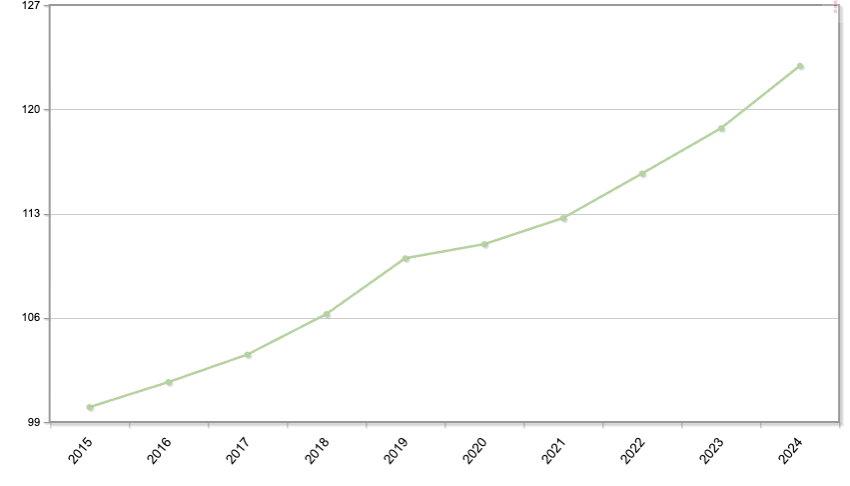
Source: INE (accessed 18 November 2026)
On top of that, add a cultural note: Spain has a pro-buying-home culture. Therefore, if you cannot afford to buy a house, you are considered a country’s pariah. No need to say what the social connotation is if you can neither buy a house nor rent one.
The housing issue was a ticking bomb. And the bomb exploded on 23 September 2026, when Maria del Carmen Abascal Martín (named “Mari Carmen”) was evicted from her (rented) home. Her house was owned by a company whose modus operandi was that of a vulture fund (a point that the company has cynically denied): like vultures (the animals), this kind of fund targets weak tenants, offers them harsh conditions to recover the asset, and then re-rents the house (or sells it) at much higher prices. It was not the first eviction in Spain, of course. But Mari Carmen’s eviction got public salience. Mari Carmen was an activist who did not shy away from denouncing her situation. Further, the “Tenants Union”, active since 2017, took this case as exemplary of how people live through the current Spanish housing crisis. Another element is the so-called “penthouse case”, which affected the President of the Madrid Autonomous Community, the PP leader Isabel Díaz Ayuso. Yes, believe it or not, in the midst of the perfect housing storm sweeping Spain, and above all in cities like Madrid, Ayuso decided to buy a “penthouse” valued at 6.3 million EUR to set up her “temporary official residence”. A Spanish daily denounced this in July 2026, just a few months before the Mari Carmen case exploded. Many indications suggested that a snap general election could be called. As Roberto Bolaño would put it:
“In the distance, hovering over the multiplied volcanoes, an electrical storm was brewing in silence.”1)
Mari Carmen died a few days after she had been evicted. Although it is not possible to access her medical record for privacy reasons, the information that has emerged is that the stress related to her eviction played an important role in putting an end to her days. Hers is a classic tale of informative manipulation: Mari Carmen “spent all her pension playing bingo”; she was “the owner of another house at Madrid’s outskirts that she did not want to use”; she “had been offered several fancy elderly residences where to spend the rest of her life, but she had rejected all these offers”, etc. Peu importe: on the day of her death, the main Spanish Unions (UGT, CCOO) together with other social organisations (such as the Tenants Union) called a general strike in the country. They also called for demonstrations all across the country, which would start at 6 PM that day. The strike and demonstrations’ motto was: “Salaries, housing, prices”.
Whose Competence?
Let me be clear: one of the most serious mistakes that the framers of the Spanish constitution made was dividing competence in the field of housing between the central government and the Autonomous Communities. The same could be said about two other crucial areas of the Spanish Welfare State, which are education and health; but we leave this for another conversation.
Article 148.3º of the Spanish Constitution states that the Autonomous Communities “may assume” competences in the fields of “territorial planning, urban planning and housing”. All the Spanish autonomous communities, without exception, have assumed this competence.
At the same time, article 47 of the Spanish Constitution provides that “Spaniards have the right to enjoy decent and adequate housing”. It further adds (and this is crucial from a competence perspective): “public authorities must foster the necessary conditions and set the appropriate rules to enforce this right, regulating land use in the public interest and preventing speculation”. Two points regarding the second sentence of article 47: first, it instructs all public authorities, without exception, to regulate this right. This includes the central government. Second, although the second sentence very confusingly refers to land use, not housing, it is obvious that the two are connected. However, although the Spanish legislator has not adopted a Housing Law until 2023, it has passed a number of Land Planning Laws (the latest one is from 2015). Of course, land planning and housing are not the same thing. In fact, the Spanish Constitutional Court, in several rulings (see, for instance, its ruling 16/2018, of 22 February) had reproached the Spanish legislator for not having (had the courage: this is my addition) to adopt a state general law on housing.
The 2023 Housing Law
The Spanish housing law of 2023 is not perfect but has some interesting elements. For example, it allows for the declaration of the so-called “housing market areas of residential tension”, where households that spend 30% or more of their income on housing may benefit from certain limits on rental price increases. In the areas of residential tension, the “small” owners must maintain the price of the previous contract when the tenant changes, and the “big” owners must stick to official rental indexes. There are yet other important elements that, for reasons of space, we leave aside.
Now you have to make three guesses. Guess who has the competence to declare “market areas of residential tension”. Bingo: Autonomous Communities. Now make a second guess: who rules in the majority of the Autonomous Communities? Bingo again, the Popular Party (sometimes aided by its shield-bearer, Vox). To be exact, the Popular Party rules in 13 of the 17 Autonomous Communities and two Autonomous Cities in Spain. Third guess: are they implementing the previously mentioned elements of the Housing Law? The answer is more nuanced but tends toward the negative. According to the information provided by the Spanish Housing Ministry, only five Autonomous Communities have designated housing market areas of residential tension in their respective territories: Catalonia, Navarra, Basque Country, Asturias and Galicia. All of them are ruled by the Socialist Party (together with the PNV in the Basque Country), except for the last one, which is a traditional feud of the Popular Party. The Autonomous Community of Madrid (the mother of all residential tensions in the country) has not made use of the Spanish Housing Law of 2023, at least in this important respect.
Who Is to Blame?
To be sure, responsibilities for the housing sector’s disaster in Spain are shared – just as government in Spain is shared. Saying that the general strike and demonstrations of 11 November were made “against the opposition” thus misses the point. On the one hand, the Spanish central government and the Spanish legislator could have done more. Historically, the Spanish central government has kept its distance, to say the least, from engaging in this crucial area of the Spanish welfare state. And the current left coalition government could have been more courageous in regulating a sector that has been crying out for public intervention since at least the explosion of the 2008 financial crisis. The central government knew that if it left the deployment of the law to the Autonomous Communities, the law would not be implemented. Granted, the Autonomous Communities hold the main competences in housing. Unfortunately, we have to live with it. But haven’t we learnt anything at all from the rich history of federal states when dealing with reluctant regional actors? What about the stick-and-carrot nuts-and-bolts that have so well served the interests of the central state in countries such as the United States of America? The European Union is yet another example: it has been very creative in “convincing” Member States that some competences once dear to them could be left to Brussels. Think of monetary union. Think, also, of criminal justice. Think of immigration. The list is really very long. I am not arguing for a total reset of the Spanish quasi-federal state. What I am saying is that to play the federal game seriously, one has to be smart – above all, when the lives and fates of many citizens are a fundamental part of that game. Always beware of the guardians of the federal essences. For essences do not weigh. Lives do.
On the other hand, Autonomous Communities bear, as we have seen, the lion’s share of responsibility for the Spanish housing meltdown (above all those governed by the PP). They have the power to act in this area; they could have made full use of all the tools the 2023 Housing Law gave them. They are the main actors in this drama. It is particularly dreadful that this lack of interest, to put it mildly, of the Autonomous Communities in implementing the Housing Law of 2023 has been weaponized by the PP against the left-wing coalition government. The result is a bomb that has now gone off. This is utterly irresponsible. I am not arguing that if the Housing Law of 2023 had been fully and credibly implemented, there would have been no Mari Carmen and no housing distress. Clearly, more than a law is needed to solve such a crisis. What I am arguing is simply that this implementation deficit has contributed to the current meltdown. My question is: now that the bomb has gone off, how will the PP and Vox clear up the debris if they win the snap general election of 29 November 2026?
References
| ↑1 | “A lo lejos, sobrevolando los volcanes multiplicados, una tormenta eléctrica se gestaba en silencio.” Roberto Bolaño, Amuleto, 1999. |
|---|