






The Only Reasonable Inference
Genocide and the Art of Eliminating Alternatives
In The Gambia v. Myanmar, the majority of the International Court of Justice (ICJ) ruled that Myanmar had committed genocide against the Rohingya. In assessing genocidal intent, the ICJ distinguishes between concurrent intentions and competing alternative inferences. Building on Itamar Mann’s discussion of the judgment, this post examines how the Court’s approach would benefit from a more systematic method for identifying and evaluating alternative hypotheses, particularly by distinguishing between conceivable and genuinely reasonable explanations.
The Problem: How Should the Standard of Proof “Fully Conclusive” Be Applied When There Are Competing Alternative Inferences?
The ICJ followed its previous case law and applied “fully conclusive” as the standard of proof. It had earlier explained that in the absence of direct evidence of genocide it could rely on a pattern of conduct if it “could only point to the existence of such intent” (Bosnia v. Serbia para. 373, Croatia v. Serbia, paras. 145 and 148). This formula is now described by the ICJ as the “only reasonable inference” test, which involves testing whether “alternative, reasonable inferences” exist (para. 438). The Court explained that this is “a general test under international criminal law, applying whenever inferences are drawn from circumstantial evidence” (para. 442). In the same paragraph, the ICJ cites several decisions of the International Criminal Tribunal for the former Yugoslavia (ICTY), in which the “only reasonable inference” test is used to operationalize the criminal standard of proof beyond reasonable doubt. Following the Bosnia v. Serbia judgment (2007), commentators argued that the ICJ had effectively adopted a standard of proof corresponding to proof beyond reasonable doubt (see, for example, Gattini, 2007 and, more recently, Milanovic, 2025). I share this interpretation.
In his immediate analysis of the judgment, Milanovic argues that while the Court formally reaffirmed its strict “only reasonable inference” precedent, the majority effectively relaxed the evidentiary threshold in practice – highlighting the urgent need for clearer criteria to distinguish reasonable alternatives from speculative ones.
The difficulty is that the ICJ requires genocidal intent to be the only reasonable inference. But how should a court determine which alternative explanations qualify as reasonable? And how should this requirement be understood when genocidal intent may coexist with other intentions? The ICJ explains that “genocidal intent may exist alongside other intentions, provided that such intentions are not incompatible with the existence of genocidal intent” (para. 443).
The Court thus distinguishes the coexistence of multiple intents from competing alternative inferences. However, while the Court articulates the distinction, it provides less guidance on the methodological question of how to determine whether an alternative constitutes a reasonable inference. Drawing on Bacon’s approach to probability, Cohen’s call for induction by elimination, Diesen’s hypothesis method and my own work on the alternative-hypothesis approach, this post develops the theoretical underpinning of this approach and criteria for assessing when an alternative inference is sufficiently specific, evidentially grounded and explanatory to qualify as reasonable.
On a terminological note, in my previous scholarship I have used the concepts “alternative hypothesis approach” (Klamberg, 2015) and earlier “the exclusion of every reasonable hypothesis of innocence method” (Klamberg, 2013, sections 3.5.3.2 and 3.5.4.5) to describe how the beyond reasonable doubt standard should be applied. It belongs to the same methodological family as the “only reasonable inference” test, to the extent they are not identical.
Competing Inferences in The Gambia v. Myanmar Case
The diagram below illustrates the relationship between the four intentions discussed in the proceedings. By allowing the circles to overlap, it distinguishes the possibility of concurrent intentions from competing explanatory hypotheses that exclude genocidal intent.
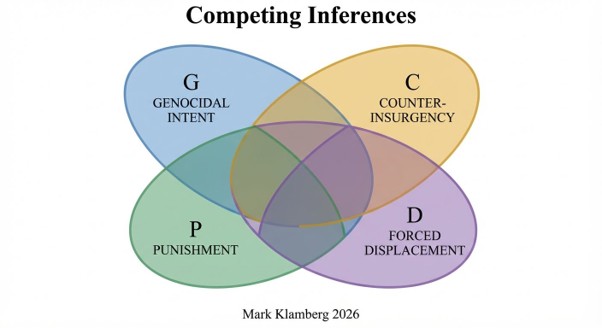
The Gambia understood the “only reasonable inference” test to mean that other “possible or plausible” inferences will only prevent a finding of genocidal intent if those inferences are reasonable. For The Gambia, intent to destroy the group may be the “only reasonable inference” even if the evidence demonstrates that there was forcible displacement, provided that the evidence also demonstrates that forcible displacement was carried out in circumstances calculated to physically destroy the group. Similarly, The Gambia argues that the Court may still find genocidal intent to be the only reasonable inference if genocide is an interim goal alongside ultimate military objectives (para. 439). On the facts, The Gambia argued that Myanmar’s actions were inconsistent with counter-terrorism (para. 446), and forcible displacement was carried out and supported an inference of genocidal intent (para. 448). This can be summarized with the proposition “G and D, not C”.
Myanmar contended that genocidal intent must be the only inference that can reasonably be drawn from the acts in question. It argued that, if any other intent may be reasonably inferred from the acts in question, then genocidal intent cannot be the “only reasonable inference”. However, Myanmar recognized that genocide can be committed in the context of counter‑terrorism operations, as long as genocidal intent is the only inference that could reasonably be drawn from the evidence as a whole (para. 440). On the facts, Myanmar argued that the clearance operations qualified as “counter-terrorism” measures (para. 444). While it denied that it had intent to forcibly displace the Rohingya, it alluded to the possibility that the Court could find that as a reasonable inference distinct from genocide (para. 447). Myanmar also suggested punishment as an alternative inference (para. 449), arguments that can be summarized with the proposition “C and maybe (D or P), not G”.
As indicated above, the ICJ majority ruled that “genocidal intent may exist alongside other intentions, provided that such intentions are not incompatible with the existence of genocidal intent” (para. 443). On the facts, the majority rejected counter-insurgency (C, not G, paras. 451-453), forced displacement (D, not G, paras. 454-462) and punishment (P, not G; paras. 463-466) as reasonable alternative inferences excluding genocidal intent. The Court found the only reasonable inference was an intention to destroy a substantial part of the Rohingya population in northern Rakhine State (para. 467).
The minority agreed with the majority on the concept of multiple intentions by stating the following:
“[W]e do not disagree with the proposition that an intent to punish may coexist with genocidal intent and that the two intentions ‘may not always be capable of meaningful separation for the purpose of drawing alternative inferences’” (joint dissenting opinion, para. 91).
The minority was still critical and described the majority’s reasoning on why Myanmar’s Government exercised restraint as “pure supposition”, which in effect requires Myanmar to disprove the hypothesis and reverses the burden of proof (para. 79). The minority also argued that “the relevant pattern of conduct reasonably permits two alternative inferences. … each of these is, on its own, incompatible with the existence of genocidal intent” (para. 80). Moreover, the minority disagreed with the majority on how to assess the facts. The joint dissent held that two incompatible alternative inferences remain available: forced displacement and collective punishment/intimidation (para. 94), summarized as “D and P, not G”.
The Alternative Hypothesis Approach: An Established Method of Fact-Finding
Having set out the arguments and rulings in The Gambia v. Myanmar, this section aims to provide the theoretical underpinning of the test adopted by the ICJ. Neither the ICJ Statute nor the Genocide Convention provides any guidance on the evidentiary standard or any test to be applied.
Fact-finding is not governed by a comprehensive set of legal rules. Judicial evaluation of evidence should nevertheless be disciplined by principles of rational inquiry. The alternative hypothesis approach offers one way of structuring that inquiry (Klamberg in Heller et al., 2020).
I have previously described the foundations and application of the “alternative hypothesis approach” as a method for applying the standard of proof beyond reasonable doubt as follows:
“[T]he ‘alternative hypothesis approach’ … is based on the writings of Bacon, Mill, Cohen, Ferrajoli, Zuckerman and Diesen. The approach suggests that we should use evidential tests designed to eliminate any hypothesis that is under consideration. The hypothesis that best resists the most concerted efforts to eliminate it, as well as any other hypotheses, is the one which should have increasing confidence. This is known as induction by elimination. It involves a comparative or ordinal gradation of probability rather than a quantitative and measurable one. Considering that the standard of proof in criminal proceedings is ‘beyond reasonable doubt’ and not (p. 466) ‘beyond any doubt’, the prosecution arguably only needs to eliminate ‘reasonable’ alternative hypotheses. Which are these? Diesen suggests that alternative hypotheses should be tested when they are reasonable in the sense that they are not pure scepticism or speculation. More specifically, a reasonable hypothesis is (i) compatible with at least some of the facts in the case, and (ii) commensurable with the indictment, that is, the alternative hypothesis should be possible to formulate as a legal and evidential theme” (Klamberg, 2015, p. 542, which is a condensed version of Klamberg, 2013).
The ICJ applies different standards of proof depending on the nature of the allegations and evidence. In her doctoral thesis, The Standard of Proof at the ICJ: On Evidentiary Standards and Judicial Decision-Making at the International Court of Justice (2025), Amanda Bills identifies three broad categories of standards of proof in the Court’s jurisprudence: a lower standard, broadly corresponding to a balance of probabilities; an intermediate standard requiring conclusive (also described as clear and convincing) evidence; and a heightened standard requiring fully conclusive evidence, particularly in cases involving charges of exceptional gravity. Her analysis is useful here because it situates the genocide cases within the Court’s broader evidentiary practice, while also highlighting the particular stringency of the standard applied to allegations of genocide.
The ICJ’s test for fully conclusive evidence belongs to the same methodological family as the alternative-hypothesis approach. Both require competing explanations to be tested and reasonable alternatives to be excluded.
What Makes an Alternative Hypothesis Reasonable?
Building on the account of the ICJ and my previous work above, I will now discuss five criteria which appear relevant for The Gambia v. Myanmar case.
Specificity
An alternative must be formulated with sufficient precision to be tested against the evidence. Counter-insurgency is a relatively broad explanation while forced displacement is more specific. Punishment or deterrence arguably needs further specification: punishment of whom, for what conduct, and with what intended consequences? A court should not accept a broadly formulated alternative merely because it is conceivable. It must identify a sufficiently concrete hypothesis to permit meaningful evidential testing. The majority’s reasoning is persuasive here when it explains why it rejected counter-insurgency as an exclusive explanation. It is not necessarily the same as rejecting the possibility that counter-insurgency operations occurred.
Evidential anchoring
An alternative must have support in the evidentiary record. The dissenting judges challenge aspects of the majority’s interpretation of Myanmar’s restraint, describing it as pure supposition (joint dissent, para. 79). This raises important methodological questions: Is an alternative supported by evidence? Or is it merely an interpretation that cannot be ruled out? The court must identify the evidence supporting an alternative, rather than simply establish that the alternative is logically possible. Equally, it must identify the evidence that undermines it.
Commensurability
An alternative hypothesis must be capable of being formulated as a legally and evidentially meaningful explanation of the conduct in question. Applying this to the case, does 1) counter-insurgency explain the particular pattern of violence? 2) forced displacement explain the treatment of the Rohingya population? and/or 3) punishment explain the scale and character of the operations? The point is not that an alternative must explain every individual fact. Rather, it must be sufficiently comprehensive to compete with the principal hypothesis (genocide with concurrent intentions).
Explanatory coverage
An alternative should be assessed against the evidentiary record as a whole, not merely against selected pieces of evidence. This is where the majority and dissent offer particularly useful opposing examples. The majority considers whether counter-insurgency, forced displacement and punishment adequately explain the overall pattern of conduct. The dissent, in contrast, considers forced displacement and collective punishment/intimidation capable of explaining the conduct without genocidal intent. The key question thus becomes: how much of the evidentiary record does each hypothesis actually explain, and what evidence remains unexplained?
The relationship between commensurability and explanatory coverage may need some explanation: they are related but distinct. Commensurability concerns whether an alternative can be formulated as a legally and evidentially meaningful hypothesis. Explanatory coverage concerns how much of the evidence that hypothesis actually explains.
Compatibility with, or exclusion of, the principal hypothesis
Both the majority and the minority expressly accept that genocidal intent may coexist with other intentions, without agreeing on all the implications of that proposition.
As Kevin Jon Heller observes in his commentary on the judgment, even military operations pursued with legitimate counter-insurgency objectives or partial compliance with international humanitarian law do not preclude a finding of concurrent genocidal intent. However, he persuasively argues that it would appear difficult to infer specific intent from acts that comply with IHL.
Consequently, the mere existence of a counter-insurgency, displacement or punishment objective cannot establish an alternative to genocide. My central proposition would be that an alternative inference only undermines the inference of genocidal intent if it is incompatible with that intent. Otherwise, it may describe an additional intention rather than an alternative explanation.
Beyond the Formula: Keeping the ICJ’s Application of the Test Transparent
In The Gambia v. Myanmar, the ICJ has provided valuable clarifications on the application of its evidentiary standard. Four methodological lessons can be drawn for future cases. First, it remains important that the Court explain how it applies that standard. The Court should identify precisely what the competing alternative is. Second, the Court needs to identify the evidence supporting and contradicting each hypothesis. Third, in cases relating to genocide, the Court must explain whether the alternative is genuinely incompatible with genocidal intent or whether it describes an intention that can coexist with genocide. Fourth, the Court has to explain why the alternative does or does not adequately account for the evidentiary record as a whole.
The challenge in proceedings such as the one in The Gambia v. Myanmar is not simply to identify alternative explanations, but to determine which alternatives deserve to be taken seriously, which can coexist with genocidal intent, and which genuinely exclude it. As Itamar Mann highlights in his analysis of the judgment’s wider implications for pending and future genocide cases, how the Court handles concurrent intentions will shape genocide litigation well beyond this dispute. The only reasonable inference test is therefore not simply a formula for reaching conclusions about genocidal intent. It is a method of disciplined comparison, requiring courts to formulate, test and eliminate competing hypotheses through transparent reasoning.

This article is part of VB Security and Crime: A Cooperation Project of Verfassungsblog and MPI-CSL. Subscribe to the newsletter to stay informed.