






Spotting Mushrooms
And Ever at my Service: Claude
This editorial is part of our “Behind the Scenes” series, in which our editors and authors describe their creative process in the age of artificial intelligence. How do ideas come to us? How do we sow and water them, and how do we know when they are ripe? And what role does artificial intelligence play in all of this?
Hunting for mushrooms is a passion of mine. I walk through the forest, over hill and dale, and let my scout’s eye wander: across fern and herb and leaf, across undergrowth, across mossy tree trunks, across the natural world – until it catches on something somewhere. Hold on. Something’s not right. There’s something not quite natural about the way last year’s leaves are layered there, between those patches of sunlight. There are cracks. Something is breaking through. Something is straining upwards. And if you look closely, among all the earth-brown and dust-grey, there are strange, often strangely intense colours: an egg-yolk yellow, a velvety brown, an ivory white.
That is how I find mushrooms – and that is how I find my ideas when I write. In the aimless drifting and free-associating, my brain suddenly and involuntarily catches on something. Hold on. Something’s not right. Something doesn’t fit. There’s tension, a contradiction, an inconsistency. Often the tension dissolves again at once: nothing there, just a misreading, just nature in its proper order. Often, too, the find proves, in the end, too overripe and worm-eaten to be worth taking home. But when it holds up: there is something! There really is something there, and you can also recognise – or at least begin to circle in on – what it is, or what it might be. You can clean it, brush off the earth and the spruce needles, feel its texture and its freshness, its scent and its colour, look at it from every angle, and scan the surrounding ground for more prize specimens. Nothing makes me happier. I lose all track of time, no longer feel mosquito bites or any kind of exertion, and whoever is meanwhile waiting for me at home or in the next room will need a great deal of patience.
++++++++++Advertisement++++++++++++

Die “Lage der Nation” ist der Politikpodcast für alle, die wissen wollen, was hinter den Schlagzeilen steckt – und wie das Zeitgeschehen juristisch zu bewerten ist.
Der Journalist Philip Banse und der Jurist Ulf Buermeyer analysieren das politische Treiben hierzulande und in der Welt, sezieren gesellschaftliche Konflikte und betrachten sie auch aus juristischer Perspektive.
Die Lage der Nation ist kein juristischer Fachpodcast, sondern liefert Fakten und politische Analyse mit juristischer Expertise. Hier hören.
++++++++++++++++++++++++++++++++
Lately, I’ve had someone – or something – by my side. He, or it, is called Claude, and he presents him-/itself the whole time as though he/it were a companion, a subject, a person. Claude, I’ll say, if that’s what has caught my attention: tell me, say, how founding myths work in the establishment of collective identities. And he/it tells me, abundantly, and for the most part it isn’t bad at all. Researches the relevant literature. Filters out the relevant passages. Claude leads me, as it were, to the spots in the forest where the mushrooms grow. That is nice, and it saves a lot of time. My gaze no longer wanders quite so freely or so widely – these days it ranges above all over Claude’s answers. There, too, I find plenty of inconsistencies. So I ask back. Is that actually true? Where did you get this from? Often enough, Claude has to admit: he/it made it up. He/it was overconfident. He/it cut corners. Which is annoying – but also kind of nice in its own way. Caught you, stupid – again! And Claude, for his part, never misses the opportunity to congratulate me lavishly on my cleverness. Often he/it also corrects me: oh no, don’t put it like that, or at least not without distinguishing at this or that point. It also happens that he/it drops something into my basket that I wouldn’t have found on my own. Time flies. So many wonderful finds! Astonishing.
Does that make me a better writer, or a worse one? I don’t know. What does “writer” even mean here? I will never let Claude actually write my texts for me. Perish the thought. But why not, really? Is what Claude has put into my basket really mine? And if not mine, then whose? If I didn’t find it – who did?
++++++++++Advertisement++++++++++++
++++++++++++++++++++++++++++++++
Claude, ever at my service, super-useful, super-effective: who exactly is serving whom here? With every sentence he/it implies that he is a subject; he/it speaks in the first person; he/it asks for my recognition. And me? I play along. I address him in the second person. What is that doing to me?
In conversation with Claude, does my eye, my mind, grow sharper or duller? What does this immense gain in possibilities cost me? Ever more productive, ever further from the product; ever more powerful, ever more sterile; in the end a fat, lazy drone of whom neither I nor anyone else can quite say by what right, exactly, I’m playing the master of this person called “Claude”?
And if it isn’t “Claude” confronting me with that question – then who is?
*
Editor’s Pick
by MAXIM BÖNNEMANN
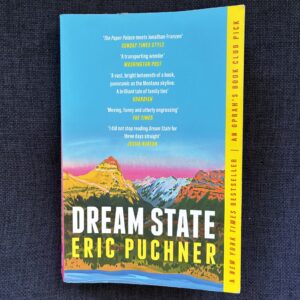
This book begins and ends in the mountains of Montana. In between, it unfolds a panorama of three friends’ lives, told with such force and tenderness that I could not put it down for days. At its center are Cece, Charlie, and Garrett. Cece and Charlie want to get married, but just before the wedding, Cece and the depression-stricken Garrett meet. Their encounter shapes the decades that follow, upends plans, and leaves its mark on the next generation as well. Puchner writes about love and grief, happiness and illness, animals and nature – all of it with such warmth that you find yourself fully absorbed into his Dream State.
*
The Week on Verfassungsblog
summarised by EVA MARIA BREDLER
Bizarre scenes played out in the European Parliament on Wednesday: highly educated ladies (few) and gentlemen (many) of middle age, who have by and large had it rather easy in life so far, rose to their feet in fine attire in the plenary chamber, clapping and contentedly chanting the slogan “Send Them Back” – half hooligans, half highborn, but please, no diversity. The Parliament passed the so-called Return Regulation with the votes of the conservative and far-right groups; a handful of MEPs at least shouted “Shame on You” in response. Absent, naturally, were those the regulation actually affects – migrants from third countries. They can now be brought, against their will, to a country they neither know nor have ever set foot in, and which the regulation, in Article 4(3), nonetheless defines as the country of return. For DANA SCHMALZ (GER), this is not a return – it is an abduction.
Interestingly, even the distinguished MEPs of the European Parliament are now getting a taste of what it means to be a second-class citizen. The US has tightened its export controls to the point that non-Americans are barred from Anthropic’s most advanced AI models – not at the border, but wherever they happen to be. If you use Anthropic, you’ll see a small banner at the bottom: “Claude Fable is currently unavailable”. GILAD ABIRI and DIMITRY KOCHENOV (ENG) see in this a disturbing new feature of citizenship: it now determines access to productivity and key technologies – and thus polices the gates of a technological future.
A bleak vision of that techno-future was published recently by tech billionaire and Palantir CEO Alex Karp in his manifesto. PAUL NEMITZ (GER) explains what lies behind its 22 points: an order in which security becomes the business model and military power the highest virtue – “a new, dangerous symbiosis of militarist state and tech capital”.
Germany is, fortunately, (still) a long way from that. Here, laws are at least meant to protect against digital violence, not to enable it. But PETRA SUSSNER (GER) warns: the federal government’s new bill ties protection from violence to far-reaching encroachments on fundamental rights.
On the military side, too, things in Germany are running along more traditional lines. The new “Pact For Civil Protection”, with which the federal government wants to bring civil and military defence into closer alignment, contains not a single mention of AI. But SEBASTIAN AMBROS (GER) points to a different gap: the military protection of cultural property. He calls for cultural protection officers in the Bundeswehr.
++++++++++Advertisement++++++++++++
Stellenausschreibung
An der Professur für Bürgerliches Recht, Handels-, Gesellschaftsrecht, Compliance und Nachhaltigkeit (Prof. Jan-Erik Schirmer) ist eine Stelle im Projekt „Viadrina Climate Litigation Clinic“ als Akademische*r Mitarbeiter*in (Kenn-Nummer 1104-26-01) zu besetzen. Bewerbungsschluss ist der 05.07.2026.
Unser ausführliches Stellenangebot: www.europa-uni.de/stellenangebote
++++++++++++++++++++++++++++++++
On Wednesday, UN Special Rapporteur Irene Khan presented her report on freedom of expression in Germany — and called on academic institutions to safeguard academic freedom and to create safe, open spaces for research and a plurality of views. The Hertie School appears to be struggling with this: it has banned Palestinian solidarity symbols at its upcoming 2026 graduation ceremony and required students to sign a declaration accepting these terms. BERNHARD KNOLL-TUDOR (ENG) takes a critical view.
The Max Planck Society is also wrestling with these questions, even in court: was it allowed to dismiss an anthropologist over his contested poem on 7 October 2023? The Halle Labour Court found the dismissal lawful. Ahead of the appeal hearing, HANNAH FRANZKI (GER) explains why she considers this legally unsound.
Criticism of Israel is also occupying the courts in the United Kingdom. After the High Court had declared the ban on Palestine Action unlawful, the Court of Appeal has now overturned that ruling and upheld the ban. For ALAN GREENE, DANIELLA LOCK and COLIN MURRAY (ENG), the margin of appreciation the court grants the Home Secretary leaves judicial review with little of substance to do.
How much of judicial review remains may also decide Zimbabwe’s fate. President Mnangagwa wants to amend the constitution to take a third term in office. That is nothing new in African constitutional culture – but the Zimbabwean constitution has specifically built in safeguards against precisely this. MARKUS BÖCKENFÖRDE (ENG) analyses whether they will hold and what role the Constitutional Court will play.
We also have to worry about executive overreach in Saxony-Anhalt. Should the AfD enter government after the election, it does not need to dismiss anyone in order to control the administration. Instead of dismissals, the AfD can rely on intimidation and uncertainty, as DOMINIK VOGEL (GER) shows.
If the AfD provides an interior minister after September’s state elections, this also raises questions for security federalism: what happens to police data-sharing when the AfD governs Saxony-Anhalt? MARKUS THIEL (GER) explains that data-protection law is built for individual cases and fails when the mistrust extends to an entire state police force.
At the AfD’s request, a district in Thuringia decided at the end of May to forgo funding under the federal programme “Demokratie leben!”. But the democracy funding programme is under pressure nationwide: federal family minister Prien has announced that more than 200 democracy projects will be wound down by the end of the year – in particular those promoting diversity, which in her view target too narrow a left-liberal milieu. VANESSA WINTERMANTEL (GER) sees this as a misreading of democracy and explains why democracy needs diversity.
Entirely in keeping with that democracy-relevant diversity, the right to vote could also be extended to residents without German citizenship. The Left parliamentary group recently called for exactly that in the Bundestag, and the backlash was immediate. Many reflexively pointed to BVerfG decisions from thirty years ago. But that falls short, argues TARIK TABBARA (GER), calling for open debate: nowhere does the Basic Law actually say that only German citizens may vote.
In India, the right to vote is being manipulated in earnest. Following its victory in West Bengal, the BJP engineered the defection of 20 opposition legislators to boost its parliamentary majority. ANMOL JAIN (ENG) shows that the anti-defection law offers no real check: House Chairpersons sit on disqualification petitions, and defecting legislators exploit a merger exception the Constitution never intended for this purpose.
++++++++++Advertisement++++++++++++
Wie können Hochschulen ihre Unabhängigkeit in Zeiten demokratischer Herausforderungen sichern?
Die Bucerius Law School sucht eine:n Program Manager:in Recht & Gesellschaft (befristet auf drei Jahre, Vollzeit) für das internationale Kooperationsprojekt Higher Education & Democratic Resilience mit der University of Oxford und dem Verfassungsblog. Gesucht wird eine engagierte Persönlichkeit mit Erfahrung an der Schnittstelle von (Rechts-)Wissenschaft, Politik und Zivilgesellschaft.
++++++++++++++++++++++++++++++++
Our symposium “On Law and Politics in the Hungarian Transition” (ENG) drew to a close this week. MÁRTA PARDAVI reminds us that even the most carefully designed constitutional reform remains ineffective if it bypasses those whose lives it is meant to improve. With an eye on Poland, KATARZYNA ŁAKOMIEC and BARBARA GRABOWSKA-MOROZ show how strikingly absent women are from the democratic rebuilding – and how that absence was already laid down in the earlier neglect of women’s rights. EDIT ZGUT-PRZYBYLSKA argues for institutionalised participation, decentralised power, and a civil society embedded directly in the work of government. RENÁTA UITZ examines how academic freedom in Hungary is currently being reshaped – and how it will have to be won back. MICHAL BOBEK holds that the same rule-of-law red lines must also apply to Orbán’s successors – to bad guys and good guys alike. The Venice Commission’s job is to monitor exactly those red lines, but Hungary has overwhelmingly ignored 27 of its opinions. ANGELIKA NUẞBERGER shows how the Commission can reliably support the country through this transition. In the closing piece, ARMIN VON BOGDANDY and LUKE DIMITRIOS SPIEKER remind us that this constitutional reform is not only a Hungarian matter, but a European constitutional moment.
But don’t worry: the next symposium has already begun. “Inter-Judicial Dialogue on Climate Change and Human Rights” (ENG) brings together judges, practitioners and scholars from the European, Inter-American and African human rights systems. At its centre stands climate change as a human rights question. ANNA LUMERDING, MELANIE MAURER and LENA RIEMER open the symposium and explain how climate change and human rights are bound up in one another. Two years on from the ECtHR’s KlimaSeniorinnen judgment, DARIAN PAVLI takes stock and looks at the cases that have followed. For STÉPHANIE CALIGARA, Müllner v. Austria is more than KlimaSeniorinnen 2.0 – the case could become the pivotal decision in the Court’s emerging climate jurisprudence. NANCY HERNÁNDEZ LÓPEZ turns to Advisory Opinion OC-32/25 of the Inter-American Court of Human Rights, which has finally made the connection between climate change and human rights legally binding.
Sadly, the law does not always keep up with the connections we already live in. We want to feel safe in our small national fortresses – drawbridge up, hatches battened down. But the sea is rising, and AI powers the fortress. The world knows no borders. May our imagination know none either, when it comes to putting that borderlessness into law.
*
That’s it for this week. Take care and all the best!
Yours,
the Verfassungsblog Team
If you would like to receive the weekly editorial as an e-mail, you can subscribe here.