





The Constitution Releases Its Children
Brasil Before the Presidential Runoff
The shock over the shift to the right in the first round of the Brazilian presidential, congressional, and state elections on October 4th runs deep. It is felt not only by supporters of the current incumbent, President Luiz Inácio Lula da Silva, and his broad coalition (which is not unlike Germany’s erstwhile ‘traffic light’ coalition), but also by all those who had hoped, Brazil would defy the crisis of liberal democracy and remain a bulwark of democratic constitutionalism. Even if there remains a glimmer of hope that the return of Bolsonarism to the presidency during the runoff on October 25 can still be held off, it is clear already after the first round that a hard right populism will dominate the Brazilian Congress and most of its state governments – and, hence, the baselines of Brazilian politics –, even if Lula should, in the end, be re-elected by a whisker.
However, if he is not, then this election will mark the end not only of the Lula era, but, more generally, of the ever fragile but ultimately stable democratic consensus that began with the country’s re-democratization after twenty-five years of military dictatorship and a new constitution in 1988. For a long time that constitution and its unusually participatory drafting supplied a positive founding narrative for a nation that wished to reinvent itself without truly being able to do so. In the mellower reading of what now looks like the final phase of this era – which likely already began with the questionable 2016 impeachment of Lula’s pre-predecessor Dilma Rousseff – this constitution is seen in a more ambivalent light (s. Bello, Bercovici & Lima; Meyer; Nunes): while it introduced a comprehensive catalogue of fundamental rights and defined minimum spending floors for health care and education, it combined this with a liberal economic constitution that made any more fundamental reforms of, for example, the tax system difficult (s. Maués).
The operative pillars of this incongruous construction were formed, on one hand, by so called coalition presidentialism, in which an undesired yet unavoidable, as well as opportunistic and politically flexible set of centrist parties in Congress (the Centrão) was needed to secure majorities for any (presidential) government (Bustamante & Meyer); and, on the other hand, by an increasingly self-confident judiciary led by the Supreme Federal Tribunal (Supremo Tribunal Federal – STF). While this judiciary, and especially its apex court, did act as a bulwark of democratic institutionalism during the turbulent years of the elder Bolsonaro’s presidency and attempted coup (Gaspardo & Oliveira), critical observers now argue that it could only assume this role because it had simultaneously remained hesitant or conservative in other areas such as economic policy or the rights of women, Afro-Brazilians and the indigenous population.
++++++++++Advertisement++++++++++++
++++++++++++++++++++++++++++++++
In any case, this election bodes for a slow and painful end for both the Centrão and for the STF. The Centrão has already gotten a first glimpse of this in the first round of the elections, in which it lost significantly more votes than the Lula coalition and might slide into political irrelevance sooner rather than later. In its stead and in the post-election future, a larger right populist (and at least partly extremist) bloc, led by the shining winner of this first round, the (oddly named) Partido Liberal of the Bolsonaro clan, would confront a shrinking left coalition that would initially need to find new leaders that could emerge from Lula’s outsized shadow.
The STF, in turn (and ironically), has largely to blame itself for its likely decline. This is precisely not because, with Justice Alexandre de Moraes above all as its face, it repeatedly put Bolsonarism in its place (much to the displeasure of the latter’s patron in Washington, D.C.); but because that same Moraes, as well as at least another three justices, found himself entangled in a bank fraud scandal of unprecedented dimensions that kept the country holding its breath, or rather, left it breathless, right during the hot phase of the election campaign. That son No. 1 and presidential candidate Flavio Bolsonaro was also implicated in the scandal through a multi-million donation disguised as a contribution to a US-produced feature film about his father (ominously named Dark Horse) ended up playing only a subordinate role.
For it was the STF that became the main theatre of war, with justices splitting into two hostile camps: one, led by a Bolsonaro (father)-nominated justice pressing for a public investigation of Moraes; the other determined to prevent such an investigation. For a fascinated public looking on, this briefly became the main stage of the election campaign, with the Bolsonaro campaign showcasing Moraes, who was neither nominated by Lula nor is of the same political camp, as a proxy representative of a corrupted post-1988 democracy.
++++++++++Advertisement++++++++++++

Princeton University invites applications for a tenured faculty position in bioethics in the University Center for Human Values, beginning on or after July 1, 2027. Rank: Full Professor. We seek distinguished scholars with a strong interest in bioethics broadly construed, including questions of policy and individual choice, with backgrounds in philosophy, political theory, legal scholarship, religious ethics, and related fields. Applications are due by November 1, 2026, for full consideration.
++++++++++++++++++++++++++++++++
And, thus, the Bolsonarist STF quip of the “dictatorship of the robe” (which was taken up, time and again, by the Trump administration) ended up merging with the diagnosis on part of critical constitutional law scholars that Brazil had mutated into a “supremocracy”, i.e. into a de facto juristocracy, with the STF often referred to simply as the Supremo, in which the latter effectively co-governed the country (s. Vieira & Barbosa). In the end, this mainly helped Bolsonaro (son)´s first-round election result. A longer term and much more dramatic consequence might, however, be a far-reaching (self-)delegitimation of the STF and the very real danger that under a new Bolsonaro presidency, during which up to four new justices could be appointed, the court’s independence would be crushed, with it then being refashioned into a political enforcement instrument of a hard right-orientation for decades to come.
This would, indeed, be a watershed (or, as Germans nowadays like to frame it, a Zeitenwende) (s. Stuenkel), from which the constitution itself would scarcely be spared. What the new times would bring is, however, highly uncertain. For despite great efforts to free itself from the historical shadows of colonialism and slavery, Brazil is still marked by enormous social inequality and the likely exclusion-enhancing polarization that lies ahead might well further inflame the ever-smoldering potential for social conflict (s. Kenkel & Hoffmann). Likewise, to the world around, such a ‘new’ Brazil would no longer be what, with brief exceptions, it has been able and willing to be over the nearly forty years since its democratic new beginning. Thus, the Constitution releases its children into an uncertain future. May they prove mature enough to shape things differently than how it currently appears they might.
*
Editor’s Pick
by GEORGIA IOSIFIDOU
Copyright: Allen Lane
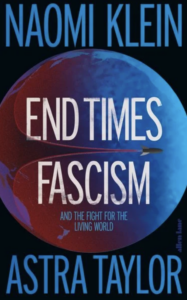
In their book “End Times Fascism,” Naomi Klein and Astra Taylor describe the dangerous alliance that has taken hold of US politics: religious fundamentalists, tech billionaires, and ethno-nationalists. These groups share little except for the belief that the apocalypse is near and that they can build their own “paradise” afterwards – convinced of their supposed superiority. I expected the book to make me feel despair. Instead, I felt energized and ready to act. The end-times fascists do not believe in a shared future on this planet. Klein and Taylor urge us to do the opposite: to fight for a better world. They recount the struggles people before us waged for this cause, struggles that continue to this day, reminding us that “it is always the task of the present to pick up where past movements left off, learning from both their victories and defeats, and taking courage from their audacity.” The book shows us how to begin doing so – in the United States and beyond.
End Times Fascism: And the Fight for the Living World, Naomi Klein and Astra Taylor, Allen Lane 2026, 384 pages.
*
The Week on Verfassungsblog
summarised by EVA MARIA BREDLER
Have you ever heard of red sprites? No, it’s not a new brand of artificial lemonade. It’s a weather phenomenon that occurs high above storms, 40–80 km up in the sky, and looks like something straight out of “Stranger Things”: electric red, with thin branches reaching downwards like spindly fingers. This week, they were captured over France, making the Apocalypse feel a bit too close for comfort. But they are harmless and fleeting.
If only we could say the same about the far right. It has its very own fantasies about the Apocalypse, starring rogue AI and what Peter Thiel calls the “Antichrist”: the regulatory state. I imagine Thiel is particularly scared of those spindly fingers reaching down. Perhaps that is why he moved from the US to Argentina, where he has teamed up with the self-declared “anarcho-libertarian” President Milei to fuse his political technology with the power of the state. WILLIAM CALLISON and VERÓNICA GAGO (ENG) explain how Milei and Thiel are turning Argentina into an “extractive state” – a laboratory for Silicon Valley and finance capital.
The German far right is not quite there yet, but it shares the same spirit: “alles ist möglich” – everything is possible – was the AfD’s campaign slogan in Saxony-Anhalt. It turned out to be a smart one. For the first time, the AfD now holds the presidency of a Landtag, a German state parliament. SEBASTIAN FRIEDRICH and JANOS RICHTER (GER) show how a Landtag president could pave the way for a gradual authoritarian transformation.
Many would rather prevent such a transformation and are calling for the AfD to be banned. However, some argue that AfD ban proceedings would fail to clear the constitutional hurdle of an “actively militant, aggressive stance”. Not so, argues JONAS DEYDA (GER): the Federal Constitutional Court discarded that specific term in 2017, and it never had anything to do with physical violence in the first place.
++++++++++Advertisement++++++++++++

The DFG-funded research training group “Post-Eurocentric Europe” at the University of Konstanz offers twelve doctoral positions from 1 October 2027 (65%, up to four years, subject to funding). The group is interdisciplinary: projects in law, political science, anthropology,history and literary and cultural studies are welcome. Requirements: an excellent Master’s degree or an equivalent qualification, a dissertation project. Apply by 12 December 2026 via the online portal (ref. no. 2026/206).
++++++++++++++++++++++++++++++++
Early this week, the Hamburg Regional Court issued search warrants for DIE ZEIT and a journalist’s home to seize interview recordings for the “Block trial”. The trial concerns the alleged abduction of two children belonging to Hamburg businesswoman Christina Block from Denmark on New Year’s Eve 2023/24. Block is accused of commissioning the abduction; the charges against her include aggravated child abduction (§ 235 StGB). Now, the case has evolved into a debate over press freedom. BJÖRN-HENDRIK OTTE (GER) argues that a free press depends on the trust of its sources, and that the court’s actions have severely damaged that trust.
India’s Supreme Court may have done similar damage: Last week, the Court dismissed a 17-year-old constitutional challenge to the prosecution of 15 journalists for remarks against then-Chief Minister Jayalalithaa. It dismissed the matter because the resolution ordering their arrest had since been withdrawn, rendering the proceedings a mere “academic exercise”. PRANAV MITTAL (ENG) explains the constitutional costs of the decision.
When it comes to the press, US President Donald Trump is, as usual, a little less subtle. He takes credit for eroding public trust in the news media. And now, he has barred media outlets that criticise him from entering the White House. JANE KIRTLEY (ENG) explains why this is an equally blunt violation of the First Amendment.
Might Trump’s recent escapades backfire in next month’s midterm elections? He at least seems to be preparing for that possibility. Trump wants to restrict postal voting, which he claims favours Democrats and is susceptible to widespread illegal voting by noncitizens. More than 20 million US citizens voted by mail in 2024. JOSHUA SELLERS (ENG) explains how Trump is trying to curb mail voting and, once again, influence election outcomes.
As Italy’s Meloni government enters the final year of its term, it seems to have given in to the same temptation: it has reformed electoral law, granting the winning party a majority bonus. BENEDETTA LOBINA (ENG) explains why the reform’s nickname, “Stabilicum”, promises more than it can deliver.
++++++++++Advertisement++++++++++++
The DFG-funded research training group “Post-Eurocentric Europe” at the University of Konstanz seeks an Early Postdoc from 1 October 2027 (full-time, until 30 September 2029). The task: develop your own post-doctoral projectand help shape the group’s research profile. The group is interdisciplinary: applicants in law, political science, anthropology, history and literary and cultural studies are welcome. Apply by 12 December 2026 via the online portal (ref. no. 2026/205).
Please find more information here.
++++++++++++++++++++++++++++++++
Two years ago, the Netherlands became the first country in the world to legalise active euthanasia for children aged 1 to 12. The review committee set up under the new rules has now published its first report, detailing a case from 2025. VANESSA BLIECKE (GER) uses this case to show why the law violates the UN Convention on the Rights of Persons with Disabilities – and why it should mark an absolute regulatory red line for other European states.
HEIKO MEIERTÖNS (GER) draws similar absolute limits in the debate on Germany’s intelligence service reform. While some fear that the planned operational powers amount to a “licence to kill”, Meiertöns points to the restrictions set by constitutional and international law, which follow from the peace imperative in Art. 26(1) of the Basic Law – effectively ruling out any such licence.
The intelligence reform is also a response to a shifting geopolitical landscape. Europe can no longer rely on former allies to guarantee its security and must start a little DIY project. The European Union is getting ready: last week, the Commission presented its policy reviews “Preparing for a wider Union”. The Commission proposes that new Member States could lose certain rights if they breach EU values or the principle of sincere cooperation. LUKE DIMITRIOS SPIEKER (ENG) argues that this would violate the equality among Member States. In a rejoinder, LETICIA DÍEZ SÁNCHEZ (ENG) shows that Accession Treaties have historically allowed disparities between older and newer Member States to persist.
Another Commission proposal sounds like a bit more fun: The “regulatory sandbox” would give companies a supervised space to test innovative products under real-world conditions.
NIKITA DIVISSENKO (ENG) argues that the proposal could foster a shared European innovation culture.
A shared innovation culture sounds promising, and in some cross-border fields of law, it may already be emerging organically. Take climate law: litigants adopt arguments, evidence and strategies from cases in other countries, and judges draw on rulings from vastly different legal systems. That is why MELINA DE BONA and BENJAMIN FRANTA (ENG) argue that courts and litigants should pay close attention when the US Supreme Court decides Suncor Energy, argued on 5 October 2026.
Four days after that, Brazil’s Federal Prosecutor’s Office and the environmental non-profit Instituto Preservar sued Shell Brasil for damage caused by the 2024 floods in Rio Grande do Sul. With this suit, Brazil joins the growing list of countries where public prosecutors are taking fossil fuel producers to court. ALESSANDRA LEHMEN (ENG) examines how Brazilian environmental liability law addresses causation when a climate disaster is linked to a single emitter.
This week, we’ve also continued our symposium “Thinking Machines, Thinking Lawyers” (ENG). ADAM CHILTON, ARTHUR LANGLOIS, JAN-ULRICH DITTMER and MILA VERSTEEG find that LLMs can reliably code simple constitutional facts, but fail when concepts require interpretation, meaning machine data cannot replace expert coding. ANMOL JAIN questions why legal academia accepts AI for polishing texts but dismisses it for developing ideas. GIOVANNI DE GREGORIO argues that universities, and European law schools in particular, still lack an institutional strategy for legal education in the age of AI. KARAITIANA TAIURU shows why AI trained on text cannot recognise Indigenous legal traditions, which exist in oral, relational and place-based forms. As Taiuru puts it: “An AI system built to learn from text does not merely fail to locate such law. It is architecturally incapable of recognising legal knowledge in the forms in which that law exists.”
Red sprites, by the way, were dismissed as pilots’ tall tales for decades until a camera happened to catch one in 1989. The sprites had been there all along. What was missing was an instrument built to see them.
The Year 2025 on Verfassungsblog
“2024 was a terrible year, filled to bursting with war and crime and unprecedented triumphs of the global authoritarian turn.” That is what we wrote in our annual report a year ago. For 2025, we could simply reuse the sentence: “The storm has not let up.”
Our Annual Report 2025 is now out (in German). It shows what we published about and against this storm (and others): 1,014 contributions by 972 authors, among them 19 blog symposia and 42 editorials like this one, plus twelve Verfassungsbooks and the conclusion of our Justiz-Projekt. We were carried by a community that is larger and more robust than it often seems in these dark times: 1,059 individual donors and 76 institutional funders supported us in 2025. And last but not least, you, our readers: our website recorded almost 5 million page views, more than 75,000 people follow us on social media, and 17,000 have subscribed to this newsletter. That gives us courage. And we are grateful for it.
Read the Annual Report 2025 (in German) here.
*
Take care and all the best!
Yours,
the Verfassungsblog Team
If you would like to receive the weekly editorial as an e-mail, you can subscribe here.