







Venezuela After the Earthquakes
A Fragile State Exposed, an Opposition Tested
On June 24, 2026, two earthquakes struck Venezuela within forty seconds, with magnitudes of 7.2 and 7.5. As of 2 July, the official death toll has climbed past 2,295, and more than 38,600 people remain unaccounted for. Satellite analysis suggests 58,000 buildings were damaged or destroyed, while a probabilistic model places the likely toll within a range that could eventually reach the tens of thousands.
Numbers of that scale can flatten into abstraction. Having lived through the disaster in Caracas and seeing people desperately crying for help, only reinforces our own empirical understanding of a state in decline. La Guaira, the coastal state north of Caracas, had already lived through a catastrophic mudslide in 1999 that killed thousands. Twenty-seven years later, the same region is again a landscape of damaged buildings and improvised camps. Residents describe neighbors and strangers doing more for them than any government agency. Hours before the earthquakes struck, 146 Venezuelans deported from the United States had arrived in Caracas and were staying in a guarded hotel when the ground shook. Several died.
Democracy rests on more than elections and checks and balances. It also depends on social trust, a functioning state with administrative capacities, and a basic expectation that collective problems can be solved through public institutions. Within hours, what the earthquakes revealed was the extent to which those foundations have eroded in Venezuela.
They also revealed a triple asymmetry: a state that retains coercive power but lacks administrative capacity; an opposition with democratic legitimacy but limited embedded institutional and governing abilities; and a foreign government, the United States, with substantial leverage but an uncertain commitment to a process of democratization.
Coercion Without Capacity
The first hours after the earthquake revealed a familiar reality for Venezuelans. Search and rescue operations were conducted primarily by relatives, neighbors, volunteers, religious organizations, local businesses, and informal networks. International rescue teams arrived mainly from across the hemisphere and Europe. Public authorities eventually mobilized resources, and the interim government led by Delcy Rodríguez declared a state of emergency and announced a $200 million reconstruction fund. But the initial response confirmed what millions of Venezuelans have experienced for years: a state that retains instruments and agents of coercive control but whose capacity to perform its most basic protective and administrative functions has been profoundly degraded.
Venezuela is not a failed state in which rival warlords fracture the map and the government loses its grip on organized force. The state has not disappeared. Although unevenly, security forces still operate, courts still issue rulings, ministries sign agreements, and the government is once again largely recognized abroad.
Venezuela evidences something potentially more troubling: a state that has preserved and developed its coercive capacities, while progressively losing its administrative capacities. A state may retain much of the first while losing much of the second. That helps explain why the government is largely able to control the political space but struggles to move rescue equipment, medical supplies and reliable information into La Guaira and other affected areas.
For more than two decades, political power in Venezuela has become increasingly centralized. The process accelerated dramatically after the opposition’s victory in the 2015 parliamentary elections. Legislative authority and oversight were effectively neutralized. Regional and local governments controlled by opposition parties were repressed and deprived of powers, resources, and autonomy. Public administration became progressively and heavily politicized. Professional bureaucracies deteriorated through corruption, clientelism, and mass migration. Emergency powers and ruling by decree became normalized as mechanisms of ordinary governance.
In short, Venezuela’s constitutional order evolved into a system characterized by permanent states of exception and the systematic dismantling of institutional checks and balances. Yet the earthquakes have revealed another consequence of this process. Authoritarian centralization has contributed to the decline of the state’s capacities. A government that concentrates power in one place gains day-to-day control, but it also strips away its own backup plan. Decentralization is not merely a democratic preference. In practice, it is a form of ‘constitutional insurance’. Regional and local governments, civil-protection bodies, courts, career bureaucrats, universities and professional associations can each act when the center cannot. When one institution fails, another may compensate. Yet, the Venezuelan government has spent decades weakening such insurances.
++++++++++Advertisement++++++++++++
Nach den Landtagswahlen könnte erstmals eine autoritär-populistische Partei in einem Bundesland (mit-)regieren.
Was kommt da auf uns zu?
Der Verfassungsblog bündelt dazu Expert:innenwissen, damit es parat steht, wenn es gebraucht wird.
Lesen Sie hier die Beiträge in unserem Spotlight.
++++++++++++++++++++++++++++++++
The consequences of that centralization became evident when citizens lay trapped beneath collapsed buildings, with no proper functioning channels to reach help and no clear chain of communication from the ground up to the central government. In many instances, people have largely organized their own rescues, block by block, because the infrastructure that should have rapidly connected them to the state was lacking or too slow to arrive.
The explanation for institutional weakness cannot be found in authoritarianism alone. It also lies in widespread corruption. The diversion of public resources over decades contributed to the deterioration of infrastructure, public housing, healthcare and emergency preparedness. But corrupt practices have not remained confined to ministries or elite networks. Informality, clientelism, distrust and transactional relations have increasingly become adaptive ways of navigating everyday life. Solidarity exists, and it matters. But solidarity will hardly be a substitute for a capable and trustworthy public administration.
The Consequences of Opposition Outsourcing
Much of the international discussion surrounding Venezuela’s opposition has traditionally focused on the effects of repression, strategic choices, representation and legitimacy. These issues remain fundamental. Yet the earthquakes raise a different question. What institutional capacity has the opposition developed or preserved after more than twenty years of struggle against authoritarian rule?
For much of the last two decades, key sectors of the Venezuelan opposition have pursued a strategy based on the belief that democratic change would ultimately occur through mechanisms external to ordinary institutional politics. This strategy has taken different forms over time: the 2002 coup attempt, the 2002-2003 oil strike, the 2005 electoral boycott, the protest cycles of 2014 and 2017, the strategy of seeking international recognition following 2019, sanctions advocacy, and repeated appeals for foreign intervention or external pressure sufficient to produce regime collapse.
The most recent boycott in the 2025 municipal and legislative elections was pushed by the opposition’s leading faction after it had won the 2024 presidential contest, which was neither free nor fair, on the grounds that participating would legitimize a presidential result the opposition did not recognize. It followed the same logic as earlier strikes and boycotts, holding that defeating the government requires refusing to operate within its institutions entirely, and that outside pressure, whether from abstention, sanctions, or eventually a foreign intervention, would fully displace chavismo.
But the boycott was not universally followed, and several opposition figures broke away. While the ruling coalition maintained vast control over the regional and local landscape, remaining essentially unopposed from the bottom up, the opposition retained a small number of municipalities, including Chacao and Baruta in Caracas.
Extra-institutional strategies did not emerge irrationally. Political competition in Venezuela has long been characterized by severe asymmetries, institutional manipulation, repression, and cooptation. Under such conditions, pursuing change through ordinary institutions can appear difficult, or even futile.
Nevertheless, strategic choices also produce institutional consequences. A substantial part of the opposition progressively outsourced the problem of democratic change. These actors believe that foreign governments, sanctions regimes, diplomatic pressure and isolation would trigger the collapse of the authoritarian ruling coalition. Simultaneously, electoral boycotts were often pursued to delegitimize the government, leading many opposition actors to abandon the difficult and often frustrating task of maintaining institutional footholds on the ground.
The consequences have become evident during the earthquake response. Leaders with institutional bases in municipalities and local governments retained some capacity to organize relief efforts, coordinate volunteers, and even interact with international actors. Opposition sectors lacking institutional capabilities and more dependent on foreign support have had considerably fewer direct tools to help Venezuelans during this tragedy.
In fact, the problem is not that the opposition lacks organizational ability altogether. Its 2024 electoral operation demonstrated the opposite: a network of representatives, observers and volunteers collecting and publishing thousands of polling-station records, preserving evidence of the popular will when state institutions refused to do so. But electoral mobilization is not the same as governing capacity.
Since August 2024, Edmundo González Urrutia has embodied, for a large part of the Venezuelan population and the Western international community, the claim of democratic legitimacy. Yet, at least in public view, that legitimacy has not been visibly crystallized into a broad, operational apparatus. For instance, no inclusive cross-party platform is yet visible to coordinate shared policy goals; there is no opposition instance maintaining structured dialogue with social sectors within the country; and/or preparing the administrative, legal and political groundwork for an eventual transition.
González Urrutia’s exile and the arrests and systematic persecution of opposition figures partially explain this deficit. But they do not erase the need to craft an institutional architecture and the relationships required to govern when an opening arises.
++++++++++Advertisement++++++++++++
Your ad — for your community and for independent constitutional debate
Hiring? Hosting a conference? Publishing a Call for Papers or a new book? Place your ad in the Verfassungsblog editorial.
You’ll reach almost 20,000 subscribers directly via newsletter — and thousands more through the website. Fellow scholars, practitioners, constitutional law nerds. And your ad helps us continue doing what we do: independent, expert-driven, rigorous, timely, readable.
Get in touch, we’ll walk you through the options! advertise@verfassungsblog.de
++++++++++++++++++++++++++++++++
Additionally, the recent experience of opposition leader María Corina Machado clearly illustrates another dilemma. Upon her return to institutional politics following her participation in and success in the opposition primary in 2023, Machado became the leading opposition decision-maker and strategist. After the 2024 fraud, her strategy has consistently emphasized the illegitimacy of authoritarian institutions and the need for external intervention to produce political change. Following the earthquakes, Machado reportedly sought U.S. support to return to Venezuela. But senior U.S. officials reportedly urged caution, citing the immediate humanitarian crisis, and the Trump administration has continued to support Delcy Rodríguez as the country’s interim leader.
The episode reveals a structural weakness in an opposition strategy heavily dependent on external actors. Politicians or movements that become excessively dependent on external stakeholders can inevitably become vulnerable to changes in their partners’ priorities. The effect is difficult to ignore. The political factions that most consistently argued that democratic transition required international intervention now face the risk that international actors, mainly the current United States government, may accept authoritarian stability in exchange for preferential, opaque access to Venezuela’s natural resources.
This complex reality does not imply that opposition participation within authoritarian institutions necessarily produces democratization. Rather, democratic resistance also requires working over the long term to preserve institutional capacity even when challenging authoritarian rule. A transition to democracy does not occur only through legitimacy. It also requires the knowledge, networks, and experience of bureaucratic administrators, local leaders, governing skills, and institutional memory.
From Democratic Transition to Transactional Authoritarian Stability?
For nearly a decade, international policy toward Venezuela rested upon a relatively simple proposition. Authoritarian rule could be quickly replaced through a democratic transition. International pressure was considered crucial to facilitate that process. This consensus is starting to appear increasingly exhausted.
The events following Nicolás Maduro’s removal from power in January 2026 illustrate this transformation. Rather than pushing for democratization, major international actors, particularly the United States, have increasingly prioritized stability, migration control, energy cooperation, security coordination, and access to natural resources. In fact, Washington continues to express rhetorical support for democracy and human rights. Simultaneously, however, it appears to have developed a pragmatic working relationship with the government of Delcy Rodríguez.
The shift is not necessarily surprising. States routinely prioritize strategic interests over democratic values and outcomes. Yet the implications of this calculation extend well beyond foreign policy decisions made in Washington. For years, international pressure served as a sort of backstop for Venezuelans, a mechanism many hoped would eventually force a resolution even when domestic politics could not. It is that backstop that the earthquakes have quietly called into question. When Machado’s plane had to turn around mid-flight, not by the government she had spent years opposing, but at the request of the same government she was counting on, the implied message was hard to miss. The foreign government that many Venezuelans had high expectations of no longer appears to regard their democratic aspirations as the most urgent.
Venezuelans are left facing not one problem, but three, and each one makes the others harder to solve. The state that cannot protect or serve its own citizens. The opposition’s leverage is highly dependent on foreign support. And the United States government, the international stakeholder with the most influence, at least for the moment, seems to prioritize the current arrangement over the democratic transition it was expected to help deliver.
Despite the above, many Venezuelans have demonstrated to themselves and the world that they still care for one another in times of crisis. The spontaneous organization that emerged across communities points to a social fabric that has withstood years of pressure. Although that fabric does not substitute for a capable government and foreign support is not a substitute for an opposition with an embedded democratic institutional capacity, this fabric may become a seed of something larger and more ambitious: a renewed fight for sovereignty and the long-deferred aspiration to live again in a democratic state that can protect, administer, respond and command trust: decentralized enough to act, professional enough to deliver, and pluralist enough to be trusted. After the earthquakes, Venezuela’s central challenge is not merely regime change. It is the reconstruction of constitutional state capacity.
*
Editor’s Pick
by JANA TRAPP
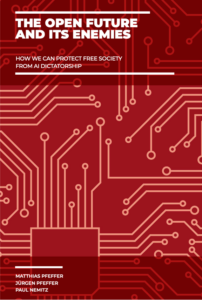
What happens to society when Artificial Intelligence takes center stage? More often than not, this question conjures up dystopian doomsday scenarios. But as Matthias Pfeffer, Paul Nemitz, and Jürgen Pfeffer show in „The Open Future and Its Enemies”, there are alternatives to Terminator tropes and tech-dictatorships. Their book is a passionate rallying cry for a democratic digital transition. With a sharp eye and zero techno-pessimism, the authors explore how we can navigate the breakneck pace of AI without losing our constitutional and ethical bearings. The result is a distinctly European take on the tension between freedom, power, and regulation. You won’t find off-the-shelf answers to thorny constitutional questions here – but you will find a wealth of brilliant insights and the inspiration to start asking the right questions.
*
The Week on Verfassungsblog
summarised by EVA MARIA BREDLER
The horrible earthquake in Venezuela is laying bare a deeper governance crisis. In Albania, a development project is doing something similar. A luxury resort linked to Jared Kushner and Ivanka Trump has sparked what is now called the “Flamingo Revolution” – flamingos populate the protected area of Vjosë-Nartë, where the project is set. “Albania is not for sale” has become the symbol of the demonstrations. The country has been an EU accession candidate since 2014, and protesters were optimistic when the European Parliament approved a resolution calling for a moratorium on any development in the Vjosë-Nartë. DARINKA PIQANI (ENG) dims the optimism and explains the limits of EU conditionality in protecting the environment.
Where EU conditionality falls short on climate, national courts sometimes hold the line. On 25 June, the Tribunal judiciaire de Paris ruled that TotalEnergies’ duty of climate vigilance covers Scope 3 emissions – the carbon released when customers burn the fuel it sells. ALESSANDRA LEHMEN (ENG) explains what the ruling’s architecture means beyond France, while MARTA TORRE-SCHAUB (ENG) shows why the court frames this expansion not as a new duty, but as an application of the vigilance obligation’s existing preventive logic. Both pieces are part of our new Spotlight on “Law and Climate” – 284 contributions and counting.
Meanwhile, eight anti-ICE protesters were sentenced at the Prairieland Detention Center in Texas, receiving a combined 450 years in prison. It is absurd: thirty years for moving a box of pamphlets. Fifty for showing up at a protest wearing black. The concept of terrorism has been hollowed out since the 1990s by legislation that paves the way for massive sentences for relatively banal acts. GREGORY MOSE (ENG) calls this “semantic hijacking” and maps how antiterrorism laws are becoming a weapon to stifle dissent – not just in the US, but also in Europe.
Citizenship law may also serve as such a weapon. The Berlin Administrative Court has upheld the withdrawal of a naturalisation on the basis of Hamas-related Instagram posts; the applicant’s counsel has announced an appeal. FERDINAND WEBER (GER) argues that freedom of expression is not being curtailed by the decision – but many questions remain open in the new nationality law.
This week, the deadline expires for applications under Spain’s extraordinary regularisation programme, which made headlines around the world when it was announced in January 2026. Designed to provide a pathway to legal residence for hundreds of thousands of undocumented migrants already present in the country, it is the largest regularisation initiative in Spain’s history. PEDRO SANZ DÍAZ (ENG) uses Spain’s programme to show how vulnerability is not a preexisting personal characteristic – but produced by the very immigration policies that define and regulate it.
If you don’t hold a German passport, you cannot vote at the federal level – no matter how long you’ve lived in Germany. YAĞMUR ÖZKAN (GER) argues that this is not only a question of democratic legitimacy, but also one of equality: excluding millions of people from voting rights amounts to structural discrimination that requires justification.
Once they are elected: how much time do parliamentarians need in the legislative process for the Bundestag to be more than a rubber stamp for executive decisions? In February, JOHANNES GALLON (GER) argued for judicial restraint: “Fast is not too fast.” Now, in light of the Heating Act proceedings before the Federal Constitutional Court, CHRISTIAN BURHOLT (GER) disagrees: the BVerfG must insist on procedural minimum standards.
Procedural minimum standards were also at issue before the ECtHR. In Minteh v. France, the Court recently held that compelling a suspect to reveal the password to a mobile phone does not violate the right against self-incrimination. JAVIER ESCOBAR VEAS (ENG) argues that revealing a password is fundamentally different from taking a defendant’s fingerprints – and calls for a different approach.
++++++++++Advertisement++++++++++++

Europe’s Foundation and its Future: The EU Charter in Focus
Jakob Gašperin Wischhoff (ed.)
The fundamental rights in the EU have undergone a remarkable journey, evolving from soft, abstract legal principles into a legally binding EU Charter with transformative force, shaping EU law. This edited volume reflects this journey and addresses the most contemporary challenges of the EU Charter in fully realizing the potential of fundamental rights in the Union.
Get your copy here – as always, Open Access!
++++++++++++++++++++++++++++++++
Phones may also incriminate otherwise: with artificial intelligence, mobile phone offences can efficiently be detected behind the wheel – but the Koblenz Higher Regional Court has set narrow constitutional limits on the use of the MonoCam. Does that spell the end for AI-assisted investigations in the law of administrative offences? Not necessarily, argue SIMON PSCHORR and JANINE BLOCHER (GER): what matters is not whether AI is used, but how.
The CJEU recently dealt with the How in the context of platform regulation. Until now, when a platform disseminates unlawful third-party content through algorithms, the so-called liability privilege shields platform operators from being held responsible for such content until they become aware of its unlawfulness. NIKOLAUS VON BERNUTH (GER) shows why a recent CJEU decision could change that – and why that is not good news for freedom of expression and information.
Some remarkable news came from the Czech Republic: relations between President Petr Pavel and Prime Minister Andrej Babiš’s cabinet have been souring since almost the moment it took office in December 2025. Things got so bad that the government tried to prevent Pavel from attending the NATO summit in Ankara. Pavel filed a competence complaint – and last week, the conflict came to a head. GOR VARTAZARYAN (ENG) explains the Constitutional Court’s interim measure on presidential accreditation.
This week, we also continued our symposium “Inter-Judicial Dialogue on Climate Change and Human Rights” (ENG). RACHAEL KONDAK argues that in climate change law, comparative law can potentially have more impact than in other fields of law. MILAGROS MUTSIOS RAMSAY examines the transformation in the relationship between the world’s regional human rights courts from the perspective of the Inter-American Court, attending closely to the three dimensions in which cooperation actually operates. SILVIA STEININGER shares observations on the emergence of regional climate change law and calls for taking this regional perspective seriously by extending it beyond what is traditionally understood as inter-judicial dialogue.
Our symposium “European Society After Commission v Hungary” (ENG) also continued. In its judgment on the Hungarian anti-LGBTIQ+ law, the CJEU defined “European society” as pluralistic and placed it at the heart of the EU legal order. This has unintended consequences for the Commission’s civil society funding strategy, as JAKOB PIEP shows. MARTIN HÖPNER argues that the claim that the EU shares a common value system is theoretically unconvincing, empirically untenable, and politically dangerous. Mutual trust is not merely a technical principle governing inter-state recognition – it is also a social mechanism; JASPER SIEGERT argues that Commission v Hungary advances the preconditions on which such trust depends. Gender equality is a value under Article 2 TEU – but it is almost absent from the CJEU’s Commission v Hungary. SILVIA STEININGER and SEONA KIM apply a feminist re-reading to the Court’s arguments and ask what a non-patriarchal European society would actually require. Identifying the impact of the judicialisation of fundamental values is no straightforward task. From a queer perspective, DAVIDE TOMASELLI challenges the liberal assumption that diversity and plurality alone will deliver full equality. Hungarian society is culturally divided on questions of gender and sexual diversity; AURÉLIE VILLANUEVA argues that the judgment in Commission v Hungary does not seek to reconcile or mitigate these diverging cultural meanings. The Reverse Solange doctrine rests on the premise that the values of Article 2 TEU set standards for any national measure; SOPHIA EFFINGER shows how the Commission v Hungary ruling turns that doctrine into reality.
And finally, TAMSIN PAIGE (ENG) portrays international law scholar Dianne Otto for the “Outstanding Women of International, European, and Constitutional Law” (ENG) project in cooperation with the University of Hamburg. Otto is a pioneer not only of feminist and queer approaches to international law, but of, say, more human approaches to international legal scholarship. Tamsin Paige writes:
“She has modelled an academic life for every international law scholar working in feminist and queer spaces that is underpinned by joy, hope, and kindness. She has shown all of us that rigour in scholarship and determination in activism for a better world do not require a sacrifice of any of these traits – indeed, scholastic rigour and determined activism are rather strengthened by joy, hope, and kindness.”
In a world testing those traits with its everyday disasters and horrors, let Dianne Otto inspire us to cultivate them all the more joyfully.
*
That’s it for this week. Take care and all the best!
Yours,
the Verfassungsblog Team
If you would like to receive the weekly editorial as an e-mail, you can subscribe here.