






Why I Write
The Struggle to Be Human in the Algorithmic Society
This editorial is part of our “Behind the Scenes” series, in which our editors and authors describe their creative process in the age of artificial intelligence. How do ideas come to us? How do we sow and water them, and how do we know when they are ripe? And what role does artificial intelligence play in all of this?
I am not an award-winning writer or scholar. I live and work in conditions that are endlessly generative in terms of ideas that I could write about, and still, those very same conditions make it almost impossible to write. Yet, in this foolish life I live, I write. I write because I have come to know that it is a way in which I experience my humanness and a way in which I connect with the humanness of others across time and space. For me, to be human, is to experience entanglement (with life around me), to know my brokenness, to be inspired to imagine possibilities beyond my own limitations and to accept the reality of death.
My motivation to write almost always comes from the world I inhabit and often because there are thoughts, views, puzzles, irritations that are bubbling within me that I want to share with those around me. If I do not write regularly, I am unsettled, even irritable. Writing centres me, gives me an outlet, allows me to connect and often, it reminds me of my desires and purposes in living. It helps me to understand myself and the world around me.
When I was serving on Sri Lanka’s Constitutional Council and I had to weather many storms, I found refuge in my writing. Sitting at my desk in the early hours of a new day, grappling with ideas, words and structure grounded me, calmed me and helped me to live to fight another day, from a place of clarity. All this to say, in as much as writing is something I do, it is also something that I am and it is one part of an iterative process through which I live out my humanness. This iterative process involves reading, going on long walks, writing out my rough ideas with pen and paper and using pens of different colours, and it involves conversations. I have had many occasions where a long walk or intense conversation (particularly disagreements) has helped me work out a better argument, figure out connections and gather myself to keep writing on days when I feel overwhelmed by the life conditions around me. There are times when I write out of desperation, when other means I have used to be heard, to convince institutions or individuals have failed. Writing has often been cathartic for me, a form of record-keeping, engagement, dissent or self-expression.
++++++++++Advertisement++++++++++++
 Postdoctoral Researcher in Comparative Constitutional Law and Political Community at Charles University, Prague.
We seek a scholar with strong expertise in comparative constitutional law and an interest in constitutional theory to examine how constitutional doctrine, including constitutional identity, contributes to the construction of political community across different constitutional systems in Europe and MENA. Salary: approx. CZK 75,000 gross/month.
Deadline: 20 October 2026.
Please find more information here.
++++++++++++++++++++++++++++++++
Perhaps this is why, for my writing, I do not use AI, at least not intentionally and not yet. Some kind and thoughtful colleagues that I respect have explained the ways in which I can, and perhaps even ought to, use AI in my work. I write to experience my humanness. Of course, I rely heavily on technology. Yet, to me, all the technology that I use seems to assist rather than limit my humanness. AI on the other hand, it seems to me, will replace my humanness in a fundamental way. I have the luxury of being able to pace my own writing, the benefit of training and experience which gives me confidence to generate my own ideas, choose my vocabulary and review my drafts. For the moment, I see no compelling reason to use AI, and I see every reason to actively resist it in my work and protect my approach. I am mindful that in a world where AI is ubiquitous, my frequency of writing and its quality may seem more and more inadequate or imperfect. I think I can live with that.
Even if I do not, knowingly, use AI in my writing, its prevalence around me affects my freedom to be human. I teach, examine, supervise, engage in administration, participate in discussions, review, report, propose policy. I also mother, consume, drive a car and am politically engaged. AI is ubiquitous across all of these spheres of activity. It is busy thinking, reading, collating, summarizing, analysing, predicting on our behalf. I have been in situations where I can see that humans are merely the front, and AI is driving the thinking, the communications and the outcomes. In such moments, I am overwhelmed by sadness, frustration and despair.
In my work and life context, where English is a second language, it seems to me that AI has become the easy way out. No longer do I deal with language issues such as poor grammar, incorrect spellings or a weak structure. Credentialism is held in high regard, most are time-poor, many are weak in their language skills, and academic and/or professional rigour has gone out of fashion. The race to succeed is paramount, and AI is there to assist. The quality of your academic work is measured by the photos on your social media posts and the marks you earn in the scheme for promotions. This is a different type of dystopia. Some students tell me that they find AI platforms addictive and their main learning task involves feeding a PowerPoint presentation into AI to have it summarised and then using a translator to read it in their first language. In my anachronistic worldview, I am still resisting the regular use of PowerPoints in the classroom! Increasingly, I feel like a dinosaur – in terms of being out of place, strange and representing a world which is no longer.
The collective shift in how we read, think, write, review, engage due to AI affects me and my engagement with the world around me. Even if I make an argument or develop new insights, whether that writing is accurate, compelling, helpful has to be determined by the world. But if the world increasingly relies on AI to make that assessment, there is a fundamental restriction to my own prospects for being human or for experiencing my humanness. The harsh truth is that my ability to remain more human than not is mostly dependent on everyone else around me. Actually, at the moment, it depends heavily on a couple of tech companies that have reached into our everyday living in ways that were unimaginable before and are nearly impossible to resist.
As someone who works with young adults and as a mother, I constantly ask myself about what all of this means for my custodianship of the life that I have been given. For now, I can preserve and practice my way of writing and engagement. But what is my responsibility to those I mother, teach, supervise, review, mentor or examine in passing on some of these traditions of being human? Collective and sustained reflection and conversation are essential to work this out – and that is the very thing that the ubiquity of AI undermines.
*
Editor’s Pick
by VERENA VORTISCH
Copyright: Verena Vortisch
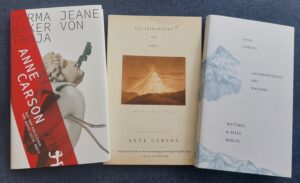
“He came after Homer and before Gertrude Stein, a difficult interval for a poet”: so begins Anne Carson’s Autobiography of Red. This extraordinary author transcends all genre boundaries – who cares whether it is an essay, poetry, prose or drama – and moves effortlessly back and forth through time. For the classicist Carson, antiquity is her most important, though by no means her only point of reference. She strips away the layers to reveal what remains human across the ages, and is precise, witty and erratic all at once. In her work, the ancient Helen can be both herself and Marilyn Monroe (in Norma Jean Baker of Troy). Here, she records lessons from the history of war that strike right to the core. Anyone seeking some distance from the present, whilst at the same time delving deeply into it, should turn to Anne Carson.
*
The Week on Verfassungsblog
summarised by EVA MARIA BREDLER
While Donald Trump and Xi Jinping dine on baby bok choy at the White House, reportedly grown in its own garden, the EU and Canada are thinking about planting garden of their own together. Last week, Commission President von der Leyen suggested that Canada could become the first “associate member” of the EU. Amid the current geopolitical gloom, the idea inspired some hope – but also many questions. What exactly would “associate membership” entail, and how would it work for a country on the other side of the Atlantic? ARNE P. WEGNER (ENG) looks for answers in the law as it stands and shows how closely the EU and Canada already work together. ANDREW DUFF (ENG) gets specific and drafts a Treaty article that would make associate membership possible.
Iceland, by contrast, had been considered a candidate for (ordinary) membership. Now Icelanders have confidently voted against joining the EU in a referendum. MARIA ELVIRA MENDEZ PINEDO (ENG) explains why and concludes that Iceland simply voted to keep “a well-functioning status quo”.
In Saxony-Anhalt, the status quo is about to end. On 6 October, the newly elected Landtag meets for its constituent session, and one of its first tasks is to decide who sits on its committees. The AfD caused an uproar by demanding committees of twelve members, half of whom would be its own. ROBERT BÖTTNER (GER) argues that this is incompatible with the principle of democracy and therefore unconstitutional.
The Landtag will soon be sitting, but no state government is in sight in Saxony-Anhalt. That hasn’t stopped the AfD from repeating that voters have given it a mandate to govern. Among other things, its manifesto promises to end the “experiment of inclusion in schools”. But could a state government simply abolish inclusive education? MARTEN BREUER (GER) shows that the federal government, the Bundestag, other Länder and those affected could all challenge such plans in court.
Whether a court could also stop the reform of German intelligence law has been a hot topic on our blog. Among other things, the reform would – for the first time – confer powers on the intelligence services in a state of tension and a state of defence. ROBERT FRAU and NICOLE NÄTHER (GER) think the reform gets this wrong for the Federal Intelligence Service (BND) and point to further problems.

MARKUS OGOREK and LUCA MANNS (GER) look at the new rights of access to information in the BND Act, which the reform will restrict further. They explain why they think this is the right call, and why the explanatory memorandum yet promises more than the Basic Law can deliver.
In July, a Munich court convicted an Iraqi couple of deliberately attacking the religious identity of two Yazidi girls. The systematic destruction of Yazidi temples and shrines by ISIS, however, has so far gone unpunished. GREGORY MOSE (ENG) argues that such attacks on religious life should be recognised as a distinct form of persecution and thus as a crime against humanity.
This week also saw the end of our symposium on academic freedom, “Die umkämpfte Freiheit der Wissenschaft” (GER). Using Florida as an example, JANIKA SPANNAGEL shows how a climate of uncertainty can lead academics to limit their research and teaching without any direct interference. HANS MICHAEL HEINIG compares Germany and the US and asks whether German university law gives too much weight to participation rights in academic self-governance. CHRISTOPH MÖLLERS, MAX LENZ and NILS WEINBERG argue that the Basic Law does not impose a general duty of neutrality on universities. DÖRTHE ENGELCKE and ILYAS SALIBA analyse how scholarship critical of the state is being disciplined in the name of fighting antisemitism. JÖRG NIEWÖHNER and FELIX MAUCH show why research funding and university autonomy cannot be separated. MICHAEL ZÜRN argues that legal protection is not enough when academia keeps losing autonomy. SASCHA SPOUN and SEBASTIAN WEINER take the view that only academia itself can judge whether a discipline meets objective standards. DAVID LANIUS and MICHAEL SCHEFCZYK set out the epistemic responsibility gatekeepers carry when they invite experts, and propose a cost-benefit test to decide which experts deserve a platform.
Expertise is a tricky thing. “He’s an expert on stones, and he loves good granite,” Trump said of Xi. Whether universities should now invite Xi Jinping to speak as a stone expert, I’ll leave to your own analysis.
*
That’s it for this week. Take care and all the best!
Yours,
the Verfassungsblog Team
If you would like to receive the weekly editorial as an e-mail, you can subscribe here.