







“The Court Has Now Opened the Door”
Five Questions to Michael A. Becker
Thousands of miles separate The Gambia’s Atlantic coast from the villages and towns of Myanmar’s Rohingya. Yet in 2019, it was the small West African state that brought a case against Myanmar before the International Court of Justice (ICJ) in The Hague, accusing it of genocide.
Seven years later, the Court has found Myanmar responsible. This marks the first time that the ICJ has held a state directly responsible for the commission of genocide. Central to its judgment was the purpose behind the violence. Myanmar invoked the fight against insurgents; the judges found that an intent to destroy a substantial part of the Rohingya group was the only reasonable inference that could be drawn from the totality of the evidence, finding that alternative possible explanations could not reasonably account for conduct attributable to Myanmar.
We spoke with Michael A. Becker from Trinity College Dublin about the judgment and its significance for the Rohingya and beyond.
1. To understand the judgment, let’s start with the case itself. How did this case come about, and what enabled The Gambia to bring a claim concerning atrocities committed so far from its own borders?
The Gambia’s case against Myanmar was a response to so-called “clearance operations” undertaken by Myanmar’s security forces in 2016 and 2017. Those operations, which Myanmar described as a counter-insurgency campaign against armed ethnic groups, led to the deaths of over 10,000 Rohingya, a Muslim ethnic minority based primarily in Rakhine State. An additional 700,000 Rohingya fled across the border into Bangladesh, where many remain today in overcrowded, dangerous camps. The Gambia instituted proceedings against Myanmar at the ICJ in November 2019, and the Court indicated provisional measures against Myanmar in a January 2020 order (for analysis, see here).
But why The Gambia? Certain types of treaties, especially in the domain of human rights, set out obligations that each party owes to every other party. These are referred to as collective obligations, or obligations erga omnes partes. Under the 1948 Genocide Convention, any state party has the right to seek to enforce it against another state party in the event of an alleged violation. Article IX of the Genocide Convention also provides for the unilateral seisin of the ICJ to resolve disputes relating to its interpretation, application, or fulfilment. Neither The Gambia nor Myanmar made a reservation to Article IX, and this provided the basis for the Court to hear the case. In a 2022 judgment on jurisdiction, the ICJ confirmed that The Gambia, even as a “non-injured state”, had standing to bring the proceedings.
Any number of states could have brought this case against Myanmar. The fact that it was The Gambia can be traced to several different factors. These included efforts by civil society groups to identify a state willing to bring the case and the active support of the Organisation of Islamic Cooperation, a 57-member intergovernmental body. The Gambia is also a Muslim-majority country, which helps to explain its willingness to seek justice for the Rohingya, a Muslim ethnic minority that has faced decades of discrimination. In addition, The Gambia’s Minister of Justice at the time, Abubacarr Tambadou, was a former prosecutor at the International Criminal Tribunal for Rwanda who took an interest in the plight of the Rohingya and was well positioned to promote the idea of The Gambia taking the lead.
2. UN investigators and other fact-finding bodies have investigated the violence against the Rohingya. How did the Court assess their reports, and what weight did it give their findings?
The Court heard live testimony from four fact witnesses and one expert during the oral proceedings in January 2026, but the bulk of the evidence in the case was made up of third-party fact-finding reports. The most prominent reports came from the Independent International Fact-Finding Mission on Myanmar (FFM), an ad hoc body set up by the UN Human Rights Council in March 2017, and from its successor body, the Independent Investigative Mechanism for Myanmar (IIMM) (established by the UN Human Rights Council in 2018). For its part, Myanmar dedicated most of the January hearing to attacking the accuracy and credibility of those reports. The Court also considered a broad range of materials from NGOs, including witness statements gathered by such groups, but generally gave these materials less attention.
In past cases, the ICJ has expressed a general preference for facts generated through an adversarial process (for example, facts established by an international criminal tribunal) over facts established through non-adversarial inquiries. In practice, however, it has shown a considerable willingness to credit the facts established by UN fact-finding bodies.
In The Gambia v Myanmar, the ICJ reiterated its established approach, which focuses on the independence and qualifications of the author, the methodology used, and the comprehensive nature and overall quality of the evidence (para. 97), as well as the importance of corroborating evidence. It concluded that the FFM reports employed a “rigorous methodology” and displayed a “level of detail and coverage” that was at least commensurate with materials relied on by the Court in past cases (para. 112). It reached that conclusion even while noting that the FFM applied a “reasonable grounds” standard of proof that differed from the “fully conclusive” standard applied by the Court – a distinction that called for caution in assessing the FFM reports (para. 109). As for the thematic IIMM reports, the ICJ considered these to carry “considerable evidential weight” on the basis of the IIMM’s methodology and demanding standard of proof, which was more geared towards future criminal proceedings (para. 119).
Based on these general assessments, the ICJ placed considerable weight on the FFM and IIMM findings in establishing a broad range of atrocities carried out by Myanmar’s security forces against the Rohingya during the 2017 clearance operations. These included the Court’s findings in relation to the number of deaths (para. 253), widespread acts of gang and mass rape and other forms of sexual violence (para. 258), the perpetration of extreme acts of violence against children (para. 261), a systematic pattern of Myanmar forces attacking people seeking to flee (para. 270), and the destruction of Rohingya property (para. 282). Significantly, the Court did not seem concerned by the fact that neither the FFM nor the IIMM was able to carry out their work within Myanmar itself (para. 111). Notably, the ICJ found that rather than undermining the credibility of third-party fact-finding reports, Myanmar’s non-cooperation with UN investigators provided a basis for “more liberal recourse to inferences of fact” where Myanmar had failed to rebut certain evidence (para. 131).
Based on a preliminary review of the judgment, it is not obvious that the Court’s approach to these materials differed substantially from its usual approach – and the Court made it clear that it did not ascribe “any probative value to the legal assessments contained therein” (para. 100). However, it is significant that the Court expressly connected the possibility of drawing adverse inferences to a party’s non-cooperation with UN fact-finding bodies or to a failure to engage with and seek to rebut their findings.
Unsurprisingly, the Court’s willingness to credit the FFM and IIMM reports also drew criticism from judges who dissented from its conclusion on genocide. The dissenting opinions of Judges Xue, Sebutinde, and Nolte each criticize the judgment for its over-reliance on the reports. While there may be discrete findings of fact in the reports that merit criticism, the judgment generally suggests a careful effort to engage with the materials. The Court may nonetheless wish to consider how to address some of the concerns raised by these judges in future cases. For example, the ICJ has never sought to question the authors of such reports directly or request clarifications from them in a contentious case. This possibility should not be foreclosed.
++++++++++Advertisement++++++++++++
Wir suchen zum nächstmöglichen Zeitpunkt eine*n erfahrene*n Referent*in für Aarhus-Rechte und Advocacy. Du bist dafür verantwortlich Gesetzgebungsprozesse in Deutschland und Europa eng zu begleiten, juristisch zu analysieren und mit den politischen Akteuren in Deutschland diesbezüglich zusammenzuarbeiten.
Alle Details zur Stelle findest Du in der vollständigen Ausschreibung.
++++++++++++++++++++++++++++++++
3. An intent to drive people from their homes is not necessarily an intent to destroy them as a group. In earlier cases, that distinction helped the Court rule out genocidal intent; here, the way the Rohingya were driven out helps establish it. What makes displacement evidence of genocide in this case, rather than an alternative explanation for the violence?
It is important to note that the Court was at pains to make clear that it was applying the same rigorous standard to establishing genocidal intent in this case as in the two previous cases – Bosnia v Serbia and Croatia v Serbia – where it faced such questions. Genocidal intent refers to the requirement that the underlying acts of genocide (for example, killing members of the protected group) be undertaken with the specific intent to destroy the group, in whole or in part. In Croatia v Serbia, the Court explained that genocidal intent could be established in the absence of direct proof (para. 139) but that inferring “the existence of dolus specialis from a pattern of conduct” requires this to be “the only inference that could reasonably be drawn from the acts in question” (para. 148; see also para. 417). In addition, evidence that Serb forces were seeking to displace the Croat population was treated as foreclosing an inference of genocidal intent. In the lead-up to Thursday’s judgment, a great deal of attention focused on whether or how the Court would apply this “only reasonable inference” test.
In The Gambia v Myanmar, the Court reiterated that “genocidal intent must be the only reasonable inference from the facts” (para. 438) and explained that it would assess the evidence “holistically” in that regard (para. 388). This clarified that the Court is not limited to examining only whether a “pattern-of-conduct” provides the basis for an inference of genocidal intent. As the Court put it, the “only reasonable inference standard means that the inference drawn should be capable of explaining all of the evidence, taken together” (para. 443).
To apply the test, the Court considered whether other inferences to explain Myanmar’s conduct could be reasonably drawn from the evidence. The judgment focused on three possibilities: that Myanmar’s actions were intended as counter-terrorism operations, that Myanmar sought to forcibly displace the Rohingya population (i.e., ethnic cleansing), or that Myanmar sought to collectively punish the Rohingya (see paras. 444-467). The Court’s conclusion that none of these possibilities could reasonably explain the underlying atrocities committed by Myanmar’s security forces arguably makes this the most important section of the judgment. The Court thus concluded that the only inference that could reasonably explain the totality of Myanmar’s actions was an intention to destroy the Rohingya population in northern Rakhine State (para. 467). That outcome was not precluded by the fact that Myanmar was also engaged in fighting against insurgent groups.
Your question relates specifically to why the Court ended up treating evidence of forced displacement differently in this case than in the Croatia and Bosnia cases. The judgment discusses this directly (see paras. 454-459). The Court found that the evidence in those cases established “an affirmative practice of transfer and evacuation of the relevant population” (para. 458). By contrast, the Court found that no evidence in the record pointed to “any effort or plan by the Myanmar Government to transfer or evacuate the Rohingya population”. It also noted that Rohingya seeking to flee were sometimes prevented from doing so or were killed in the process (para. 459). In short, the difference between Thursday’s judgment and the earlier cases turned on different facts rather than a different approach to establishing genocidal intent in the face of other possible objectives.
4. The Court appeared to depart from its established case law with respect to the duty to prevent genocide. Is that correct?
The question in this case was whether Myanmar failed to fulfil the obligation to prevent genocide based on evidence that non-Rohingya civilians participated alongside the Myanmar security forces in carrying out the underlying acts that amounted to genocide. The Court could not establish that these people were acting under the effective control of the government, so their conduct was not attributable to Myanmar. But the Court did find that Myanmar should have taken steps to prevent this from happening. The knowledge of a serious risk of genocide triggers a due diligence obligation on the part of the state, and that obligation was unmet here (see para. 485).
Having already reached that conclusion, however, the Court then went on to further discuss the nature of the duty to prevent genocide. Most notably, it stated that “international responsibility for breach of the duty to prevent genocide is not conditioned on a finding that genocide has occurred” (para. 487). This departs from what the ICJ said in the Bosnia case – that “a State can be held responsible for breaching the obligation to prevent genocide only if genocide was actually committed” (para. 430). It was also unnecessary to address the point in this case, where genocide actually did occur.
On the one hand, the Court’s case law had already established that the duty to prevent genocide will be triggered at the moment a state should normally have been aware of a serious risk of genocide. Thursday’s judgment reaffirms this. On the other hand, the Court has now opened the door to holding states internationally responsible for failing to take action, whether or not a serious risk of genocide comes to fruition. This has potentially far-reaching implications. It may place greater pressure on states to react to situations involving mass atrocities, even in the face of uncertainty about whether a situation meets the legal definition of genocide. It may also be unclear what type of response will be sufficient to satisfy the state’s preventive duties. The Court’s position will also have consequences for the pending ICJ case between Nicaragua and Germany. Whether Germany can be held responsible under the Genocide Convention will no longer necessarily turn on whether the situation in Gaza constitutes genocide. It also seems to reduce the likelihood of that case being dismissed based on the fact that Israel is not a party to those proceedings.
I note that the duty to prevent genocide was another point of division within the bench (compare Judge Tomka’s scepticism with Judge Cleveland and Judge ad hoc Kress’s support). It is fair to ask whether the judgment adequately explains why a departure from past practice was justified, even if the new rule articulated by the ICJ is more in line with the object and purpose of the Genocide Convention.
++++++++++Advertisement++++++++++++ Die Universität Greifswald, Rechts- und Staatswissenschaftliche Fakultät, Lehrstuhl für Strafrecht, insb. Medizinstrafrecht, Strafprozessrecht und Rechtsphilosophie, Frau Prof. Dr. iur. Grischa Merkel, sucht zum 01.02.2027:
Wissenschaftliche*r Mitarbeiter*in (m/w/d), EG 13 TV-L Wissenschaft, Teilzeitbeschäftigung (50 v.H.), befristet bis zum 31.03.2029, zur Mitwirkung in Lehre und Forschung und Unterstützung der Organisation und Selbstverwaltung des Lehrstuhls. Die Stelle dient der Qualifizierung in der ersten Qualifikationsphase. Es werden Aufgaben übertragen, die der Vorbereitung einer Promotion förderlich sind.
Bewerbungsfrist: 10.12.2026. Weitere Informationen finden Sie hier.
++++++++++++++++++++++++++++++++
5. The Court holds that The Gambia can seek reparations in the interests of the Rohingya, even though it is not itself an injured state. How significant is this ruling for the enforcement of the Genocide Convention, and what does the judgment mean for the Rohingya’s prospects of obtaining reparation?
The ICJ made clear that a non-injured state like The Gambia is situated differently than a directly injured or specially affected state, and that The Gambia is not entitled to claim reparation for itself. There is no bar, however, to The Gambia seeking reparation on behalf of the beneficiaries of the obligation breached – that is, the Rohingya group (para. 609).
The judgment sets out a range of remedies, including a requirement that Myanmar enact legislation to give full effect to its Genocide Convention obligations. In terms of restitution, the Court directed Myanmar to return or replace lost or damaged property, facilitate the search for disappeared individuals, and above all, facilitate “the safe, voluntary and dignified” return of the displaced Rohingya to Myanmar (para. 615). Notably, the Court did not go so far as to direct Myanmar to extend citizenship to all members of the Rohingya group (para. 603), although one can speculate that the Court would certainly welcome a reform of Myanmar’s citizenship law as a guarantee of non-repetition.
This is also the first time that an ICJ case brought by a non-injured state has involved a request for compensation, alongside other forms of reparation. On this point, the Court decided that the amount and modalities of compensation would need to be decided later, in part because this may depend on the extent to which restitution takes place. It therefore directed Myanmar to report back to the Court in two years, after which the Court will determine what further proceedings are required to decide on financial compensation. In practical terms, this could mean that the Rohingya will be waiting for a decision on financial compensation for another three to four years.
Some judges raised concerns about the Court’s approach, pointing out, for example, that The Gambia lacks any “independent basis on which to assess the damage suffered by them” and has no mandate to decide what level of compensation would be appropriate (Separate Opinion of President Iwasawa, paras. 18-19; see also the Separate Opinion of Judge Aurescu).
It is not entirely clear why The Gambia could not undertake the additional research necessary to present a credible and defensible proposal on compensation for the Court to consider at a future stage of the proceedings. The Court could also consider whether it should avail itself of its own powers under the ICJ Statute to enlist expert assistance in determining an appropriate measure of compensation (although a recent effort to do so in Armed Activities (DRC v Uganda) may have dampened the Court’s enthusiasm for such an approach). The situation is novel, however, and the judgment shines a light on the need to give further consideration to how best to handle financial compensation in cases brought by non-injured states.
All of the above, however, will run up quickly into political realities. Myanmar is engulfed by internal armed conflict, and Rakhine State is now largely under the control of the Arakan Army, an armed ethnic group that itself may be hostile towards the Rohingya. Moreover, the military junta that seized power in 2021 – led by the same individuals who oversaw the genocide carried out by Myanmar’s security forces in 2017 – shows little sign of wanting to voluntarily comply. In short, the conditions on the ground in Myanmar are not amenable to realizing the relief that the ICJ has ordered anytime soon. Instead, it now falls upon states to seize on the ICJ’s judgment to apply further pressure on Myanmar to change course and to support additional forms of accountability.
*
The Week on Verfassungsblog
summarised by EVA MARIA BREDLER
Have you seen the pictures? Hundreds of people crowded around a screen, cheering and laughing, children throwing their hands in the air. A public viewing of a different kind: the pictures show Rohingya refugees following the (rather monotonous) delivery of the International Court of Justice’s judgment in The Gambia v. Myanmar – and celebrating after waiting almost ten years for justice. In our editorial, MICHAEL A. BECKER discusses the judgment in detail.
ITAMAR MANN (ENG) looks through both a legal and a political lens at what the judgment means for South Africa v. Israel – that is, for the question of whether Israel is committing genocide in Gaza.
In Germany, Sahra Wagenknecht’s party, the BSW, would have liked a public viewing of its own: a recount of the 2025 federal election. It won’t get one: the Federal Constitutional Court has rejected the electoral complaint with which BSW voters sought the recount. HEIKO SAUER (GER) argues that mere speculation cannot prove electoral errors, even when the result is close.
A week ago, the Bundestag passed the contentious intelligence services reform. The Federal Intelligence Service (BND) and the domestic intelligence service (Verfassungsschutz) may now use AI to analyse data without any specific cause. JOHANNES BUCHHEIM and PAUL HARNISCH (GER) warn that the law hollows out principles such as the separation of informational powers. According to CONSTANTIN GOSCHLER (GER), it was precisely this separation principle that allowed surveillance to spiral – and the reform should have reined it in. He calls for the Verfassungsschutz’s areas of surveillance to be cut back significantly and limited to concrete threats.
Concrete threats include power grids, hospitals and public authorities: at least since Russia’s war of aggression against Ukraine, we have known these are targets of cyberattacks. Recently, however, hackers shut down supermarket refrigeration systems. JOHANNES BRINKSCHMIDT (GER) doubts that the new IT security rules adopted by Germany and the EU will be able to prevent such attacks any time soon.
++++++++++Advertisement++++++++++++
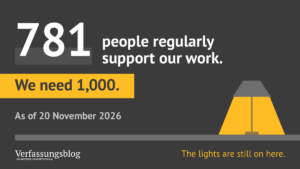
The lights are still on.
Somewhere, someone is reading Verfassungsblog right now, open to all and without a paywall. To keep it that way, our work needs stable funding shared by many. By mid-January, we want more people to support us on a regular basis.
Join the Verfassungsblog community: from €5 a month, cancel anytime: https://verfassungsblog.de/support-us/
++++++++++++++++++++++++++++++++
Latvia’s and Estonia’s cooling systems seem to be working just fine: the two EU member states have frozen the assets of two Russian businessmen who had just been removed from the EU sanctions list. MAXIMA HUBBES (ENG) examines whether this falls within the member states’ competence.
Meanwhile, Javier Milei – chainsaw in hand, preferably – is imposing sanctions of his own on Argentina’s public universities: since he took office in December 2023, their budgets have lost more than a fifth of their value in real terms, and by May 2026 university salaries had lost more than a third of their purchasing power. As NAHUEL MAISLEY, MARIELA PUGA and ROBERTO GARGARELLA (ENG) show, austerity alone cannot explain this.
Goethe University Frankfurt has also announced drastic cuts. FLORIAN BUTOLLO, STEPHAN LESSENICH and BENNO ZABEL (GER) explain why the wave of cuts in higher education is so dangerous and how universities can be destroyed from within.
The value of science is under pressure – and so are its values. A common critique holds that science is never neutral but always value-laden. Yet the AfD could invoke the very same argument to bend research to its own agenda, warns GERHARD SCHURZ (GER) – a “boomerang effect” – and argues that for that reason alone, we should hold on to value neutrality.
Sisyphus had a boomerang problem too; his came in boulder form. The Venice Commission permits exceptions to the rule of law where the alternative would perpetuate an unacceptable status quo – a condition that WOJCIECH SADURSKI (ENG) calls “Sisyphean democracy”. He explains what this means for the recent crisis of Poland’s Constitutional Tribunal.
A quick reminder: on 30 October 2026, Anna Korwin-Piotrowska, acting President of Poland’s Constitutional Tribunal, temporarily suspended the two judges who had until then served as President and Vice-President. The move drew sharp criticism. KIM LANE SCHEPPELE, LAURENT PECH and MACIEJ KISILOWSKI (ENG) push back against the critics.
GÁBOR HALMAI, KATARZYNA KRZYZANOWSKA and ANDRZEJ SCHULTZ (ENG) disagree: this line of argument, they say, brushes aside legitimate legal and social concerns about the Tribunal. What Poland needs is a long-term compromise across parties and institutions.
Kosovo isn’t in much of a mood for compromise either: on 16 September 2026, the Kosovo Specialist Chambers convicted Hashim Thaçi and three co-defendants, a judgment that met with fierce backlash in Kosovo. A few days later, its Democratic Party introduced an amendment to the law governing the court. If it enters into force, Kosovo will be in breach of its obligations towards the EU, argues MOHAMED M. EL ZEIDY (ENG), since the amendment was pushed through without consulting Brussels.
Like Kosovo, Syria must find its footing again after long years of war. Following the fall of Bashar al-Assad, Syria’s new – and fragile – parliament convened for the first time on 12 July 2026. MOUNIR ZAHRAN (GER) explains what role it plays vis-à-vis the transitional government today, and what role it could play in the future.
++++++++++Advertisement++++++++++++

Whether it is intelligence service reform, dynamic tech like Palantir or counter-terrorism policy, criminal and security law is facing rapid shifts. Once a month, the VB Security & Crime Dossier breaks down the key developments for you: expert commentary bridging constitutional, criminal and security law, an overview of the current debates, and our quick-hit ‘Aktenvermerk‘ as a concise insight. Everything you need to know, straight to your inbox.
Subscribe now for free: verfassungsblog.de/newsletter-mpi/ (available in German only)
++++++++++++++++++++++++++++++++
This week, our symposium “Wenn es ernst wird: Recht zwischen Wehrfähigkeit und Bündnisfall” (When Push Comes to Shove: Law Between Defence Readiness and Collective Defence) (GER) came to a close. CHRISTIAN RICHTER does not see the Reserve Strengthening Act as a return to conscription. ELISABETH ROSSA considers a European army compatible with the Basic Law, as long as the Council of the EU decides unanimously. MORITZ VON ROCHOW argues that once the EU’s mutual assistance clause is triggered, the alliance provision of Art. 80a(3) of the Basic Law applies automatically – so Germany remains a reliable ally regardless of the Bundestag. In June 2026, German politicians debated sending German minesweepers to the Strait of Hormuz. FELIX LANGE makes the case for a constitutional amendment that explicitly ties such deployments to international law. The Bundestag and Bundesrat decide whether a state of tension or a state of defence exists, but the relevant knowledge lies with the federal government – FYNN GRÄBER therefore calls for a statutory duty to inform both bodies proactively. CHRISTIAN MARXSEN holds Germany to account on AI in weapons systems: it should push for international regulation and take a clear position of its own. Finally, SUÉ GONZÁLEZ HAUCK criticises the Federal Constitutional Court for giving alliance capability more weight than international law ever since its Ramstein judgment.
Over the coming days, we will publish more pieces on the historic ICJ judgment in The Gambia v. Myanmar. In the meantime, a prompt for your weekend journalling: Is justice delayed justice denied?
*
That’s it for this week. Take care and all the best!
Yours,
the Verfassungsblog Team
If you would like to receive the weekly editorial as an e-mail, you can subscribe here.