






Cuts Behind the Scenes
On Artificial Intelligence, Physical Presence, and Idea Injustice
This editorial is part of our “Behind the Scenes” series, in which our editors and authors describe their creative process in the age of artificial intelligence. How do ideas come to us? How do we sow and water them, and how do we know when they are ripe? And what role does artificial intelligence play in all of this?
How do I find ideas for what I write?
Take this one, for instance: an editorial on writing in the age of AI. The best inspiration, of course, is that I was invited to write it, and that esteemed colleagues have kindly already gone first. A sip of rosé (please allow the cliché at a solid 35 degrees in a French mountain village), then I plunge into the previous instalments of the editorial: a warm piece by Eva Maria Bredler that makes me want to write and eat almond cake, one by Maximilian Steinbeis about mushroom-hunting with his dog and his new companion Claude, a third by Victor Loxen arguing that everything has already been said anyway, even before AI.
This reminds me of my philosophy teacher, Mme Jouint, who told us before our final exams: “Do not imagine you can come up with something brilliant. People have been thinking about philosophical questions for thousands of years. Whatever you are thinking now, someone has certainly said before you, only better. So, if you cannot back up your thoughts with a source, you have not researched thoroughly enough.“ I have tried to live by Mme J’s maxim ever since, to this day. I research meticulously, convinced that someone has already said the same thing, only better, only – where?
There is only one remedy: read and talk about it. And the more I read and talk, the more ideas I have, the more I write, practically automatically, until further reading and talking reveals that, indeed, someone has already said this. So: read, write, read, cut, write, delete, because now I have found a better source after all, my thoughts take a different turn, the text takes on a different shape and a sharper focus.

Short break, another sip of rosé. Is there actually a word for having too many ideas?
Time to ask AI (finally, you must be thinking) – Co-Pilot, in this case. In English, it is more difficult to find the term I am looking for than in German; I must re-prompt three times to get:
Positive phrases for “too many ideas”
-
- Creative abundance — having more ideas than you can use, in a good way.
- Idea-rich — full of ideas, like a resource.
- Overflowing with inspiration — a mind that keeps generating sparks.
-
A fertile mind — ideas grow easily and plentifully.
I think I suffer from inspiration overflow. That is why I had to study law (yes, Dad, precisely because it is so “dry”). To rein in my creative overpressure. Charlotte Schmitt-Leonardy put this well recently on her podcast on the limits of free expression – et voilà, the source that said it earlier and better: studying law, she said, helped her „not get lost in waffling“, but instead cut to the chase. I feel the same way. Law helps me to put order in my thoughts, focus on what matters, and gives me a structure.
But too much structure also hems me in, creates a void. I need structure and rupture, order and chaos, focus and association.
++++++++++Advertisement++++++++++++ Professur (W3) Global Justice and International Law an der Technischen Universität Dresden:
Gesucht wird eine wissenschaftlich ausgewiesene Persönlichkeit mit exzellenter Forschung im Völkerrecht und Bezug zu globaler Gerechtigkeit, etwa in Wirtschafts-, Umwelt- und Klimavölkerrecht, Nachhaltigkeit oder Digitalisierung. Erwartet werden Lehre in Deutsch und Englisch, interdisziplinäre Zusammenarbeit sowie Mitwirkung in Forschung und akademischer Selbstverwaltung.
Den vollständigen Ausschreibungstext finden Sie hier.
++++++++++++++++++++++++++++
Luckily, beyond law there is also theatre, where I do not have to choose between guilty and not guilty, where I can instead engage with social questions in all their ambivalence – though there too, crucially, you should not waffle, at least not without dramaturgical purpose.
Because in theatre especially, you must think of the audience – the one you must not lose at intermission, the one you want to reach. So here, above all (unless the confusion is dramaturgically intended): away with overlong monologues, unnecessary scenes, confusing plots. Cut, cut, cut – and if necessary, even the parts you are most attached to. Kill your darlings. Thank you, Liz and Annika, for burning that into me.
I try to follow this rule when writing academic texts too, where in my view far more should be cut. Unfortunately, the cutting does not happen in texts, where it would make sense, but behind the scenes, where it is devastating. We are currently witnessing radical cuts to budgets for the arts and academia – at universities, at theatres, in the off-scene. Libraries can no longer buy books, contracts are not renewed, crumbling buildings go unrenovated, opening hours are shortened.
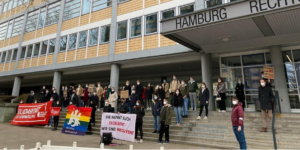
Student protest against funding cuts outside the law faculty building of the University of Hamburg
Two days ago, I was at the theatre festival in Avignon and saw Marion Siéfert’s “Bunker”. During the applause, the director walked onto the stage and read out a text she had written together with the ensemble, describing the scale of the cuts to France’s culture budget in favour of rearmament. We do not want to educate our children, she claimed – instead we send them to war.
The ensemble thus put into words an old materialist insight that is becoming painfully clear again: in times of crisis, when capitalist society is thrown back on its bare material conditions, the rule of law shows its teeth. Supposedly, there is no room left for art, culture, and science.
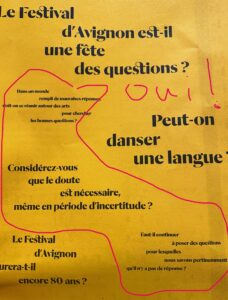
Programme notes of the theater festival in Avignon
That is a fallacy. It is precisely when democracy is under threat that scholarly insight and cultural education matter most – precisely then that critical reflection is needed, that feelings of community and solidarity must be strengthened. To borrow from the Avignon programme notes: it is especially in times of uncertainty that one must doubt. This is what democratic resilience means.
But doubt requires the ability to question what feels certain; democratic discourse requires spaces that make physical encounter possible; critical questioning requires knowledge of what already exists; ideas require time in which to come up with them.
Theatres and universities are essential places for offering those preconditions to a broad range of citizens. But when the cutting happens behind the scenes, theatres and universities can no longer live up to that mandate. Then there is a risk of creating, or reinforcing, injustice of ideas.
Injustice of ideas is the flip side of overflowing with ideas: creative underflow or frustrated or unrealised creativity. Injustice of ideas can be understood as a sub-category of “aesthetic injustice”. The term has recently been coined by, among others, Rachel Fraser and Gustavo Dalaqua. It builds on Miranda Fricker’s concepts of epistemic and hermeneutical injustice, and describes the harm that arises when someone is wronged in their capacity as an aesthetic subject because of structural discrimination. This does not only happen when the concepts to understand and describe the wrong done to you as a subject of knowing are missing, but when all forms, procedures, buildings, and social roles in which ideas can arise structurally do not fit certain groups of people and exclude them. Say, for instance, when a group of workers in the suburb think: “people like us” do not go to the theatre, do not study law, or do not have good ideas – because we do not express ourselves elegantly enough, do not wear the right clothes, or because buildings are not accessible to us. Or that the ideas you have do not receive the same attention as other people’s ideas, because you do not have the same socially recognised position as a speaker – again, because you do not express yourself in sufficiently refined language, do not have the right social status, are not dressed well enough, and so on. In other words: when you cannot participate – or only in a limited way – in the “marketplace of ideas” because you do not hold shares in it.
++++++++++Advertisement++++++++++++

intRecht bietet mit seinem Virtuellen Lesesaal einen kostenfreien Zugang zu einer umfassenden Auswahl digitaler Fachressourcen, darunter u. a. Bloomsbury / (Auswahl inkl. Hart), die Cambridge University Press Law eBook Collection, Dalloz.fr (inkl. E-Books), Lexis360 Frankreich sowie Oxford Scholarship Online / HSS Collection.
Das Angebot richtet sich an Hochschullehrende sowie wissenschaftlich Mitarbeitende der Rechtswissenschaft in Deutschland. Beantragen Sie hier Ihren Zugang.
++++++++++++++++++++++++++++
In my view, idea (in)justice has, beyond its distributive dimension, a relational one as well: it is not just abstractly about having ideas, but about giving and exchanging them. This does not have to be a strict do ut des, but reciprocity and exchange are central to the plurality of ideas. And here, I have to say, AI falls short: not only because it only gives back what you put into it, but because it reinforces existing inequalities in access to resources and creates systematic dependencies – since whoever has more money can afford more powerful AI models, which are often controlled by a handful of tech billionaires from Silicon Valley (which, incidentally, was exactly the subject of Marion Siéfert’s play).
The German Council of Science and Humanities (Wissenschaftsrat) has recently raised concerns about exactly this in its “Recommendations for Higher Education in the Age of Generative AI” (p. 25). It also warns of a loss of social relationships and direct exchange, which are central functions of university education (p. 24). Physical presence and personal exchange in small groups open up different spaces for reflection – which, not so incidentally, matches how political theatre and materialist critiques of law operate. Reflections which cannot arise in the same way through the isolated monologue with an LLM. Opening such spaces of physical presence and actual encounter costs money, admittedly. But at least that money would not flow into the pockets of a handful of tech billionaires – it would instead support a wide range of educated, committed lecturers who strengthen our democracy.
This was supposed to be a light piece about writing, some pleasant summer reading, and I apologise that it did not turn out that way. But these days, I cannot ignore the political and social preconditions, cannot close the stage doors, cannot hide what happens behind the scenes. Ideas emerge through a reciprocal process built on equal access, exchange with others, and physical presence. Resilient democracies foster that process – instead of cutting it short.
*
Editor’s Pick
by MARIE DÜRR
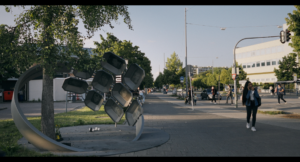
Copyright: ZDF/ Julian Vogel
Ten years ago, Sibel and Hasan Leyla lost their son Can in the attack at Munich’s Olympia Shopping Centre, and Arbnor Segashi lost his sister Armela. The documentary trilogy Einzeltäter (Lone Perpetrator, 2023) deals with the far-right attacks in Hanau, Halle and Munich. In Munich, nine people were murdered in the terrorist attack on 22 July 2016. The first episode follows the Leyla and Segashi families as they grieve, cope with everyday life, and fight for institutional and public recognition of the racist motive behind the attack. For years, the attack in Munich was dismissed as the apolitical mass shooting of a lone perpetrator, although there was clear evidence of the perpetrator’s far-right and racist ideology. It was only in 2019 – more than three years after the attack – that the authorities recognised it as a “politically motivated crime from the right.” One scene shows the families’ lawyer requesting further clarification in a letter to the Federal Ministry of the Interior. The documentary ends in 2021. To this day, the families’ demands for further clarification remain largely unmet, and no parliamentary committee of inquiry has yet been established. Three years after its release – and ten years after the attack – the documentary shows all the more poignantly how difficult and long their struggle is.
*
The Week on Verfassungsblog
summarised by EVA MARIA BREDLER
Jens Spahn has now resigned as leader of the joint CDU/CSU parliamentary group in the Bundestag, after all of Germany discussed his family planning. Once again, we have successfully reassured ourselves of our idea of normality and can carry on peacefully leafing through the tabloids. Those looking for more stimulating reading (and I dare assume that includes you) should turn to THORSTEN KINGREEN (GER): he reconstructs the moral debate in all its political and legal contradictions, sets the fundamental-rights framework straight, and explains why a reform of surrogacy is overdue.
How long does a good reform actually need, and when is it just hot air? The Federal Constitutional Court now ruled on this in the Heating Act proceedings and moved away from its earlier interim order. The Court held that the length of the Bundestag’ deliberation is, above all, a matter of parliamentary self-organisation. ALEXANDER THIELE (GER) sees this as a pragmatic change of course, stepping back from an unrealistic image of Parliament.
The Federal Constitutional Court also dismissed the complaints against the reform of the Building Modernisation Act. In doing so, it raised the admissibility threshold for Organstreit proceedings: MPs must now specify precisely which institutional rights they consider to have been violated. PHILIPP OVERKAMP (GER) argues that this is how the Court is pushing forward the juridification of the political process.
Buildings must not only be modernised but also newly built. A new bill therefore proposes that housing construction should be treated as a matter of “overriding public interest” when certain building zones are designated in a development plan. However, this would also give commercial construction priority over climate and nature protection, MICHAEL SAUTHOFF and SABINE SCHLACKE (GER) argue – calling the draft “a Trojan horse at the environment’s expense”.
Less Trojan is our way of destroying that same environment in every possible way. In view of the climate crisis, we sometimes lose sight of the massive loss of biodiversity: scientists are discussing whether we are already in the midst of a sixth mass extinction. ANDREAS BUSER (ENG) seeks to initiate a broader discussion on the promises and pitfalls of replicating successful climate advisory opinion initiatives for the integrity of the biosphere and biodiversity.
Not only biological diversity but political diversity too seems increasingly unwelcome: during Iran’s matches at the 2026 World Cup, FIFA banned the historic Lion and Sun flag from stadiums; a Los Angeles court declined to grant emergency relief against the policy. FARAZ FIROUZI MANDOMI (ENG) analyses FIFA’s freedom of expression policy.
Meanwhile, JANA LIPINSKI and JOHANNES MAURER (GER) analyse the German public broadcaster ZDF’s freedom-of-expression policy: may ZDF require contributors to its programmes to refrain from cooperating with persons or organisations on US sanctions lists? Their verdict: the clause produces only unwelcome “chilling effects”, is otherwise ineffective, and should therefore be scrapped.
Scrapping is also what MILAD SCHUBART (GER) proposes for the electoral threshold in the Saxony-Anhalt state election: if several parties fail to clear the 5% threshold, the AfD could win an absolute majority with as little as 42% of the vote – at which point the (already democratically problematic) threshold would have failed its own purpose, he argues.
At the end of June, the Society for Civil Rights (Gesellschaft für Freiheitsrechte, GFF) presented its expert opinion on the AfD. In it, the GFF calls for establishing the “clear” unconstitutional character of the AfD and the “high probability” of a successful party-ban proceeding. SOFIANE BENAMOR (GER) finds the Federal Constitutional Court’s standard for party bans neither coherent nor consistent – the ban proceeding remains a political act.
In another political act, the European Parliament has now adopted a resolution acknowledging the sexual violence committed during the Turkish invasion of Cyprus. NATALIE ALKIVIADOU (ENG) sees this as an important step toward the “expressive dimension” of justice, in which Cypriot women and girls can tell their story and be heard.
++++++++++Advertisement++++++++++++

What is the future of criminal and security law? Keeping up requires more than just headlines. Once a month, our new VB Security & Crime Dossier brings the essential debates straight to your inbox: featuring sharp commentary at the intersection of constitutional, criminal and security law, a comprehensive debate review, and a brief “Memo” from our editors for a quick takeaway. In-depth, curated, and straight to the point.
Subscribe now for free: https://verfassungsblog.de/newsletter-mpi/ (available in German only)
++++++++++++++++++++++++++++++++
International criminal proceedings carry such expressive dimension, too: they should reckon with crimes and give those affected a voice. But what happens when traumatised witnesses are barely protected, and the affected community remains largely excluded from proceedings? Last week, the tenth German criminal trial concerning IS crimes against the Yazidi ended with a conviction before the Munich Higher Regional Court. For ANNA-JULIA EGGER and SOPHIE KONRAD (GER), the proceedings shows how far claim and reality diverge.
Claim and reality diverge in criminal legislation, too – often for lack of a proper empirical basis. Take Section 184l of the German Criminal Code, which has banned the possession of child sex dolls since 2021 and whose constitutionality the Federal Constitutional Court has now upheld. The Court not only failed to seize the opportunity to mark out the constitutional limits of criminalisation, it also reversed the direction of empirical review, as JENNIFER GRAFE (GER) criticises.
Another offence has been enjoying a sort of renaissance in recent years: the formation of criminal organisations (Section 129 of the German Criminal Code). A case from the Netherlands now draws attention to a previously neglected constellation: the criminal liability of defence counsel for supporting a criminal organisation. Between legitimate defence and punishable support of an organisation runs a narrow line, argues LUKAS DANNER (GER) – and the courts should not too readily assume that it has been crossed.
The Supreme Court crossed a line of a different kind: in Trump v. Slaughter, it endorsed, among other things, the unitary executive theory: the claim that the president alone controls the entire executive branch. All of this was made possible by judges who were credentialed through one and the same organisation: the Federalist Society. For CHRISTOPHER ARMITAGE (ENG), membership in the Federalist Society is sufficient cause to impeach and remove a federal judge.
Meanwhile, the EU is strengthening executive oversight: the new EU Anti-Corruption Directive introduces uniform standards for civil servants and elected representatives. EROL POHLREICH, PHILIPPOS-GEORGIOS KOTSALIS and NASTARAN TALE ISMAILI (ENG) explain how the German system may continue to differentiate between the two groups.
Since June, the EU Migration and Asylum Pact has been applicable across the European Union. It was criticised from all sides: the European Council on Refugees and Exiles called it “a dark day for Europe”, Viktor Orbán “another nail in the coffin of the European Union”. JANKA DELI and KATERINA LINOS (ENG) focus on the solutions the Pact brings – the “silver linings”.
In Ukraine too, there are small “silver linings”. Ukrainian long-range drone operations are increasingly reaching targets deep inside Russian territory. Their strategic advantages remain unclear, but one thing is certain: the strikes are eroding the ritual core of Russian remembrance. ALINA CHERVIATSOVA (ENG) describes how this has reshaped Russia Day and the 2026 Victory Parade.
In India, student protests centred on the Cockroach Janta Party are reshaping the country. They are now centred around entrance exam irregularities and education reforms. ANMOL JAIN (ENG) assesses what these protests convey about the arc of a government and describes it in three phases: hope, fear, and anger.
This arc is familiar. I hope it is also reversible once governments start acting: slowly moving away from anger, toward the fear of new promises that may still be broken – and finally to hope: not only for another future, but for another present.
*
That’s it for this week. Take care and all the best!
Yours,
the Verfassungsblog Team
If you would like to receive the weekly editorial as an e-mail, you can subscribe here.