






Stammheim to Stammheim
A Stage for State Self-Assurance
When German readers encounter the word “Stammheim”, they usually do not think of a quiet, leafy suburb in the city of Stuttgart. Instead, the name immediately evokes Germany’s most notorious maximum-security prison. It conjures images of concrete barricades, armed checkpoints, and a dark chapter in Germany’s history: the era of homegrown left-wing terrorism, a state in existential crisis, and public enemies staring through bulletproof glass. Stammheim is the physical embodiment of a profound democratic dilemma: how should a constitutional democracy deal with those it considers an existential threat from within?
It is highly symbolic, then, that the successor building, located next to the now-demolished courthouse built in 1975 specifically for the first major trial of the leaders of the far-left militant group known as the Red Army Faction (RAF), has once again appeared on court dockets in the summer of 2026. Today, the Stuttgart Regional Court is using this infamous high-security courtroom to try five pro-Palestinian activists, a group dubbed the “Ulm5”. The accusation: the defendants broke into a factory in the city of Ulm owned by Elbit Systems, an Israeli defense contractor they hold partly responsible for military operations in Gaza. They allegedly caused around one million euros in property damage and spray-painted political slogans that German prosecutors classify as antisemitic, including “from the river to the sea” and “baby killers”.
The choice of venue is apparently not unusual. The facility, a court’s press offices stated, regularly hosts high-profile trials involving suspected Islamist terrorists, far-right Reichsbürger extremists plotting to overthrow the government, and organized gang violence. Yet in drawing that comparison, the court has already framed the case. At its core, the actual indictment is for trespassing and property damage – ordinary offenses for which German law mandates a maximum sentence of just two years.
The twist? Prosecutors suspect that the five individuals comprise a German chapter of the British activist network Palestine Action. Whether this group, “Palestine Action Germany”, even exists as a formal organization remains legally unproven. Nonetheless, by invoking Section 129 of the German Criminal Code – a powerful offence that criminalizes membership in a criminal organization – the state has elevated a case of political vandalism to a matter of national security. It is at this exact point that historical ghosts of Germany begin to stir.
In such – if you will, “political” – criminal trials, the focus is rarely limited to adjudicating past actions; they also expose how the state’s definition of what constitutes a threat. For over two years, I observed the trial at the Munich Higher Regional Court against Jennifer W., the first returning female ISIS member to stand trial in Germany back in 2019. She was primarily charged with the murder of a Yazidi girl, war crimes, and crimes against humanity. The fact that a young German woman sat in the dock added a whole new layer of intensity to the case. In a palpably charged atmosphere, almost electric with public voyeurism, my focus was initially entirely on the timeline: When did she radicalize? When did she marry her ISIS husband Taha al-J.? Who gave which orders, and when? Yet, at the very latest when the defendant gave her statement and was questioned by the court, the question of “what happened?” gave way to much larger inquiries: What do we as a society find unacceptable? Where is the ideological boundary of what we are still willing to understand? What does the state mean by “security”, and what rights is it prepared to sacrifice to achieve it?
The courtroom is, ultimately, a stage for state self-reassurance. What matters is not just what is being tried, but how.
The lasting impression that the state and its political order are in danger is carefully manufactured through a complex choreography of three elements: the severity of the formal charges, the procedural decisions made by the prosecutors and judges, and the accompanying media echo chamber.
This choreography begins with the physical space, the stage itself. National security trials in Germany rarely take place in ordinary courtrooms. Instead, they are moved to high-security zones, specially fortified compounds, or – as in the case of the Ulm5 – locations that already carry a heavy historical burden. Even before the indictment is read, the extraordinary nature of the proceedings is impossible to miss, triggering specific historical associations in our minds.
Anyone who regularly attends such trials knows that gaining entry to these spaces is a highly ritualized affair. Visitors must pass through multiple checkpoints, body scanners, and aggressive bag searches – sometimes being frisked right down to their socks. Entering the courtroom feels more like navigating a stressful airport security screening than attending a public hearing. This does not just apply to the public; members of the press, too, are often not spared from these restrictions – at times even being forced to forgo sharpened pencils for security reasons.
++++++++++Advertisement++++++++++++

The Max Planck Institute for Comparative Public Law and International Law in Heidelberg is looking for a Head Coach (x/f/m) for the 2026/27 Heidelberg Jessup Team!
As the home of the Heidelberg Jessup Team, MPIL offers a unique environment for coaching:
- Access to world-class research facilities
- The opportunity to pursue your own research
- A dynamic Jessup community, with many colleagues who competed in or coached Jessup teams before
If you’ve coached a Moot Court before or are ready to lead a team for the first time, we encourage you to apply.
Deadline: 30 June 2026
+++++++++++++++++++++++++++++++
Once inside, the backdrops are revealed – a carefully arranged architecture of distance. Modified seating layouts and thick panels of bulletproof glass separate the defendants from their lawyers and visiting relatives alike. Appearances in handcuffs and leg irons, along with harsher pre-trial detention conditions (Section 119 of the German Code of Criminal Procedure), including near-solitary confinement and strict communication bans, are part of the standard playbook of these security trials.
An atmosphere of mutual distrust almost inevitably permeates the entire process. Lines between the bench and the defense regularly harden, fueled by escalating measures from both sides. Whenever national security narratives dominate, the rights of the defense are all too easily dismissed as a mere logistical inconvenience.
And so, nearly 50 years after the RAF trials, the court and the defense are clashing once again in Stammheim. On the first day of the trial, the defendants sat separated from their lawyers behind glass walls – a measure the prosecution claimed was dictated by the architectural layout of the room. Communication was supposed to take place solely via microphones, but these were switched off at the start of the proceedings. When the defense team protested collectively and walked out, the presiding judge threatened to permanently strip them of their mandates. The trial escalated further when the defense lawyers responded by staging a sit-in inside the defendants’ glass booth. The court abruptly adjourned the session.
Then there is the spotlight: shifting the focus away from the specific criminal act and toward the individual’s character and political convictions. The more politically charged a trial is, the heavier the attributed ideology weighs. The legal system begins to view the defendants through rigid, pre-existing templates: the RAF represents armed, far-left subversion; returning ISIS fighters represent jihadist terrorism and brutality.
This does make sense, right? Individuals who openly resort to violence, belong to terrorist networks or criminal organizations, or commit war crimes present genuine security challenges to a constitutional state. After all, when the goal is dismantling terrorist cells, extending the classic framework of a criminal trial easily wins broad public backing. The sheer gravity of those crimes – usually involving severe injury or the (systematic) killing of human beings – casts a long shadow, inevitably shaping the trial and how it is perceived.
This is why we must talk about the trial against the Ulm5 today. It forces us to ask where exactly the boundaries of state security narratives lie in criminal proceedings – and at what point procedural harshness violates the constitutional principle of proportionality.
The discrepancy between the monumental symbolism of Stammheim and the restrictive procedural measures on the one hand, and the relative mildness of the actual criminal charges on the other, is impossible to ignore. Furthermore, unlike in most national security cases, these defendants – who have no prior criminal records – did not evade the police, nor did they operate from an underground cell. They openly admit to the property damage and intend to justify their actions in court using legal arguments. The justification for keeping them detained at all requires serious explanation. Yet, the activists remain in pre-trial detention – and have been for nearly nine months.
The fact that the judiciary nevertheless deploys the full arsenal of its procedural security architecture – or rather, is able to deploy it – reveals, first and foremost, the immense leverage of modern German national security laws. Section 129 acts as a procedural catalyst: it activates the full machinery of state surveillance and preventative law enforcement, ostensibly to secure the trial and protect those involved.
The Ulm5 have become flashpoints for a highly polarized European debate about Gaza, antisemitism, and the limits of political activism. If the judiciary unconditionally surrenders a trial like this to the state’s security narrative, a dangerous shift occurs: when the measures used to secure a trial become entirely disproportionate to the actual crime, the trial degrades into a form of preventative punishment that is alien to a liberal legal system.
++++++++++Advertisement++++++++++++

Im Rahmen des DFG-Projekts „Informalisiertes Völkerrecht und Außenverfassungsrecht: Dogmatik, Empirie, Reform (RE_INFORM)“ sind zum 1.10.2026 folgende Stellen zu besetzen (befristet für die Dauer von 36 Monaten):
-
Wiss. Mitarbeiter*in (w/w/d) (Max Planck-Doktorandenfördervertrag) am Max-Planck-Institut für ausländisches öffentliches Recht und Völkerrecht, Prof. Dr. H.P. Aust
-
Wiss. Mitarbeiter*in (m/w/d) (EG 13 TV-G-U, 0,75 %) an der Goethe-Universität Frankfurt, Prof. Dr. T. Kleinlein.
Die Bewerbungsfrist endet am 8.7.2026.
++++++++++++++++++++++++++++++++
Is this the emergence of the so-called Feindstrafrecht – the “criminal law of the enemy”? This concept sparked intense debate within German criminal law scholarship in the early 2000s, popularized by Günther Jakobs’ theory that intensifying counter-terrorism efforts was creating two distinct legal spheres: a standard criminal law for ordinary citizens, and a separate, harsher legal system for “enemies” of the state. Regardless of the academic controversies surrounding the term, what we are observing today is the direct result of elastic German national security offences that have been aggressively expanded over recent decades to allow for earlier state intervention.
While lawmakers during the terrorism crises of the 1970s had to forge “emergency” procedural laws ad hoc under intense political pressure, no new legal tightening is required today. The state can rely on a well-stocked toolkit that standardizes and legitimizes intrusive interventions – interventions that effectively create the impression of a high-stakes national security case. The defense must counter these measures by arguing that a concrete threat and actual necessity are entirely lacking.
In the United Kingdom, a London court recently performed a very similar choreography. There, four activists known as the “Elbit Four” were convicted of criminal damage against the very same defense contractor, Elbit Systems – an offense that typically carries a fine or a maximum of 18 months in prison. Behind closed doors, however, the judge classified the action as an offense with a “terrorist connection”. The jury that ultimately found the activists guilty of property damage had no idea that their verdict would culminate in a terrorism sentence. In the end, the prison sentences totaled more than 22 years. Whether through the suspicion of belonging to an illicit organization or by a quiet judicial decree, many roads lead to national security courts.
Buildings do not speak, but they do remind us. The Stammheim of the 1970s stands for a highly visible, aggressive state of exception: sharp new laws and Germany’s democracy in defensive mode. The fact that this same location is being used today as a stage for political criminal justice, where the system prosecutes the Ulm5 with maximum severity, is not a demonstration of strength. It is a symptom of nerves.
Editor’s note: This post was corrected after publication to reflect the correct location of the proceedings. The previous version stated: “It is highly symbolic, then, that this historic venue – built in 1975 specifically to try the leaders of the far-left militant group known as the Red Army Faction (RAF) – has once again appeared on court dockets in the summer of 2026.”
*
Editor’s Pick
by EVA MARIA BREDLER
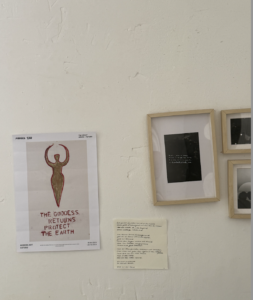
There is a poem I keep on my wall, directly above my desk. It has carried me through times of transition, bold decisions, studious nights, and moments of lonely stagnation. Every time I read it, it still gives me goosebumps. Isn’t that pure magic? Rilke wrote these lines on 4th October 1899 in Berlin-Schmargendorf, and today, in 2026, they reach across time and space to touch me here in Barcelona. I’m curious what they will do to you. I’m afraid that magic might get lost in translation, so if you do speak some German, I invite you to read the original. If not, here’s a translation by Joanna Mercy:
God speaks to each of us as he makes us,
then walks with us silently out of the night.
These are the words we dimly hear:
You, sent out beyond your recall,
go to the limits of your longing.
Embody me.
Flare up like a flame
and make big shadows I can move in.
Let everything happen to you: beauty and terror.
Just keep going. No feeling is final.
Don’t let yourself lose me.
Nearby is the country they call life.
You will know it by its seriousness.
Give me your hand.
*
The Week on Verfassungsblog
summarised by EVA MARIA BREDLER
There are many stages for the state to stage itself. Parliaments, too, dance to the music of political (dis)harmonies. We saw a particularly vivid example recently in the European Parliament, with the passing of the so-called Return Regulation – as DANA SCHMALZ already analysed last week. Her piece is now available in English, too.
The Swedish Parliament, too, is rehearsing a bold piece. A new proposal aims to strip dual citizens of their nationality when they have committed offences in connection with organised crime and gang criminality that “seriously threaten Sweden’s vital interests”. ESTER HERLIN-KARNELL (ENG) shows how the legal standard of “vital interests” is prone to misuse.
Germany has just had its own depressing premiere of a piece on the revocation of citizenship. And another piece keeps running: internal border controls – meant as exceptional, time-limited measures – have proliferated since 2015, with refugees pushed back at borders once meant to be open. Schengen is dying by a thousand cuts – and the Commission may just have helped along the way, with its long-awaited opinion on the necessity and proportionality of German border controls. LEON ZÜLLIG and STEFAN SALOMON (ENG) explain why it beats around the bush, and reveal a troubling vision for Schengen’s future.
If the Commission won’t help, perhaps German courts will. The Bavarian Higher Administrative Court and the Koblenz Administrative Court have just ruled in favour of plaintiffs challenging internal border controls – including, of all people, a law professor on his way home from the official celebration of forty years of Schengen (you can’t make that up). The federal government invoked overburdened immigration offices; the courts were unconvinced. LEON ZÜLLIG (GER) analyses the rulings (feat. Britney Spears).
While public administration claims to crumble under migration-induced burdens, new technologies arrive right on cue. In recent years, both the European Union and its Member States have come to rely heavily on advanced technologies, including AI, to support border control, migration management and asylum administration. One prominent example is the Dialect Identification Assistance System, used by the German Federal Office for Migration and Refugees in asylum proceedings. JULIANE BECK (ENG) shows why that system is not a neutral, objective tool but poses risks to individual rights protection – and carries a clear danger of institutional concealment.
Advanced technologies are themselves vulnerable to threats. Geopolitical threats to data protection, in particular, can arise from armed conflicts and cyberattacks. The processing of personal data needed to deliver vital services may be disrupted, public records and databases may be destroyed, and data may be misused to enable human rights abuses. CHRISTOPHER KUNER (ENG) observes that EU law is currently unprepared, and calls for action from the EU institutions and the data protection authorities.
++++++++++Advertisement++++++++++++

What is the future of criminal and security law? Keeping up requires more than just headlines. Once a month, our new VB Security & Crime Dossier brings the essential debates straight to your inbox: featuring sharp commentary at the intersection of constitutional, criminal and security law, a comprehensive debate review, and a brief “Memo” from our editors for a quick takeaway. In-depth, curated, and straight to the point.
Subscribe now for free: https://verfassungsblog.de/newsletter-mpi/ (available in German only)
+++++++++++++++++++++++++++
While the focus today is very much on digital technologies, we should not lose sight of technologies that are tangibly changing the way we live. The EU, for instance, has just deregulated new genomic techniques in the area of genetically modified organisms – the most radical change in EU GMO regulation in three decades. Yet ALEXANDRA MOLITORISOVÁ and ALEKSANDRA HUBAR-KOŁODZIEJCZYK (ENG) argue that the change was inevitable.
Change seemed inevitable in the United Kingdom, too: Keir Starmer resigned two years after Labour’s landslide victory – before completing a single term. GIOVANNI CAPOCCIA (ENG) argues that his fall says more about the predicaments of liberal democracy than about Labour’s failures.
The predicaments of liberal democracy have prompted PUBLIC LAW SCHOLARS (ENG) to interject in Hungary’s current play of constitutional transition. In an open letter to the Hungarian Parliament, they support replacing high-ranking public office-holders who have remained in post from the previous autocratic regime, while urging Parliament to show self-restraint when electing their successors.
New public office-holders were also elected in the small German town of Aue-Bad Schlema – though by the narrowest of margins. The CDU candidate Marcus Hoffmann edged out Stefan Hartung, the candidate of the far-right party “Freie Sachsen”, to become mayor. The election raises fundamental questions about the limits of eligibility for elected local officials. ANDREAS NITSCHKE(GER) examines how German law responds to candidates from anti-constitutional parties.
Anti-constitutional parties, in turn, respond to the law. Time and again, the AfD tries to put pressure on educational institutions by accusing them of insufficient neutrality – most recently at TU Berlin. The case fits the broader pattern of authoritarian threats to academic freedom, argues MAX LENZ (GER).
The AfD finds another stage in the civil service. For now, civil servants’ constitutional duty of loyalty still stands in the way – as it did in the recent ruling from the Berlin Administrative Court, which upheld the refusal to appoint an AfD local politician to the police force. From AfD members seeking civil service appointments, the courts demand both complete passivity and active distancing from the party’s aims – Schrödinger’s loyalty test? This case law is paradoxical, argues SOFIANE BENAMOR (ENG).
Paradoxical, too, is the way criminal law handles femicides: although the murder provision already covers them, courts have for decades failed to consistently recognise patriarchal motives as such. For ALINA GORSTEIN and SASCHA SEBASTIAN (GER), this imbalance bears on the state’s duty to protect women – and puts the legislator under obligation.
++++++++++Advertisement++++++++++++

The ICJ’s Advisory Opinion on Climate Change
Edited by Maria Antonia Tigre, Maxim Bönnemann & Antoine De Spiegeleir
The ICJ’s Climate Advisory Opinion is one of the most significant developments in international climate law. This new volume shows why – and explores its implications for global climate governance.
Get your copy here – as always, Open Access!
++++++++++++++++++++++++++++++++
One subject has grown over the past few weeks into a small symposium of its own: reviving the European Defence Community. After Robert Schütze’s critique, FEDERICO FABBRINI, NIELS KIRST and FRANZ C. MAYER (ENG) clarify their position.
We have continued our symposium “Inter-Judicial Dialogue on Climate Change and Human Rights” (ENG). MARIA ANTONIA TIGRE traces the arc of more than two decades of jurisprudential construction, culminating in the Inter-American Court of Human Rights’ Advisory Opinion OC-32/25 on the Climate Emergency and Human Rights. LILIANA ÁVILA reads Advisory Opinion OC-32/25 as a transformative moment for organisations that have spent years fighting for communities on the front lines of the climate emergency. ANNA LUMERDING and MELANIE MAURER take the landmark KlimaSeniorinnen ruling as a starting point to examine the role of procedural rights in climate litigation before the European Court of Human Rights.
We have also launched a new symposium: “European Society After Commission v Hungary” (ENG). The landmark Commission v Hungary judgment has opened a new chapter in EU law: the CJEU not only held that Article 2 TEU can be invoked as a self-standing provision in infringement proceedings, but also acknowledged the existence of a European society in which certain values prevail – a historic first. In this symposium, we set out to show the diverse ways in which scholars from law, philosophy and the social sciences reflect on European society, in and beyond Commission v Hungary. In their introductory post, SILVIA STEININGER and JASPER SIEGERT take a genealogical approach to the emergence of European society as a research interest, and lay out its implications and challenges. ARMIN VON BOGDANDY argues that the Court is likely referring to a European society – and sketches four foundational understandings of that newly introduced (legal) concept. FRANK SCHORKOPF warns that this could turn jurisprudence into a political act, severing law from social reality. JACOB VAN DE BEETEN argues that, on closer inspection, there is little that is genuinely transformative in either the Article 2 TEU case law or its invocation of European society. The Italian Constitutional Court has just acknowledged European society for the very first time, in a case concerning citizenship for descendants of Italians abroad. For CHIARA GENTILE, the significance of that development lies in a fundamental question: who belongs to European society? PIOTR ZAŁĘSKI writes that pluralism, taken seriously, means that Article 2 TEU cannot become a mandate for one vision of the good society. OLIVER GERSTENBERG argues that it functions as a normative organising concept, guiding courts toward “reflective equilibrium” rather than top-down judicial imposition. Through a Habermasian lens, FRANCA MARIA FEISELshows that the Court’s appeal to European society as a source of authority is difficult to reconcile with democratic legitimacy.
If, in this heat, your thinking thickens – fair enough. Save Habermas for another time, and go and stare at a real stage up close instead, in the air-conditioned dark.
*
That’s it for this week. Take care and all the best!
Yours,
the Verfassungsblog Team
If you would like to receive the weekly editorial as an e-mail, you can subscribe here.

This article is part of VB Security and Crime: A Cooperation Project of Verfassungsblog and MPI-CSL. Subscribe to the newsletter to stay informed.
Sorry, my (not yet approved) comment is not reasonably readable and I cannot find a way to edit it. So EDIT:
I don’t think that it is reasonable to change the German part “An eine dunkle Episode in der Geschichte der jungen Bundesrepublik” to “It conjures images of [..] the darkest chapter in Germany’s history”. The RAF may have been a dark chapter of the joung Federal Republic, but it was certainly not the darkest chapter of Germany.
Vielen Dank für diesen Text. Aber: Dass er die durch die Symbolik von “Stammheim” künstlich erzeugten und von der Staatsanwaltschaft ja beabsichtigten RAF-Analogien nicht klar zurückweist, sondern in der Schwebe hängen lässt, wirkt allerdings fatal. Die Angeklagten haben zu jedem Zeitpunkt große Mühe darauf verwendet, dass bei ihrer Aktion keine Menschen zu Schaden kommen. Man kann offenbar sogar in den Videos hören, wie sie sich gegenseitig ermahnen, beim Herauswerfen von Gegenständen aus dem Fenster besonders aufzupassen. Und genau diese Stellen wurden im Zusammenschnitt durch die Polizei für die Vorführung des Videos im Gericht als Beweismaterial weggelassen. Es liegt in der Absicht des Gerichts, die Angeklagten als gewalttätig und terroristisch darzustellen. Es wäre sehr wichtig, dieser Darstellung hier entgegenzutreten, anstatt sie – wenn auch sicherlich unbeabsichtigt – zu reproduzieren.
Sehr geehrte Frau Detjen, ich bin bei den bisherigen Verhandlungstagen nicht zugegen gewesen. Dennoch kann ich mir kaum vorstellen, dass die von den Angeklagten selbst gefertigten Videos nur ausschnittsweise in die Beweisaufnahme einfließen werden. Sie dürften ja auch der Verteidigung in voller Länge vorliegen. Die junge Welt berichtet, es seien am siebten Verhandlungsmaterial über 90 Minuten Videomaterial abgespielt worden, von einer Kürzung ist dort nicht die Rede. Woher stammt Ihre Erkenntnis?
*Verhandlungstag muss das natürlich heißen